Arachnida in crisis
15 records. Red List version 2026-1
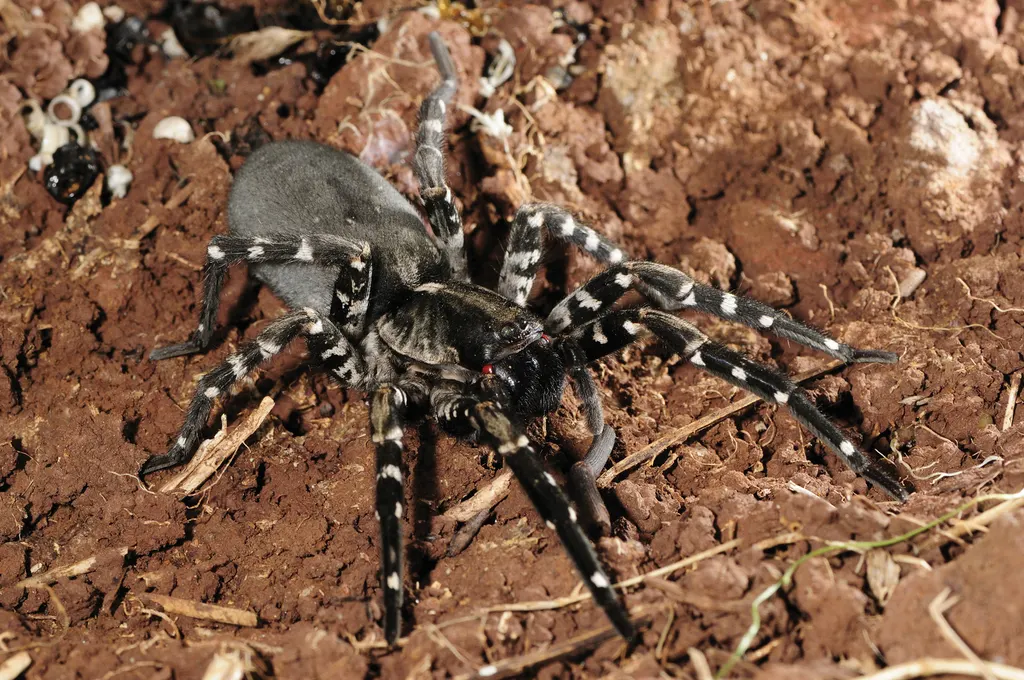
In this catalog, Arachnida stands for spiders, scorpions and their relatives. We list 15 arachnids that the IUCN Red List records as threatened enough to be Critically Endangered, Endangered or Extinct in the Wild: 5 Critically Endangered and 10 Endangered.
The biggest groups are the orders Araneae (14) and Holothyrida (1), and the families with the most listed species are Theraphosidae (6), Archaeidae (3) and Lycosidae (2). The full list below is grouped by order.
A class is a filing shelf, not a measure of risk: it says nothing about how fast any one species is declining. Status and assessment years come from the IUCN Red List (version 2026-1); how to read an IUCN assessment explains what the categories and criteria mean, and each record links to its own assessment.
Some of these animals are also kept or traded as pets. For the legal side in each US state, see exotic pet laws by state.
Arachnids are eight-legged arthropods with no antennae: spiders, scorpions, harvestmen, mites, ticks and a handful of stranger relatives. Around 110,000 species have been named (a 2023 review figure), and researchers think the true number could pass a million. Spiders are the largest order at roughly 51,000 species, followed by mites at about 32,000.
Most arachnids are carnivores that eat insects and other small animals. Nearly all live on land, though a few live in fresh water or the sea. Ticks and many mites are parasites, which is the side of the group most people meet.
Why these animals are threatened
Many threatened arachnids have tiny ranges. Pelican spiders (the family Archaeidae) are small hunters of other spiders, found only in Madagascar, Australia and South Africa. A species that lives in one patch of forest has little room to lose habitat before it is in trouble.
Trade adds a second pressure. Mexican tarantulas of the genus Brachypelma have been under CITES Appendix II since 1994 (one species from 1985), yet wild-caught animals are still smuggled out of Mexico, and at least 3,000 were reported sent to the US or Europe in the few years before 2017. Females take roughly 9 to 10 years to mature in the wild, and the group is slow to reproduce, so removals hurt.
Poecilotheria, the ornamental tree-dwelling tarantulas of India and Sri Lanka, face habitat loss as the main threat, with collection and smuggling for the pet trade an added risk for at least one species. All of them were on CITES Appendix II as of 2019.
What the catalog lists
The catalog holds 15 arachnid records, nearly all of them spiders in the order Araneae, with one record from the order Holothyrida. Tarantulas (Theraphosidae) make up the biggest family in the facts file at 6, followed by pelican spiders (Archaeidae) at 3.
That is a very small slice of 110,000 named species. It reflects which arachnids have been formally assessed, not how many are really at risk, so the list should not be read as a count of everything in trouble.
Sources for this section
- Wikipedia, Arachnid: about 110,000 named species, spiders about 51,000, mites about 32,000, possibly over a million (Agnarsson 2023), no antennae, carnivory, habitats, parasitic mites and ticks
- Wikipedia, Poecilotheria: India and Sri Lanka range, arboreal, habitat loss and pet trade threats, CITES Appendix II as of 2019
- Wikipedia, Brachypelma: Mexico, CITES 1985 and 1994, smuggling, at least 3,000 specimens a few years before 2017, females mature in 9 to 10 years
- Wikipedia, Archaeidae: pelican spiders eat only other spiders, Madagascar, Australia, South Africa
Status breakdown
15 records: Critically Endangered 5; Endangered 10.
All species
Araneae (14)
- Brachypelma boehmei EN
- Brachypelma schroederi EN
- Deserta Grande Wolf Spider Hogna ingens CR
- Kauaʻi cave wolf spider Adelocosa anops EN
- Madagascarchaea lotzi EN
- Madagascarchaea rabesahala EN
- Nephilingis borbonica EN
- Nothophantes horridus CR
- Poecilotheria formosa EN
- Poecilotheria hanumavilasumica CR
- Poecilotheria metallica CR
- Poecilotheria rufilata EN
- Turinyphia cavernicola EN
- Zephyrarchaea austini CR
Holothyrida (1)
The A to Z index lists the species with a full account; the catalog search finds any record by name.
Quick answers
- How many arachnids are in this catalog?
- 15, listed by the IUCN Red List as 5 Critically Endangered, 10 Endangered.
- What is Arachnida?
- Here, Arachnida means spiders, scorpions and their relatives. It is a taxonomic class used to group the catalog.
- Where do the statuses come from?
- From the IUCN Red List (version 2026-1), with a link to each species' assessment on iucnredlist.org.