Critically Endangered
Zephyrarchaea austini
Zephyrarchaea austini
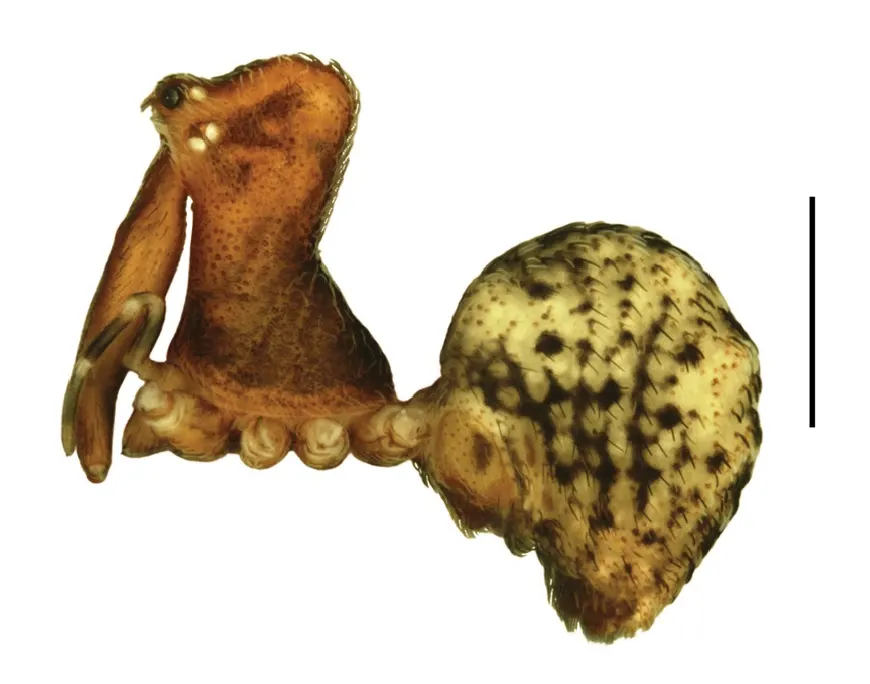
The Kangaroo Island assassin spider (Zephyrarchaea austini) is a tiny, long-legged spider known only from the north-west of Kangaroo Island, South Australia. Rated Critically Endangered on the IUCN Red List in 2021, it was feared lost after the 2019 to 2020 bushfires until two were found in 2021.
How to recognise it
This is a very small spider, with a body about 2 mm long. It belongs to the assassin spiders (family Archaeidae), also called pelican spiders, an ancient group that hunts other spiders.
Only females are known. They differ from their relatives in the same genus by their small size, a smooth abdomen without tubercles, and a strongly dipped profile behind the eyes. Michael Rix and Mark Harvey described the species in 2012, two years after it was first found, and named it for the entomologist Andy Austin.
Where it lives
Before the fires it was known from a single area, the Western River Wilderness Protection Area, where it reportedly lived in leaf litter in wet eucalypt woodland near Billy Goat Falls. It uses litter that hangs suspended in low vegetation at about knee height, close to creeklines in open eucalypt communities.
The IUCN assessment records one location, an extent of occurrence of about 1,000 square kilometres, and temperate forest as its only habitat.
Pins are Wikidata “endemic to” fields. Orange dots, when present, are GBIF occurrence tiles — survey bias included.
Why it is in trouble
Fire is the main problem. The litter it depends on burns easily, even in low-severity fires. The 2019 to 2020 bushfires burned its known habitat at high severity, and the IUCN assessment records a reduction of about 95 percent, based on the loss of habitat.
A planned burn shows how little room there is for error. Part of the protection area was burned on purpose in 2015, and later surveys found that the litter layer hadn't re-formed and no suitable spider habitat remained. Feral pigs and the fragmentation of native vegetation are also named as threats. The assessment lists roads and the plant pathogen Phytophthora cinnamomi as possible future threats. With a tiny range and limited ability to disperse, the spider can't easily recolonise burned ground.
What is being done
In late September 2021, South Australian Museum researchers led by Dr Jessica Marsh found two spiders, reportedly a female and a juvenile, in one patch of leaf litter in a remnant of long-unburned habitat. DNA testing confirmed the species. The survey was paid for by a Landcare Led Bushfire Recovery Grant.
Because both animals came from a single sample of litter, more surveys are needed to find out whether other populations exist. Low dispersal and reduced genetic diversity after the fires may leave survivors vulnerable, and intervention may be considered. The IUCN lists awareness work and site management as conservation actions.
Sources
Written for this catalog in our own words from the sources below, checked against them on 12 November 2026. Population figures are estimates and carry the year they were made. Status and assessment year: IUCN. 2026. The IUCN Red List of Threatened Species. Version 2026-1. iucnredlist.org.




