Critically Endangered
Horrid Ground-weaver
Nothophantes horridus
The horrid ground-weaver (Nothophantes horridus) is a money spider only about 2.5 mm long, known from limestone quarries and an industrial site in the Cattedown area of Plymouth, England. The IUCN Red List rated it Critically Endangered in 2015, with a decreasing population.
How to recognise it
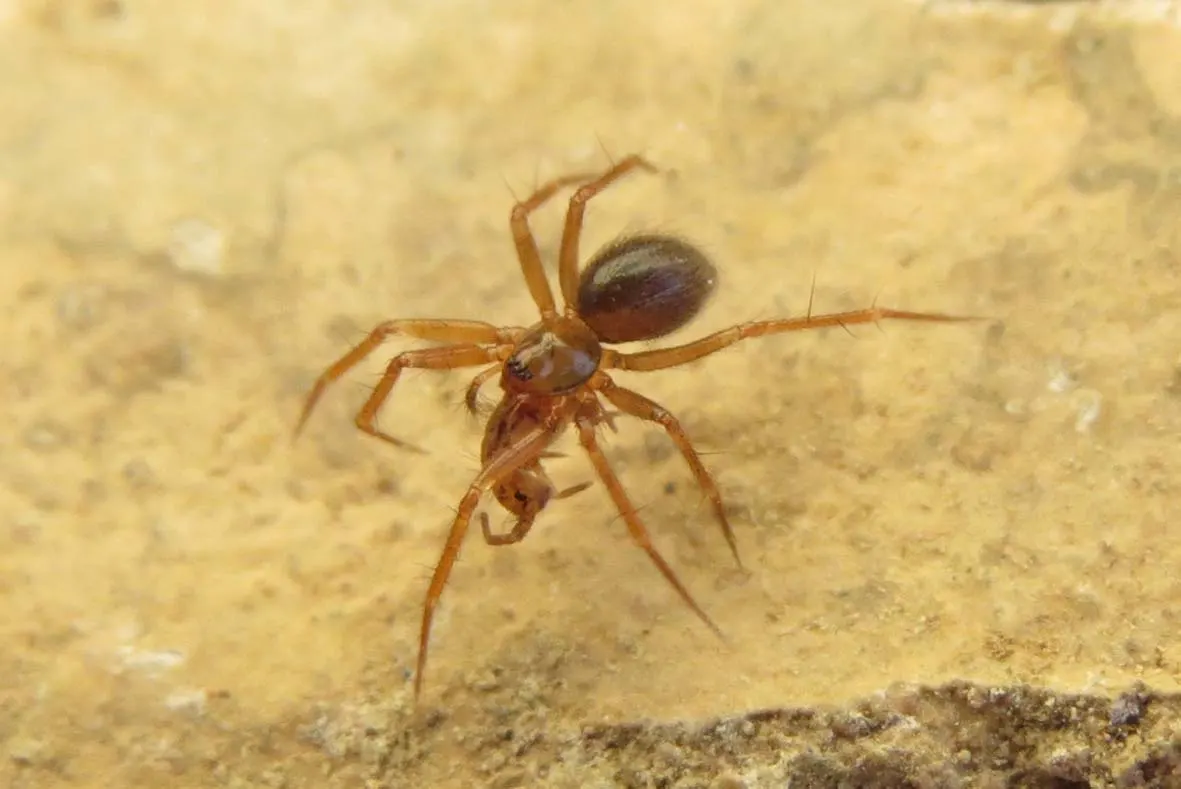
It is a dwarf spider in the family Linyphiidae, the sheet-web builders often called money spiders. Females measure roughly 2.2 to 3 mm in total length and males about 2.4 mm. The abdomen is pale or darker grey with pale yellow stripes along the back, and the fourth pair of legs is the longest.
Males have a long, curved spine on the pedipalp, and the legs carry numerous long spines. Merrett and Stevens described the species in 1995. The genus name means roughly 'false weaver', and the species name is Latin for bristly.
Where it lives
All records come from the Cattedown area of Plymouth, Devon, in an area smaller than one square kilometre. The IUCN assessment gives the occupied area of the two surviving quarries, Radford Quarry and one at Billacombe, as about 0.1 square kilometres in total. The IUCN counts two locations, between sea level and about 20 m above it, and classes its habitat as subterranean. It probably lives in narrow limestone fissures and has been found under stones and debris on the floors and faces of disused quarries.
The type locality, Shapter's Field Quarry, has been developed and is now an industrial estate. Radford Quarry is a County Wildlife Site. An industrial site in Cattedown was reportedly added in 2016, after the assessment, and searches of similar habitat elsewhere in Plymouth reportedly found no other populations.
Pins are Wikidata “endemic to” fields. Orange dots, when present, are GBIF occurrence tiles — survey bias included.
How it lives
Very little is known about its daily life. The IUCN assessment says it probably emerges from its fissures only occasionally, to hunt small arthropods, and it is thought to be nocturnal. Adult females have been recorded in March and April, and males in March.
It was reportedly first photographed alive in 2016, and a 2020 photograph showed one eating a springtail. Its predators are unknown, and its habits are largely inferred from related sheet-web spiders.
Why it is in trouble
With so small a range, one development can take out a large share of the species. One of the three locations where it was recorded has already been lost, and plans existed for both remaining quarries when the IUCN assessed it. The assessment names housing and commercial or industrial building as the threats, both affecting nearly the whole population and rated as causing very rapid declines.
It estimated that 80 to 100 percent of the population could be lost within ten years if the developments went ahead. No population size has ever been estimated, so the IUCN used the loss of occupied area as a stand-in for the population trend.
What is being done
The spider is a UK Biodiversity Action Plan priority species and a species of principal importance in England. In early 2015 a plan for 57 houses at Radford Quarry went to a planning inquiry after the city council had refused it. Buglife objected, and an online petition drew about 10,000 signatures. The development was reportedly delayed.
The IUCN assessment's action list includes site protection, habitat restoration and species recovery. Buglife's species champion fact sheet names the main tasks as leaving enough space for rare species and making the planning system protect them. The long-term future of the spider is uncertain.
Sources
Written for this catalog in our own words from the sources below, checked against them on 12 November 2026. Population figures are estimates and carry the year they were made. Status and assessment year: IUCN. 2026. The IUCN Red List of Threatened Species. Version 2026-1. iucnredlist.org.
- IUCN Red List assessment, Nothophantes horridus (2015)
- Horrid ground-weaver, species article
- Nothophantes, genus article
- Radford Quarry horrid ground-weaver, Buglife post via Mark Avery (January 2015)
- Horrid ground-weaver fact sheet, MP Species Champions Project (Buglife, 2015)
- GBIF backbone record 2136568




