Endangered
Algar do Carvão Cave Spider
Turinyphia cavernicola
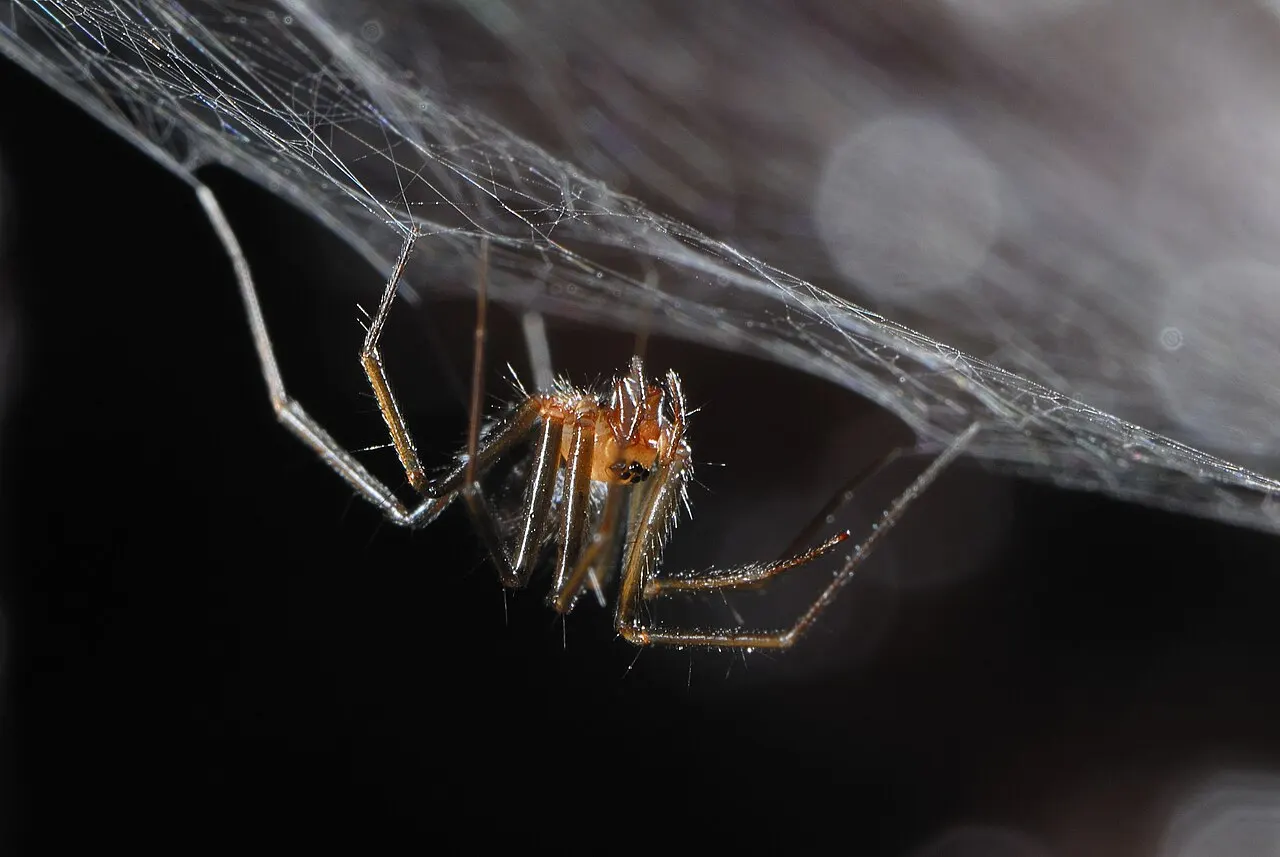
The Algar do Carvão cave spider is a pale, long-legged sheet-web spider of about 2 mm that lives only in a few lava caves on Terceira, in the Azores. The IUCN Red List assessed it as Endangered in 2021, with its tiny range still shrinking.
How to recognise it
You'd need a hand lens and a very dark cave. This is a pale spider, around 2 mm long, with long legs and large eyes. Males are told apart from related spiders by small features of the palp, the mating organ at the front of the body, such as a tooth-shaped hook on one of its parts. It belongs to the sheet-web spiders (Linyphiidae) and was described by Wunderlich in 2008.
Where it lives
It is a true cave specialist, known only from Terceira Island in the Azores, Portugal. Surveys of 15 caves on the island found it in just three, at roughly 460 to 583 m above sea level: Algar do Carvão, Gruta da Malha and Furna de Santa Maria. Algar do Carvão, a volcanic pit and the place where the species was first described, holds the only large population. The other two are small, and a 2016 conservation profile judged them unlikely to be sustainable.
Its range is minute. That profile gave an extent of occurrence of about 2 square kilometres and an occupied area of 0.75 square kilometres, while the IUCN assessment lists three locations and an occupied area of 8 square kilometres. Either way, the animal occupies almost nothing.
Pins are Wikidata “endemic to” fields. Orange dots, when present, are GBIF occurrence tiles — survey bias included.
How it lives
The spider lives in humid lava tubes and volcanic pits, from the dim twilight zone near the entrance to the deep interior. It spins small sheet webs in holes and crevices on the cave walls. At Algar do Carvão, the stone walls along the visitor stairs gave it extra places to anchor webs. A generation is estimated at about one year.
Why it is in trouble
Most of the surface above Terceira's caves is pasture. Intensive cattle farming changes the water and nutrients entering the caves, and clearing trees changes humidity. The 2016 profile also reports cave destruction from road building and pasture. The IUCN assessment also lists plantations, volcanic activity, drought, habitat shifts and recreation among the pressures.
Rising visitor numbers are a concern at Algar do Carvão, the cave with the largest population. The 2016 profile estimated the spider has lost about 93 per cent of a possible original range of around 70 square kilometres, though that figure is an estimate.
What is being done
About 40.5 hectares around Algar do Carvão became a Regional Natural Monument in 2004, and the IUCN records that 41 to 50 per cent of the population sits inside protected ground. The IUCN records no recovery plan and no systematic monitoring scheme. Researchers have urged wider protection, fencing at the cave, long-term monitoring of tourism effects, and restoration of other caves so the spider could be reintroduced.
Sources
Written for this catalog in our own words from the sources below, checked against them on 12 November 2026. Population figures are estimates and carry the year they were made. Status and assessment year: IUCN. 2026. The IUCN Red List of Threatened Species. Version 2026-1. iucnredlist.org.




