Endangered
Brauer's giant mite
Sternothyrus braueri
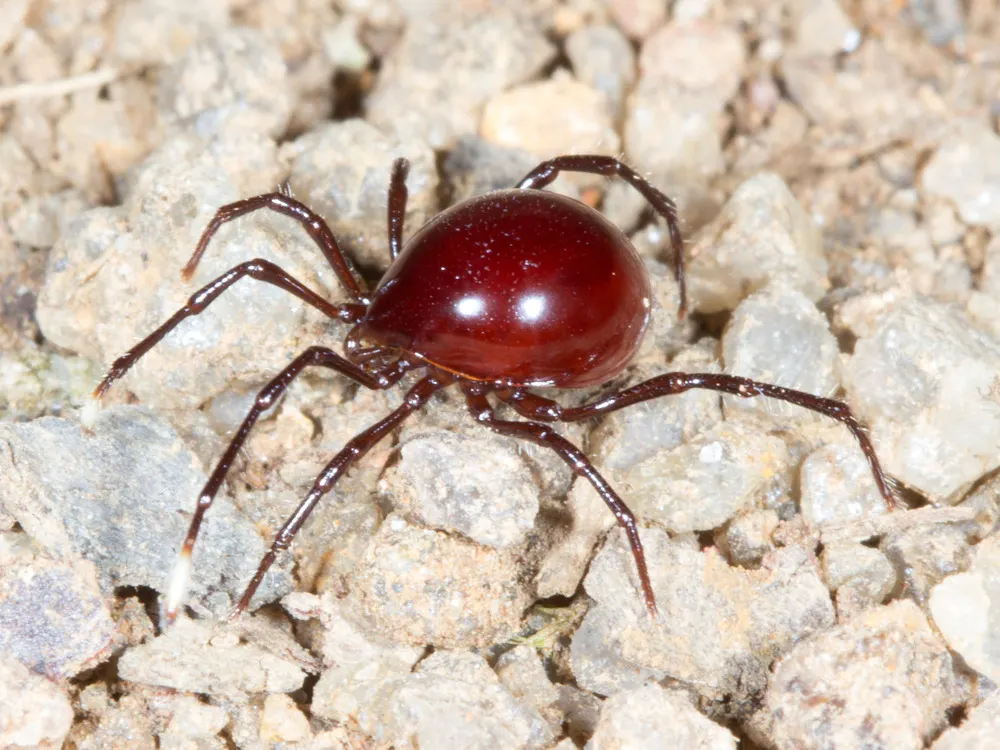
Brauer's giant mite (Sternothyrus braueri) is a large, hard-bodied mite found only in the Seychelles. It belongs to the order Holothyrida, a small group that is the sister of ticks. The IUCN Red List rated it Endangered in 2014, and its population trend is unknown.
What kind of mite it is
Holothyrid mites are unusually big for mites, with heavily armoured bodies over 2 mm long. The order is the sister group of the ticks (Ixodida), and it is largely confined to land that was once part of the southern supercontinent Gondwana. The family Holothyridae, to which this species belongs, occurs in Sri Lanka, Indian Ocean islands, New Guinea and New Caledonia.
Sternothyrus braueri was first described by Thon in the early 1900s under the name Holothyrus braueri, and is now placed in Sternothyrus. Little has been published on this particular species. A 1998 experiment on mites of a different holothyrid family found they ignored living animals but fed on the body fluids of dead arthropods, so scavenging is likely in the order, but it has not been shown for this mite.
Where it lives
All eight records in the Global Biodiversity Information Facility are from Seychelles. They include two museum specimens collected in 2000 at Jardin Marron on Silhouette Island, and photo records logged on iNaturalist in 2015, 2025 and 2026, in the districts of Plaisance and Port Glaud on the main island, Mahé. Two more records are DNA sequences. Coordinates are deliberately blurred to about 31 km because the species is threatened.
The IUCN assessment lists moist lowland forest, at elevations from about 390 to 900 m. It counts two locations and treats the range as restricted.
Pins are Wikidata “endemic to” fields. Orange dots, when present, are GBIF occurrence tiles — survey bias included.
Why it is in trouble
The IUCN lists farming and plantations, on both small-holder and industrial scales, as the threats, and records continuing decline in the area of forest it uses. Whether the population is shrinking or fragmented is recorded as unknown, and no conservation action is listed.
The Seychelles have already lost one giant mite. Gardiner's giant mite (Dicrogonatus gardineri), from Mahé, was last recorded in 1909 and is listed as Extinct. Its loss is linked to habitat decline after cinnamon trees were introduced.
Sources
Written for this catalog in our own words from the sources below, checked against them on 12 November 2026. Population figures are estimates and carry the year they were made. Status and assessment year: IUCN. 2026. The IUCN Red List of Threatened Species. Version 2026-1. iucnredlist.org.




