Critically Endangered
Deserta Grande Wolf Spider
Hogna ingens
The Desertas wolf spider (Hogna ingens) is among the largest wolf spiders in the world, a stocky grey hunter with black and white banded legs. It lives in a single valley on Deserta Grande, in Portugal's Madeira archipelago. The IUCN Red List rated it Critically Endangered in 2014, and a zoo breeding programme now backs up the wild population.
How to recognise it
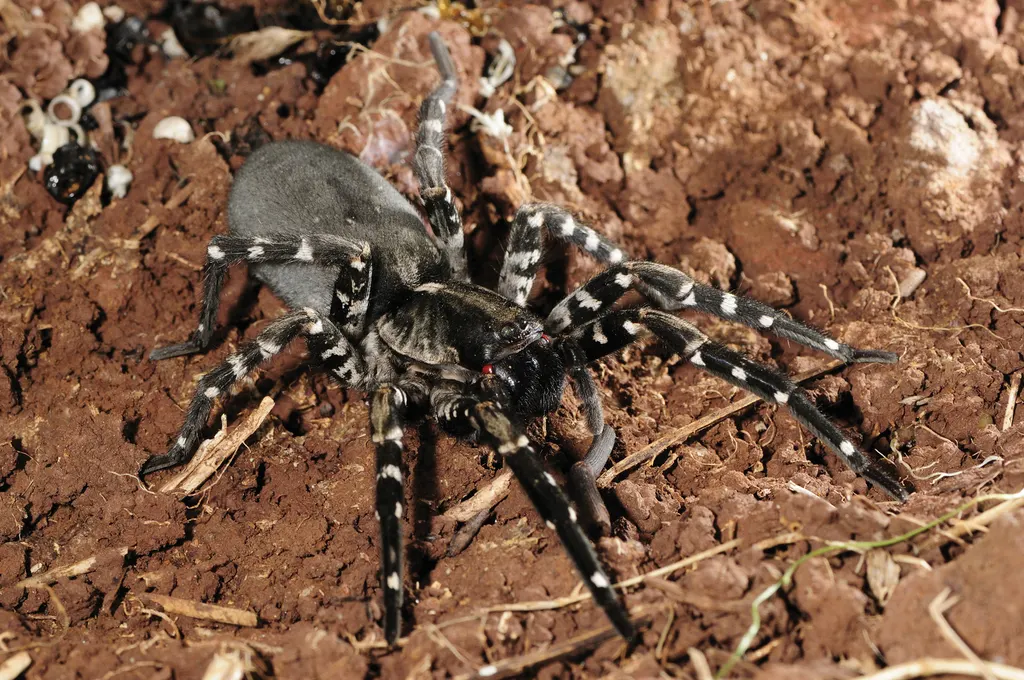
This is a big, bulky spider with a body that looks large for the length of its legs. Adults are mid-grey, with a slightly darker front section edged in white and a white patch near where it joins the abdomen. The jaws are black with a small red dot on each side, and the legs are banded black and white.
Large females can reach a leg span of 120 mm, though adults are usually 70 to 80 mm across. Females grow to about 40 mm in body length and males to 30 to 35 mm. Newly hatched spiderlings are brown, only 4 to 5 mm across, and start to show adult colouring at roughly 25 mm.
Where it lives
The Desertas are three uninhabited islands about 20 km southeast of Madeira. The spider has historically been recorded only from the Castanheira Valley at the northern end of Deserta Grande, an island of about 10 square km. The valley is roughly 2.8 km long and covers an estimated 83 hectares, at 150 to 350 m above sea level. The IUCN assessment lists grassland as its habitat and counts a single location.
Pins are Wikidata “endemic to” fields. Orange dots, when present, are GBIF occurrence tiles — survey bias included.
How it lives
By day the spider stays in a burrow under a rock and is rarely seen unless disturbed. Field observers think it may be most active around dusk. With no native land mammals on the island, it is a top predator. Prey recorded or suspected include beetles and the introduced millipede Ommatoiulus moreleti, and adults have been seen taking young lizards. Burrow walls are often lined with the leftovers of meals.
Juveniles are the most exposed stage. Lizards, birds and mice eat them, particularly while they wander in search of a new shelter. Spiderlings ride on the mother's back for about a week to ten days. The species is thought to take up to two years to mature, and fieldwork points to two groups in the wild, one maturing in June and one in September or October.
Why it is in trouble
Around 2005 a grass of the genus Phalaris spread rapidly through the valley. It now blankets the soil and crevices, blocking access to the shelters the spider and other local animals depend on, including endemic land snails. The spider's range has shrunk sharply since.
The 2014 assessment estimated 4,086 individuals, an area of occupancy of 0.23 square km and a decreasing trend. Introduced goats and rabbits are also reported to damage the native vegetation.
What is being done
A conservation strategy was drawn up in 2016. That year, 25 juveniles were collected from Deserta Grande and taken to Bristol Zoo, which in 2017 became the first to breed the species, hatching more than 1,000 spiderlings. Of the original 25, six females and three males reached adulthood. By 2018, seven European institutions held the species, with some 600 animals alive.
Other zoos, including The Deep and Longleat, joined the project, which also covers habitat restoration on the island, control of invasive species, and the aim of eventually releasing captive-bred spiders.
Sources
Written for this catalog in our own words from the sources below, checked against them on 12 November 2026. Population figures are estimates and carry the year they were made. Status and assessment year: IUCN. 2026. The IUCN Red List of Threatened Species. Version 2026-1. iucnredlist.org.




