Endangered
Madagascarchaea rabesahala
Madagascarchaea rabesahala
Madagascarchaea rabesahala is a pelican spider, a tiny long-necked member of the family Archaeidae, known only from montane rainforest in central eastern Madagascar. The IUCN Red List assessed it as Endangered in 2021, based on two known locations and a small, shrinking forest range.
How to recognise it
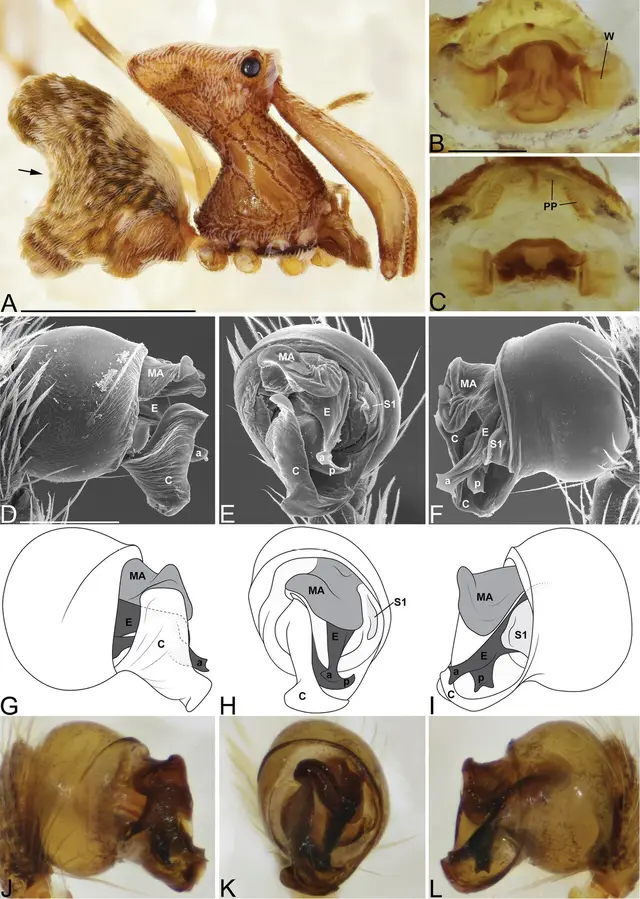
Adults are very small. Males measure about 1.6 mm in total length and females about 1.9 to 2.1 mm, so even a female is only a couple of millimetres long. Like other pelican spiders, it carries its eyes on a raised, neck-like head, and its jaws are long, about twice the length of the carapace in the measured male.
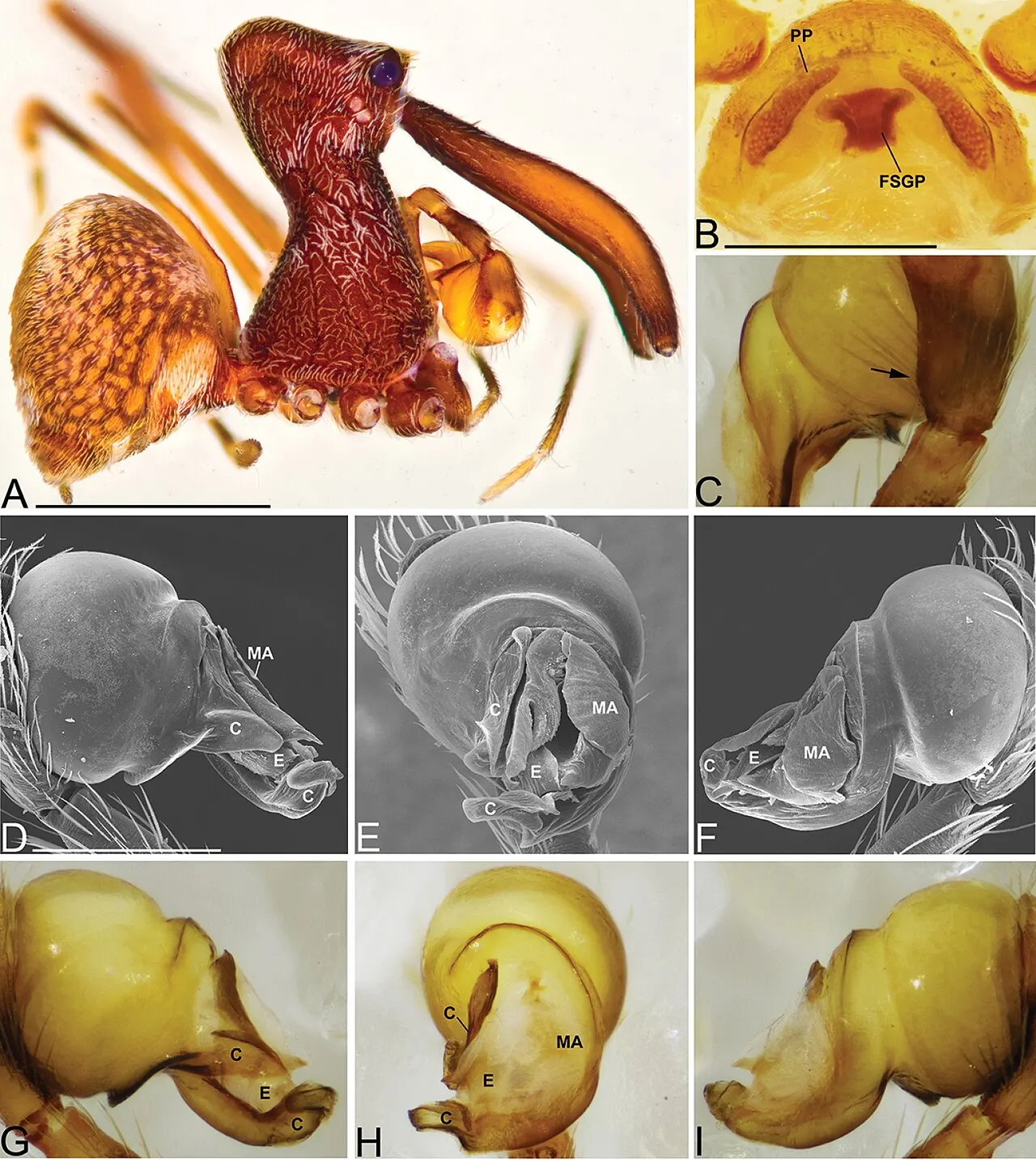
The carapace, jaws, breastbone and legs are reddish brown with white hairs, and the legs have darker rings on two of their segments. The abdomen is dark brown with lighter round patches. Specialists separate it from the similar Madagascarchaea legendrei by the shape of the head, which is less perfectly rounded, and by details of the male palp.
Where it lives
Hannah Wood and Nikolaj Scharff named the species in a review of Madagascar's pelican spiders published in ZooKeys in January 2018. The name honours Gisele Rabesahala, a Malagasy activist and politician.
The type specimens came from montane rainforest near Andranomay, in the Antananarivo region and south-south-east of Anjozorobe, at 1,300 m, collected in December 2000. Others came from the Analamazaotra forest station near Andasibe at 964 m, in 2009. The Red List counts two locations, at elevations between 964 and 1,300 m.
Pins are Wikidata “endemic to” fields. Orange dots, when present, are GBIF occurrence tiles — survey bias included.
How it lives
Collectors found it by beating low vegetation, sweeping, and sifting leaf litter around logs, dead fern fronds and the base of a traveler's palm. One sample from Andasibe included a female, a juvenile and an egg case. Very little else is recorded about its hunting or breeding, and there is no population count.
Why it is in trouble
The Red List assessment names shifting agriculture, more frequent fires, small-holder farming and grazing, and unintended harvest as pressures, all of which convert or degrade the forest where it lives. The area it occupies is judged to be shrinking, and the population trend is recorded as unknown.
At least one of its sites lies inside a protected area, and site protection and management are the conservation actions listed for it.
Sources
Written for this catalog in our own words from the sources below, checked against them on 12 November 2026. Population figures are estimates and carry the year they were made. Status and assessment year: IUCN. 2026. The IUCN Red List of Threatened Species. Version 2026-1. iucnredlist.org.