Endangered
Reunion Hermit Spider
Nephilingis borbonica
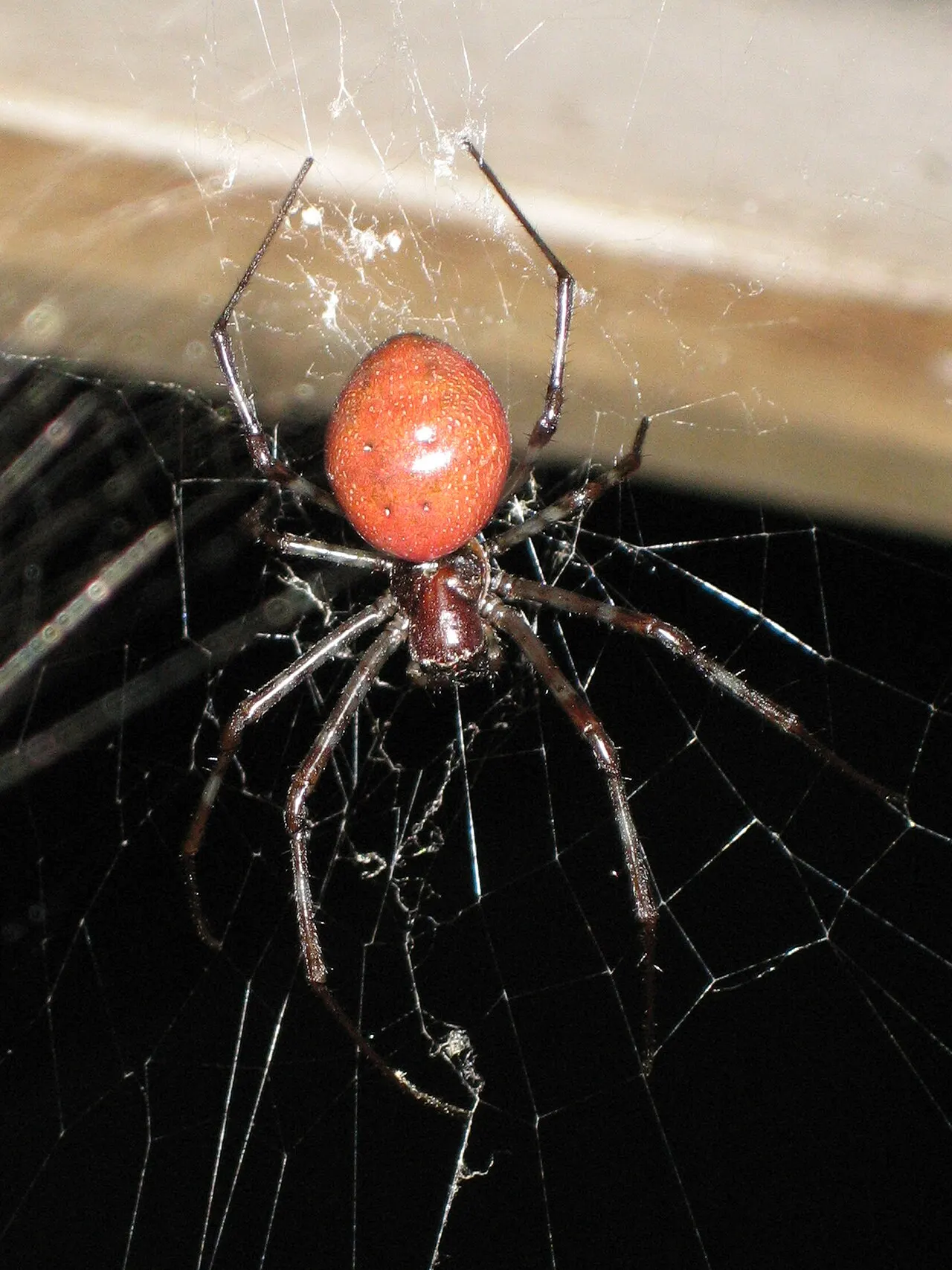
Nephilingis borbonica, the Reunion hermit spider, is a golden orb-weaving spider found only on Réunion, the Indian Ocean island once called Bourbon. Females are large and often reddish. The IUCN Red List classed it as Endangered in 2017 because its forest habitat is fragmented and shrinking, though its actual population trend is unknown.
How to recognise it
The sexes are very different in size. Females measure roughly 14 to 22 mm in total length, with an abdomen that ranges from bright red to whitish-red, and larger females are brighter. Males are tiny by comparison, about 4 to 6 mm, with a yellow-brown front body and a grey abdomen dotted with white.
It belongs to the golden orb-weavers, which the World Spider Catalog now places within the orb-weaver family Araneidae. Vinson described it in 1863 as Epeira borbonica. The species name points to Bourbon, Réunion's name until 1848.
Where it lives
It is endemic to Réunion. The IUCN puts its extent of occurrence at about 2,500 square kilometres, roughly the size of the island, and the area it occupies at about 1,250. It builds its web on trees, so it depends on forest. Distribution models point to coastal lowland forest, the Red List rates moist lowland and dry forest as suitable habitat of major importance, and it is occasionally reported from towns and rural gardens. Cloud forest records reach up to 1,500 m.
Records from Madagascar and nearby islands were once filed under this name, but a 2011 revision restricted the species to Réunion. Spiders from Madagascar and the Comoros belong to Nephilingis livida, and those from Mauritius to Nephilingis dodo. Earlier, borbonica was treated as a subspecies of Nephilingis cruentata before being raised to species rank in 1963.
Pins are Wikidata “endemic to” fields. Orange dots, when present, are GBIF occurrence tiles — survey bias included.
How it lives
Most of what is published concerns mating. A 2009 paper in the Journal of Arachnology by Kuntner, Agnarsson and Gregoric studied hermit spiders, including this species, with field observations on Réunion. It reported a rival male that had lost its palps (the organs that transfer sperm) causing another male to lose a whole palp, and it found that 50 wild-caught males were missing both palps. It concluded that plugging the female and this eunuch behaviour are more flexible than earlier thought.
Why it is in trouble
The 2017 assessment calls the population severely fragmented, with a continuing decline in the area it occupies, although the overall population trend is listed as unknown. The main driver is deforestation on Réunion. Present pressures are small-scale wood harvesting, shifting agriculture and small-holder farming, each judged to affect a minority of its range and to cause slow but significant declines.
A possible future threat covers the whole range. The assessment names two related spiders, Nephilingis cruentata and Nephilingis livida, as potential invaders from Africa and Madagascar that might compete with it.
What is being done
The assessment records no species-specific conservation action, no recovery plan, no monitoring, no harvest plan and no captive population, and whether the spider lives inside a protected area is unknown. The only action it lists is awareness and communication, along with research on its distribution, ecology and threats.
Sources
Written for this catalog in our own words from the sources below, checked against them on 12 November 2026. Population figures are estimates and carry the year they were made. Status and assessment year: IUCN. 2026. The IUCN Red List of Threatened Species. Version 2026-1. iucnredlist.org.




