Endangered
Montipora informis
Montipora informis
Montipora informis is a brown, crust-forming stony coral of shallow reefs, found from the Red Sea and East Africa across the Indian Ocean to Japan, Australia and the central Pacific. The IUCN Red List rated it Endangered in 2024, after Least Concern in 2008 and 2014, because reef decline is projected to continue.
How to recognise it
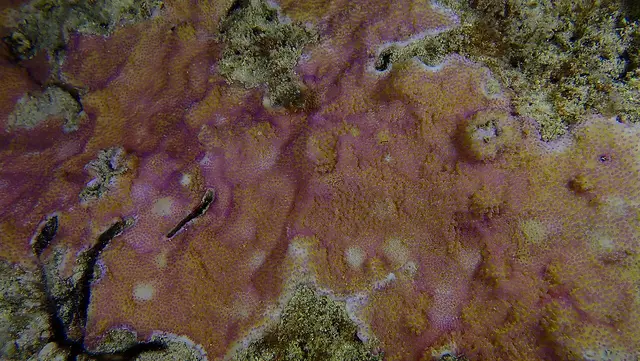
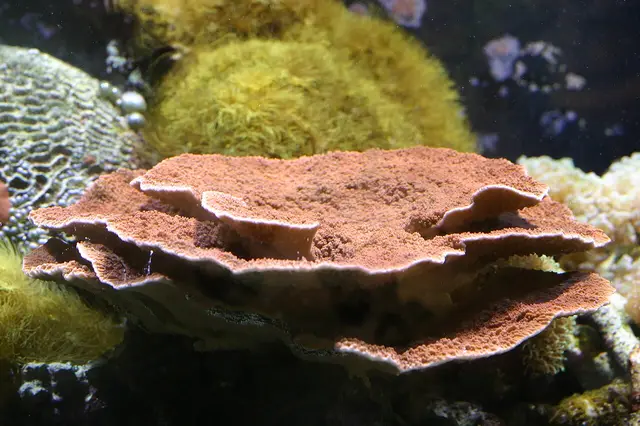
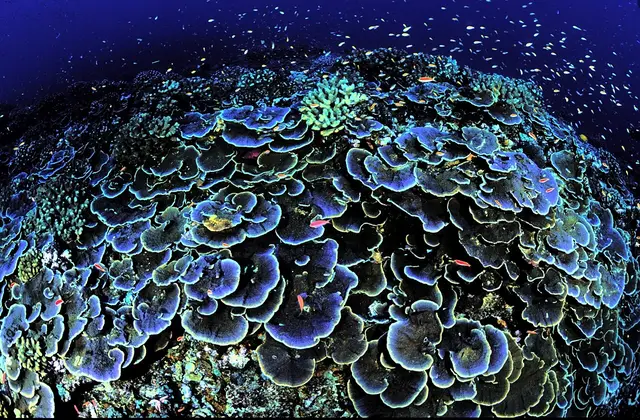
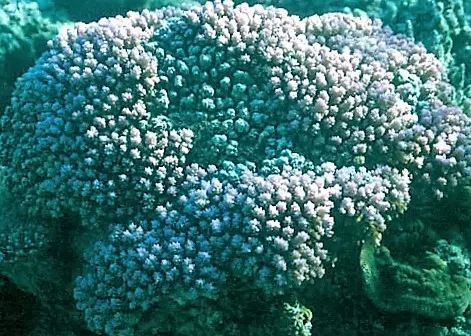
Colonies grow as thick crusts or lumpy masses. They are brown or brown mottled with white. The tips of the surface bumps can be white or blue, and white tentacles may reach out during the day.
The feature that gives it away is the surface. The tiny skeleton cups are evenly spread and sunk into the skeleton, and the skeleton between them is covered in elongated bumps (papillae) that are all the same length. The Corals of the World factsheet says no other species has such an even cover. Montipora efflorescens and M. corbettensis are the species to compare it with.
Where it lives
Bernard described the species in 1897. It is recorded across the tropical Indo-Pacific, between roughly 35 degrees north and 30 degrees south, from the Red Sea, Gulf of Aden and Persian Gulf to the central Pacific. The IUCN lists about 75 countries and territories. They include Egypt, Saudi Arabia and Jordan on the Red Sea, Kenya and Tanzania, the Maldives, India, Indonesia, China, Japan, Australia, Fiji, and Pacific islands such as Niue, the Cook Islands and French Polynesia.
It lives on shallow tropical reef, mainly on the upper slopes. The IUCN gives a depth of 1 to 40 metres, mostly 1 to 20 metres, and a fish and invertebrate database gives 0 to 48. The IUCN and a coral reference guide both call it common.
Pins are Wikidata “endemic to” fields. Orange dots, when present, are GBIF occurrence tiles — survey bias included.
Why it is in trouble
Corals of this genus are susceptible to bleaching. They grow fast and spread by breaking into fragments, so they can recover quickly where fragments re-establish. The IUCN notes that the encrusting form of this species is severely threatened on reefs off southwestern Taiwan. It also cites survey data showing Montipora corals in general down by 72 percent on the crest and 35 percent on the slope of the Great Barrier Reef since 1995.
For this species the IUCN estimates a decline of about 12 percent since 1989 and projects a fall of at least 61 percent by 2050, three generations of about 10 years each. Its threat list includes temperature extremes, storms and flooding, silt running off the land, coastal building for housing, industry and tourism, shipping lanes, crown-of-thorns starfish and unintended damage from small-scale harvesting.
The species was rated Least Concern in 2008 and 2014, then Endangered in 2024. A global reassessment of reef-building corals announced by the IUCN in October 2026 found 340 of 774 assessed species (44 percent) threatened, with climate change the main driver. The release says the work was finished before the 2023 to 2025 global bleaching event, so the real share is probably higher.
What is being done
All stony corals are on CITES Appendix II, so exports need checks that trade will not harm wild populations. Parts of this species' range overlap marine protected areas, although the IUCN records whether it occurs in one as unknown.
The actions the IUCN lists as needed cover protecting and managing reef sites, restoring habitat, species recovery work, captive propagation and a genome resource bank.
Sources
Written for this catalog in our own words from the sources below, checked against them on 12 November 2026. Population figures are estimates and carry the year they were made. Status and assessment year: IUCN. 2026. The IUCN Red List of Threatened Species. Version 2026-1. iucnredlist.org.