Endangered
Montipora altasepta
Montipora altasepta
Montipora altasepta is a small-polyped stony coral that forms warty, clustered stems on shallow reefs across the western Pacific and Southeast Asia. The IUCN Red List raised it from Vulnerable to Endangered in 2024, projecting a 64 percent decline as reef habitat degrades.
How to recognise it
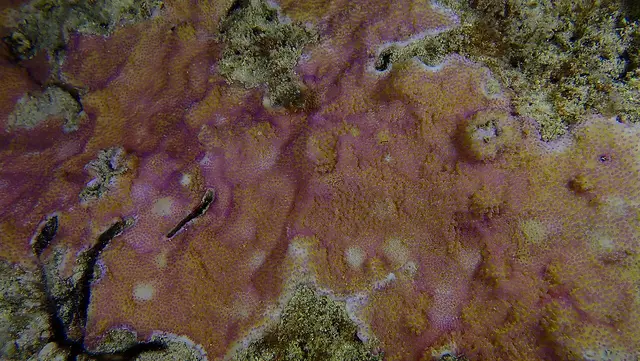
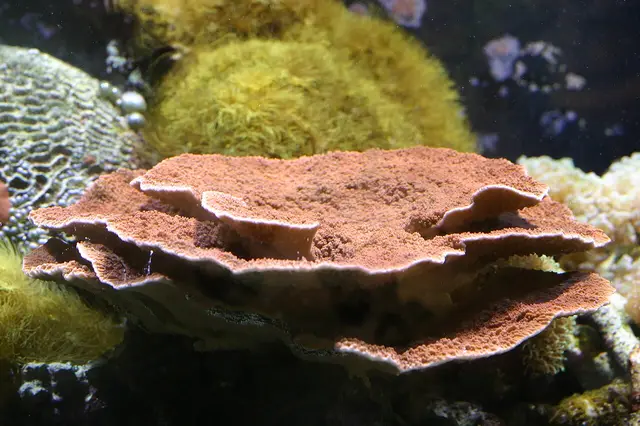
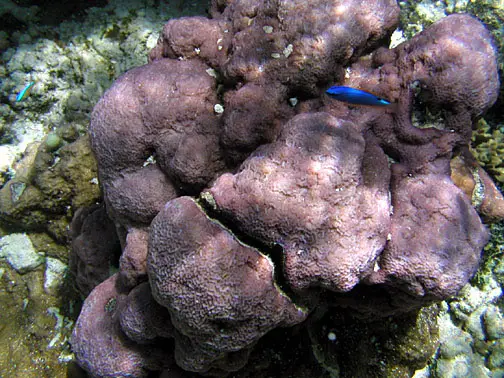
Colonies are a loose cluster of slightly spreading, partly fused stems with a very warty, nodular surface. In the original description from the Philippines, the living part stood 5 to 6 cm high. Lower stems end bluntly while taller ones branch in a fan.
The cups that hold the polyps (calices) are 0.6 to 0.8 mm across and sit flush with the surface, each with a distinct ring around it. Between the cups, the skeleton carries crowded, sharp-pointed spines. Two of the partitions inside each cup are thicker than the rest. The original description gives no colour. Up close, the species is hard to separate from other Montipora.
Where it lives
The Red List gives a wide range: Taiwan, Japan, the Philippines, Malaysia, Singapore, Indonesia, Brunei, Timor-Leste, Papua New Guinea, the Solomon Islands, Vanuatu, New Caledonia, Fiji, Palau, the Marshall Islands, Micronesia, Kiribati, Nauru, Tuvalu and Australia. It lives on coral reef at depths of 1 to 25 m.
The species was described by Nemenzo in 1967. The type material was collected at Varadero Point, Puerto Galera, Oriental Mindoro, in 1954. Two names from the same author and year, Montipora coalita and Montipora inconstans, are treated as synonyms.
Pins are Wikidata “endemic to” fields. Orange dots, when present, are GBIF occurrence tiles — survey bias included.
How it lives
Like the rest of its genus, it is a colony of tiny polyps sharing a limestone skeleton and living with symbiotic algae. Montipora is the second most species-rich genus of reef-building coral, with about 85 species. In the genus, polyps are usually extended only at night. Montipora corals are hermaphroditic broadcast spawners, typically spawning in spring, and their eggs already contain the symbiotic algae. These are genus-level facts, not records for this species.
Little has been published about this species in particular. The IUCN uses a generation length of 10 years.
Why it is in trouble
The 2024 assessment projects a population reduction of 64 percent, based on decline in reef area and quality and on the effects of pathogens, pollutants and other pressures (criterion A3ce). The area of reef it depends on is recorded as still shrinking, though the population is not considered severely fragmented. In 2008 it had been rated Vulnerable.
Threats named in the assessment include housing and urban development, commercial and industrial areas, tourism and recreation areas, shipping lanes, soil erosion and silt, storms and flooding, temperature extremes and small-scale harvest. Together they lead to degraded reef, coral death, disturbance and competition.
What is being done
The assessment lists site protection and management, habitat restoration, captive breeding, a genome bank and species recovery among relevant actions. Whether it lives in any protected area is recorded as unknown. It is on CITES Appendix II, so its international trade is monitored.
Sources
Written for this catalog in our own words from the sources below, checked against them on 12 November 2026. Population figures are estimates and carry the year they were made. Status and assessment year: IUCN. 2026. The IUCN Red List of Threatened Species. Version 2026-1. iucnredlist.org.