Endangered
Montipora caliculata
Montipora caliculata
Montipora caliculata is a stony reef-building coral with a textured, often massive or pillar-like skeleton, scattered across the tropical Indo-Pacific from East Africa to the central Pacific. The IUCN Red List raised its status from Vulnerable to Endangered in 2024, because warming seas, disease and reef damage are expected to cut its numbers sharply.
How to recognise it
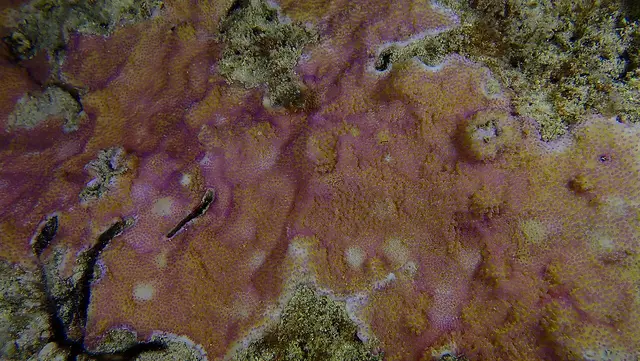
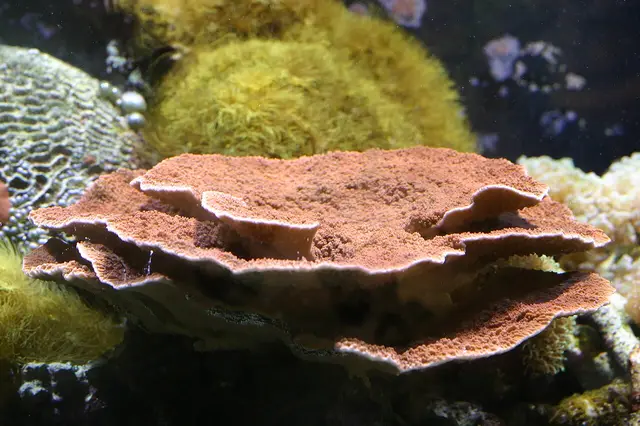
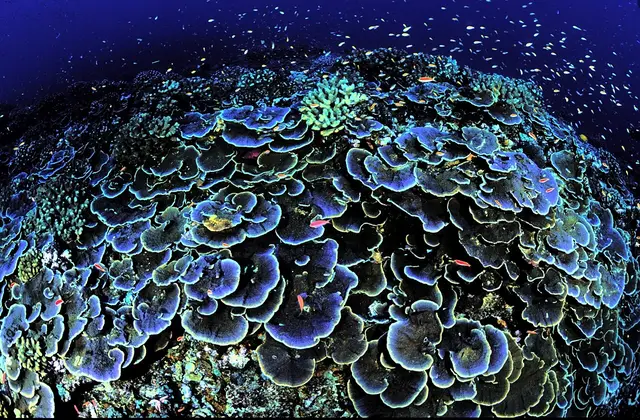
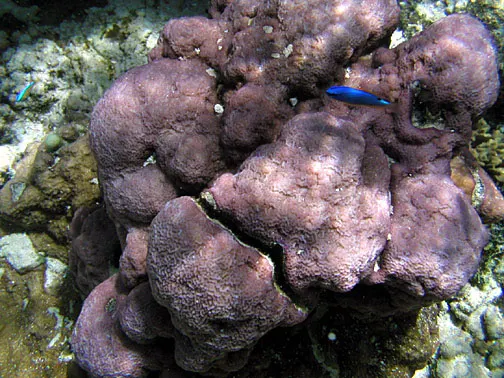
Colonies are usually massive, sometimes forming crusts, and are brown or blue. A reef-aquarium writer describes some colonies growing thick upright pillars or stout branches, with a strikingly textured surface, unlike the thin plates and branches of many other Montipora.
The corallites, the small pits where polyps sit, are a mix of flush and funnel-shaped types. The funnel-shaped ones usually have wavy rims, and most lose part or all of their walls, so neighbours merge into short valleys. Leftover wall fragments can look like small bumps. Montipora venosa has larger, more clearly funnel-shaped corallites, and M. foveolata is another look-alike.
Where it lives
The IUCN lists it from more than 40 countries and territories, including East Africa (Kenya, Tanzania, Mozambique, Somalia), Madagascar, Mauritius, India, Southeast Asia, Japan, Taiwan, Australia, New Caledonia and many Pacific island groups from Fiji and Samoa to French Polynesia and Pitcairn.
It is found on coral reefs from about 1 to 40 m deep. Corals of the World calls it uncommon but present in most reef environments. A reef-aquarium writer says it favours clear oceanic water and high-energy reef settings and is not especially common in the wild.
Pins are Wikidata “endemic to” fields. Orange dots, when present, are GBIF occurrence tiles — survey bias included.
How it lives
Like other reef-building corals, it is zooxanthellate, meaning its tissue holds symbiotic algae that feed it through photosynthesis. Little else is recorded about its biology. The IUCN assessment gives a generation length of about 10 years.
The same aquarium writer says it is less suited to the quick propagation used for thinner plating and branching Montipora, and that it is not especially common in the hobby.
Why it is in trouble
Reef decline is the core issue. The IUCN lists rising sea temperatures, storms and flooding, sediment and runoff, coastal development, shipping, tourism, disease and harvest among the pressures, and records that the area of suitable habitat is still shrinking.
It qualifies as Endangered under criterion A3ce: a projected population reduction of about 63 percent over three generations, or roughly 30 years, based on habitat loss and the effects of pathogens and other biological pressures. The population is not considered severely fragmented. The species was Vulnerable in 2008 and 2014.
What is being done
The IUCN lists protection and management of reef sites, habitat restoration, species recovery, captive propagation and a genome resource bank as relevant actions, though no species-specific programme is described. Whether it occurs in a protected area is recorded as unknown, though it is widespread across many reef regions.
Sources
Written for this catalog in our own words from the sources below, checked against them on 12 November 2026. Population figures are estimates and carry the year they were made. Status and assessment year: IUCN. 2026. The IUCN Red List of Threatened Species. Version 2026-1. iucnredlist.org.