Endangered
Montipora venosa
Montipora venosa
Montipora venosa is a pore coral that forms small, knobby colonies on reefs across the Indo-Pacific, from the Red Sea and the Gulf to Polynesia. The IUCN Red List assessed it as Endangered in 2024, up from Near Threatened in 2014. Warming seas are among the threats it lists.
How to recognise it
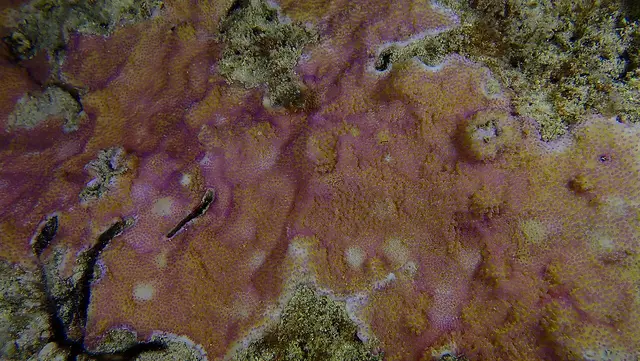
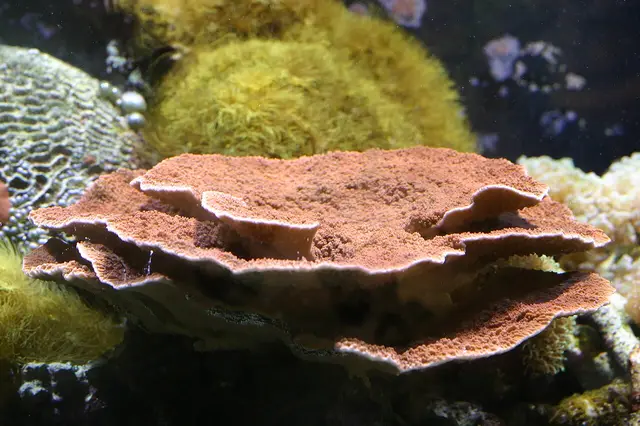
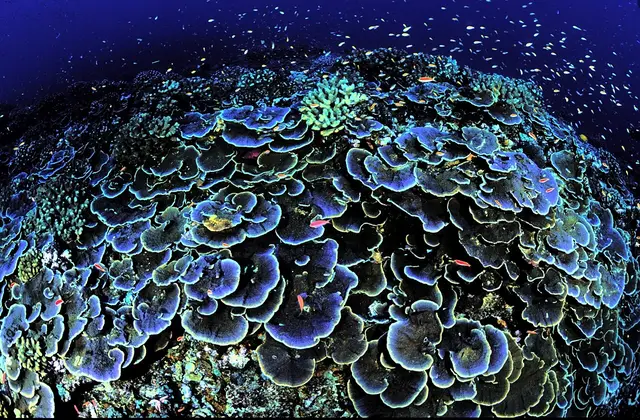
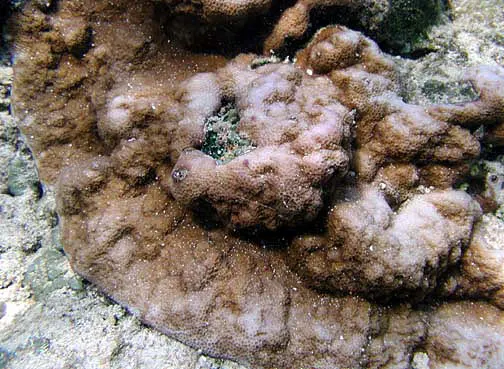
Colonies are usually small and rounded, built up from knobs. The corallites, the tiny cups that house the polyps, are conspicuous and less crowded than in many relatives. Colour ranges from green to light or dark reddish-brown.
As in the rest of the genus, the skeleton is porous and the corallites are very small. Montipora is often confused with Porites, but corallite structure tells them apart. The species was first described by Ehrenberg in 1834.
Where it lives
It has a very wide range. The IUCN counts around 70 countries and territories, from Djibouti, Eritrea, Egypt, Saudi Arabia, Iran and the Gulf states, across the Indian Ocean to Indonesia, the Philippines, Japan, Australia, and island groups such as Samoa, French Polynesia, the Cook Islands and Pitcairn. One database puts its range between roughly 32 degrees east and 135 degrees west.
It is found in most reef settings, on coral reef and on subtidal rock. The IUCN records depths from the surface to about 30 metres, though SeaLifeBase lists down to 65.
Pins are Wikidata “endemic to” fields. Orange dots, when present, are GBIF occurrence tiles — survey bias included.
How it lives
The genus Montipora is better studied than this species. Its corals are hermaphroditic broadcast spawners, generally releasing eggs and sperm in spring, and their eggs already contain the algae that the colony depends on. Polyps are typically extended only at night, and butterflyfish are among the fish that graze on the genus. The IUCN uses a generation length of 10 years for M. venosa.
Why it is in trouble
Temperature extremes are among the threats the IUCN lists, along with storms and flooding, sediment from soil erosion, coastal housing and industry, shipping, tourism and unintended harvest. Habitat area is still declining and the overall trend is decreasing. The Endangered listing (criteria A3ce) is based on a projected population reduction of about 61 percent over three generations, roughly 30 years.
Its Red List category was Near Threatened in 2008 and again in 2014. A 2026 reassessment of 892 reef-building corals by the IUCN's coral specialists found 44 percent of the 774 with enough data threatened, with climate change the main cause.
What is being done
Whether the species lives in a protected area is recorded as unknown. The IUCN lists site protection and management, habitat restoration, species recovery work, captive propagation and a genome resource bank among relevant actions. Like other stony corals, it is covered by CITES Appendix II.
Sources
Written for this catalog in our own words from the sources below, checked against them on 12 November 2026. Population figures are estimates and carry the year they were made. Status and assessment year: IUCN. 2026. The IUCN Red List of Threatened Species. Version 2026-1. iucnredlist.org.