Endangered
Montipora spumosa
Montipora spumosa
Montipora spumosa is a reef-building stony coral of the Indo-Pacific, growing as crusts, plates or columns in brown, cream or blue. It occurs from the Red Sea and East Africa to the western and central Pacific. The IUCN Red List assessed it as Endangered in 2024, with a decreasing population.
How to recognise it
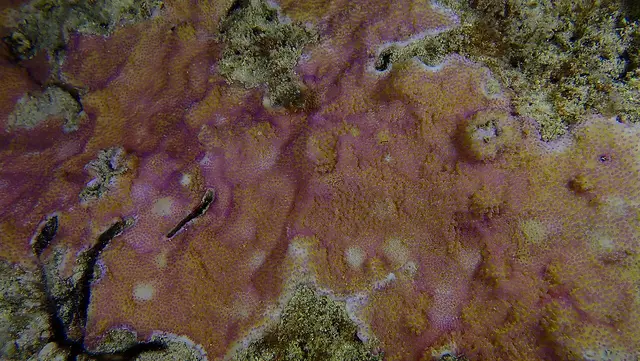
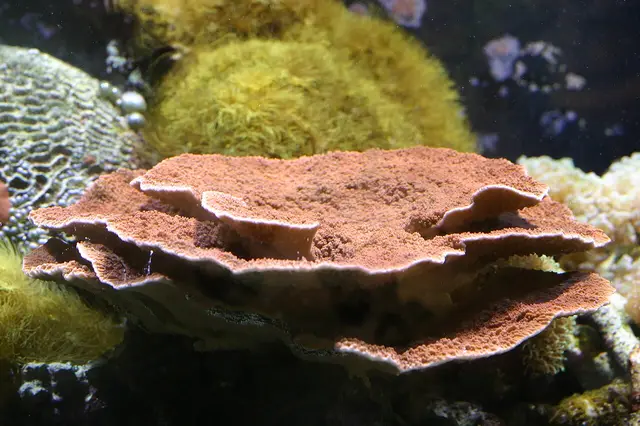
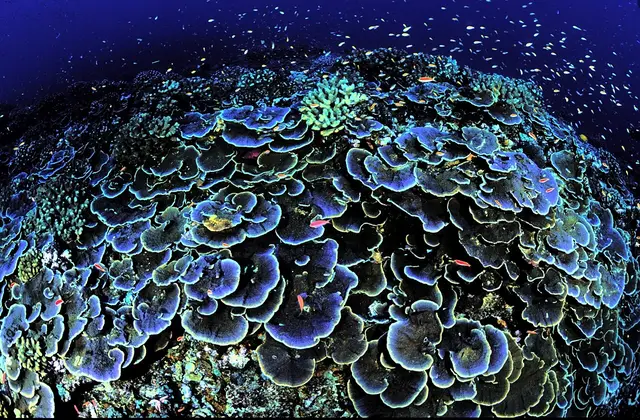
Colonies take several shapes. They can be encrusting sheets, plates, or upright columns, and the tops of the columns often carry vertical or flame-shaped ridges. Encrusting colonies may send out small rootlets. The colour is usually mottled or uniform brown, cream or blue, sometimes with a differently coloured rim.
Divers identify it by its skeleton. The tiny cups that hold the polyps are sunk into the surface and have no small projections (papillae), and the skeleton between them is coarse enough to see underwater. Two look-alikes, Montipora incrassata and Montipora spongodes, have a fine skeleton there. Most Montipora species are one even colour, but this one, like Montipora verrucosa, can look mottled.
Where it lives
The Red List records it as present in 61 countries and territories, in a belt that runs from Egypt, Jordan, Saudi Arabia, Eritrea, Djibouti and Kenya through Madagascar, the Maldives, India and Sri Lanka to Indonesia, the Philippines, Japan, Australia, Fiji and French Polynesia. The assessment notes it may have been misidentified in the past. Another database counts confirmed or strongly predicted records from 90 ecoregions, none of them in the Atlantic.
The Red List gives a depth range of 1 to 40 m, with most records from 1 to 30 m, and describes it as a coral of tropical reefs, including rocky reefs and murky, semi-turbid water. Sources disagree on how common it is. A coral identification site calls it common in most reef environments, while the IUCN assessment calls it widespread but uncommon.
Pins are Wikidata “endemic to” fields. Orange dots, when present, are GBIF occurrence tiles — survey bias included.
How it lives
The assessment treats it as highly susceptible to bleaching and to disease, and as moderately vulnerable overall to reef decline. It puts a generation at about 10 years.
Little else is recorded for this species itself. Genus-level biology, drawn from the Montipora group as a whole, is that colonies share their tissue with symbiotic algae and usually extend their polyps only at night. Members of the genus are reportedly hermaphrodites that release eggs and sperm into the water, typically in spring, and pass algae to their offspring inside the egg. None of this has been confirmed for M. spumosa specifically.
Why it is in trouble
The assessment records a decreasing population and continuing loss of reef area. It estimates a suspected decline of under 25% over the past three generations, since 1989, and a suspected decline of at least 62% by 2050, the figure that qualifies it as Endangered under criterion A3ce. Both estimates are inferred from global coral cover data and projected bleaching, not counted on the species itself.
It lists many ongoing threats, each scored low in impact on its own. They include temperature extremes, storms and flooding, sediment from eroded land, shipping lanes, housing, commercial and industrial development, tourism and recreation, and small-scale harvest.
Warm water is the main trigger of coral bleaching worldwide. Corals under heat stress expel the algae that give them colour and food, and turn white. A bleached coral can recover if the stress is mild, but if it lasts, the coral eventually dies, and survivors are more prone to disease.
What is being done
All stony corals are listed on CITES Appendix II, which regulates international trade. The assessment says parts of the coral's range overlap marine protected areas, but records as unknown whether it occurs in one. It lists site protection and management, habitat restoration, species recovery, captive breeding and a genome resource bank among relevant actions, and recommends research on its taxonomy, numbers and threats.
Sources
Written for this catalog in our own words from the sources below, checked against them on 12 November 2026. Population figures are estimates and carry the year they were made. Status and assessment year: IUCN. 2026. The IUCN Red List of Threatened Species. Version 2026-1. iucnredlist.org.