Endangered
Montipora nodosa
Montipora nodosa
Montipora nodosa is a reef-building stony coral that grows as crusts and lumps on shallow reefs across the Indo-Pacific and Red Sea. It has no widely used common name beyond "pore coral". The IUCN Red List moved it from Near Threatened in 2008 to Endangered in 2024, because reef habitat is declining.
How to recognise it
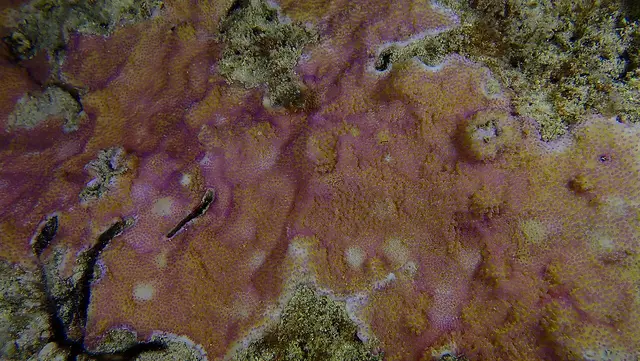
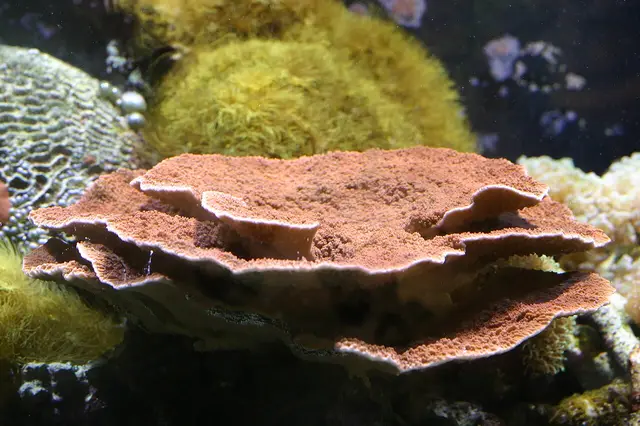
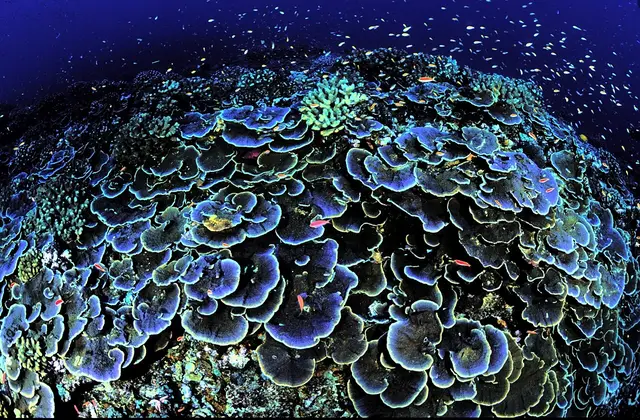
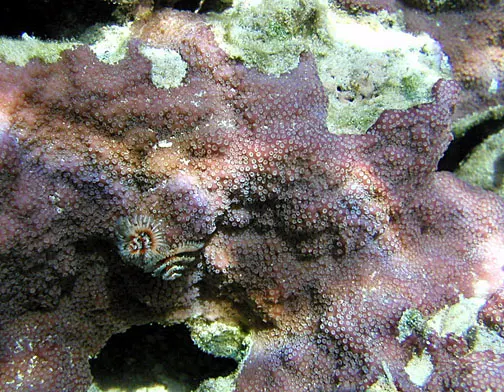
Colonies are massive, slightly lumpy or encrusting. The tiny skeleton cups (corallites) sit either sunken or slightly raised and are ringed by fused papillae, with more papillae usually on the surface between them. Colour is usually pale brown, green or blue, though it can photograph purple. Reference works list Montipora grisea as a lookalike, so identification can be tricky.
Where it lives
The IUCN lists about 40 countries and territories, from the Red Sea (Egypt, Jordan, Israel, Saudi Arabia, Sudan, Eritrea, Yemen) and East Africa down to Mozambique and Madagascar, across to India and Southeast Asia, and out to Australia, Japan, Fiji, Samoa and Pitcairn. Most of the 289 records on GBIF come from American Samoa, Australia and New Caledonia.
It lives on coral reefs at about 1 to 30 m depth, and the standard reef reference Corals of the World calls it usually uncommon.
Pins are Wikidata “endemic to” fields. Orange dots, when present, are GBIF occurrence tiles — survey bias included.
What is known about its biology
Little has been published on this species itself. Corals in the genus Montipora are hermaphroditic broadcast spawners, typically in spring, and their eggs already carry the algae that supply much of the colony's energy, so each generation inherits them.
Why it is in trouble
The Red List projects a population reduction of about 63%, using a generation length of 10 years. The assessment bases this on loss of reef habitat quality and on the effects of pathogens, pollutants and competing organisms. Listed threats include coastal building and urban development, tourism areas, sedimentation, storms and flooding, extreme temperatures, shipping lanes and small-scale harvest. The population is not considered severely fragmented, but reef area continues to decline.
What is being done
The IUCN lists site protection and management, habitat restoration, species recovery, captive breeding and a genome resource bank among the conservation actions. Whether the species occurs in a protected area is recorded as unknown. Stony corals as a group are covered by CITES Appendix II, which governs international trade, and the assessment records no use or trade for this species.
Sources
Written for this catalog in our own words from the sources below, checked against them on 12 November 2026. Population figures are estimates and carry the year they were made. Status and assessment year: IUCN. 2026. The IUCN Red List of Threatened Species. Version 2026-1. iucnredlist.org.