Endangered
Montipora efflorescens
Montipora efflorescens
Montipora efflorescens is a stony coral that grows as lumpy crusts and mounds on the upper slopes of Indo-Pacific reefs, most often bright or dark green. The IUCN Red List moved it to Endangered in 2024, from Near Threatened in 2014, even though it's described as common, because its reef habitat is projected to decline.
How to recognise it
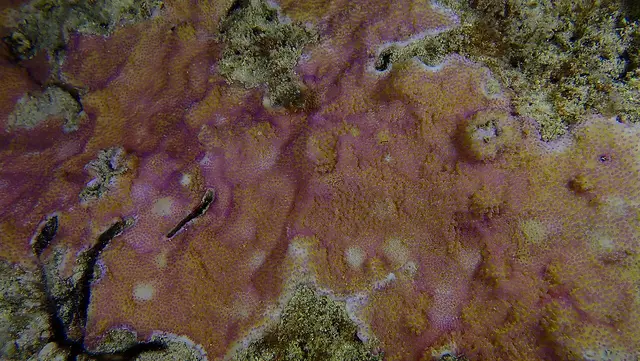
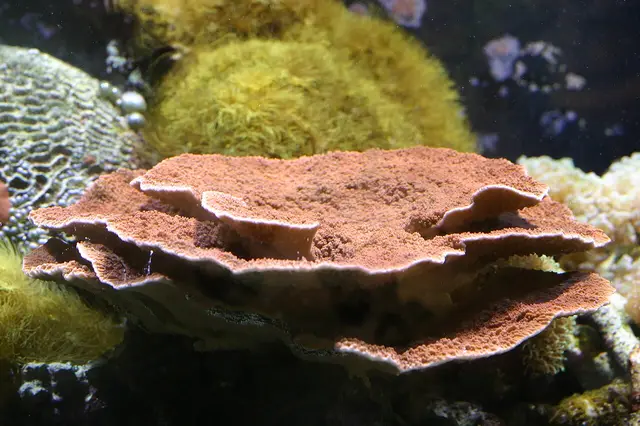
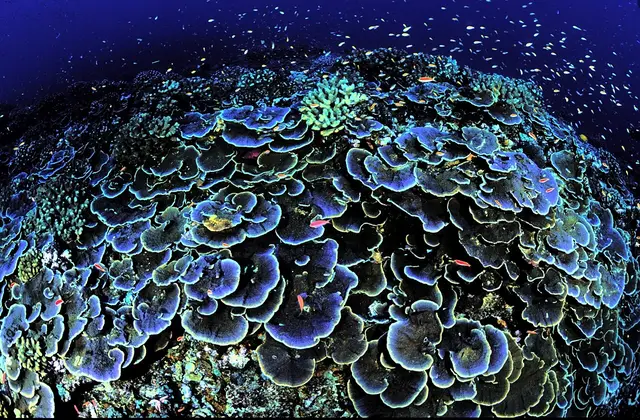
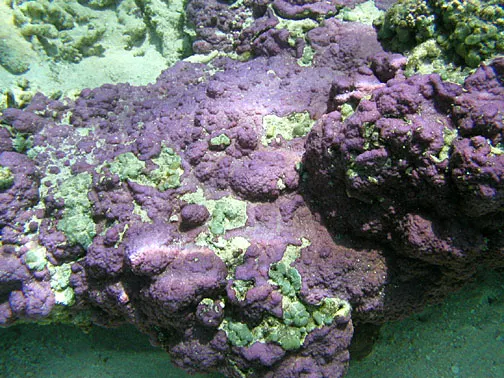
Colonies are submassive to encrusting, with surfaces that are flat or built from irregular mounds or short columns. The skeleton is covered with papillae, tiny bumps that are long on the mounds and short on flat plates. Those around each corallite opening are always present and can form a ring.
Colour varies. Green, bright or dark, is the usual colour, with cream, brown, pink and blue colonies less often. Montipora grisea has more compact corallites and doesn't form mounds. Montipora lobulata, peltiformis and stilosa are other species to compare.
Where it lives
Bernard described the species in 1897 in the British Museum's catalogue of madreporarian corals. It's a coral of the tropical Indo-Pacific. The Red List lists 71 countries, territories and island groups, from Egypt, Kenya, Madagascar and the Maldives to Japan, Fiji and French Polynesia. Corals of the World maps it in 94 of the world's 150 reef ecoregions, and none in the Atlantic.
It grows on upper reef slopes. The Red List gives a depth range of 1 to 50 m, while SeaLifeBase gives 1 to 26 m.
Pins are Wikidata “endemic to” fields. Orange dots, when present, are GBIF occurrence tiles — survey bias included.
How it lives
No study of this species' biology turned up, so what follows is about the genus. Montipora corals are hermaphroditic broadcast spawners, typically spawning in spring, and their eggs already contain symbiotic algae. Corallivorous fish such as butterflyfish feed on Montipora.
The Red List uses a generation length of 10 years for this species.
Why it is in trouble
A coral can be common and still be Endangered. The 2024 listing (criteria A3ce) is based on a projected population reduction of 62%, linked to a decline in habitat quality and to the effects of introduced taxa, pathogens and other biological stresses. The assessment also records a continuing decline in the area the species occupies, and a decreasing population trend. Its 2014 and 2008 assessments were Near Threatened.
The threats named include temperature extremes, storms and flooding, sediment from erosion, housing and commercial development, tourism and recreation, and shipping lanes. They fit a wider pattern. A global reassessment announced in November 2024 covered 892 reef-building coral species, found 44% threatened with extinction, and named climate change as the main threat.
What is being done
Stony corals, this one included, are listed on CITES Appendix II, which regulates international trade. The Red List records it as unknown whether the species occurs in any protected area. Its conservation actions include site protection and management, habitat restoration, species recovery work, and captive propagation and genetic resource banking. For reef-building corals generally, the IUCN says cutting greenhouse gas emissions is the main solution.
Sources
Written for this catalog in our own words from the sources below, checked against them on 12 November 2026. Population figures are estimates and carry the year they were made. Status and assessment year: IUCN. 2026. The IUCN Red List of Threatened Species. Version 2026-1. iucnredlist.org.