Critically Endangered
Lamarck's Sheet Coral
Agaricia lamarcki
Lamarck's sheet coral (Agaricia lamarcki) is a plate-forming reef coral found across the Caribbean, mostly on slopes and walls below the shallowest reef. The IUCN's 2022 assessment rates it Critically Endangered, with a decreasing population and a large projected loss of reef habitat over three generations.
How to recognise it
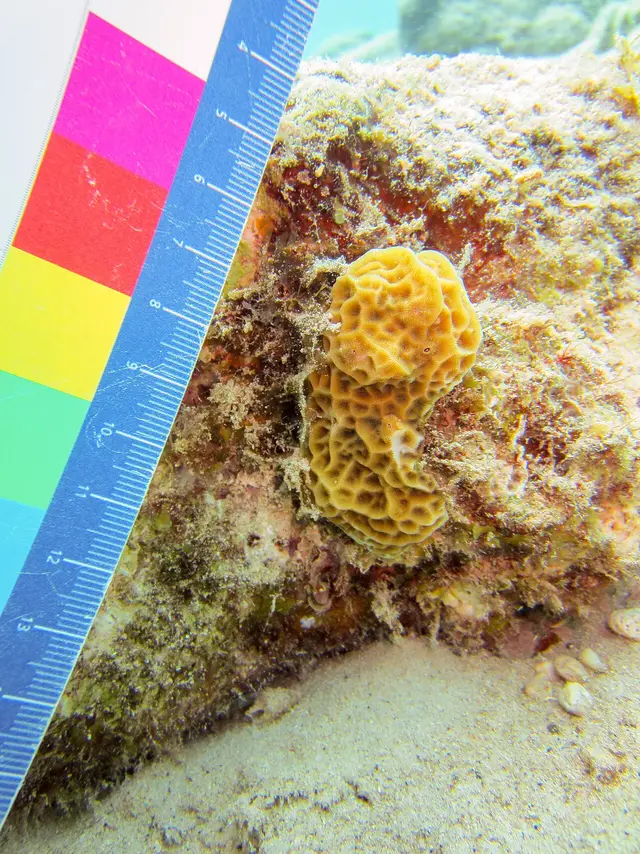
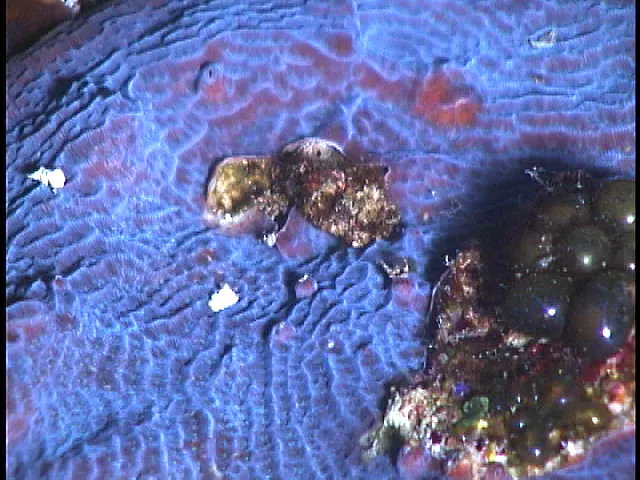
Colonies grow as large, mostly thick plates with rounded or pointed edges, and neighbouring plates often overlap. One reef guide gives colony size as about 30 cm to 1.8 m. The upper surface carries concentric ridges separated by wide valleys, and white, star-like polyps sit in the middle of those valleys. The underside is smooth and bears no polyps.
Colonies are yellow-brown, golden-brown or brown, sometimes with bluish or grey tints, which makes the white polyps stand out. Each corallite measures 3.1 to 4.5 mm across and has 20 to 32 septa, the thin plates that radiate inside it. It is also called the whitestar sheet coral.
Where it lives
The species is a western Atlantic coral of the Caribbean and Bahamas. Guides describe it as common in the Caribbean and occasional in Florida and the Bahamas. The IUCN lists it from about 40 countries and territories, from Mexico, Belize and Honduras through Panama and Colombia to Venezuela and across the island chains from Cuba and the Bahamas down to Trinidad and Tobago.
It prefers sloping reefs and walls. Depth figures vary by source: 5 to 45 m in one reef guide, 5 to 50 m (most often 20 to 35 m) in a Caribbean diving guide, and 10 to 76 m in the IUCN data. The IUCN lists its habitat as coral reef and subtidal rocky reef.
Pins are Wikidata “endemic to” fields. Orange dots, when present, are GBIF occurrence tiles — survey bias included.
Why it is in trouble
The assessment qualifies it under criterion A3c, which looks at projected decline in habitat. It estimates a past reduction of about 26 percent and a projected reduction of about 80 percent, using a generation length of 10 years, and records a continuing decline in the area it occupies. The population is not considered severely fragmented.
The threats it lists include commercial and urban development, sediment running off the land, shipping lanes, tourism and recreation, storms and flooding, temperature extremes, and small-scale harvesting. Coral disease also reaches deep reefs. A survey at El Seco, a deep reef off Vieques, Puerto Rico, in late June and July 2020 found Lamarck's sheet coral among the species with stony coral tissue loss disease, although nearly all infected colonies there belonged to the genus Orbicella.
What is being done
The species occurs in at least one protected area. The Red List entry lists site protection and management, habitat restoration, species recovery, captive breeding or propagation, and a genome resource bank as conservation actions needed for the species. Those are recommendations rather than a record of programmes under way for this coral in particular.
Sources
Written for this catalog in our own words from the sources below, checked against them on 12 November 2026. Population figures are estimates and carry the year they were made. Status and assessment year: IUCN. 2026. The IUCN Red List of Threatened Species. Version 2026-1. iucnredlist.org.