Critically Endangered
Agaricia tenuifolia
Agaricia tenuifolia
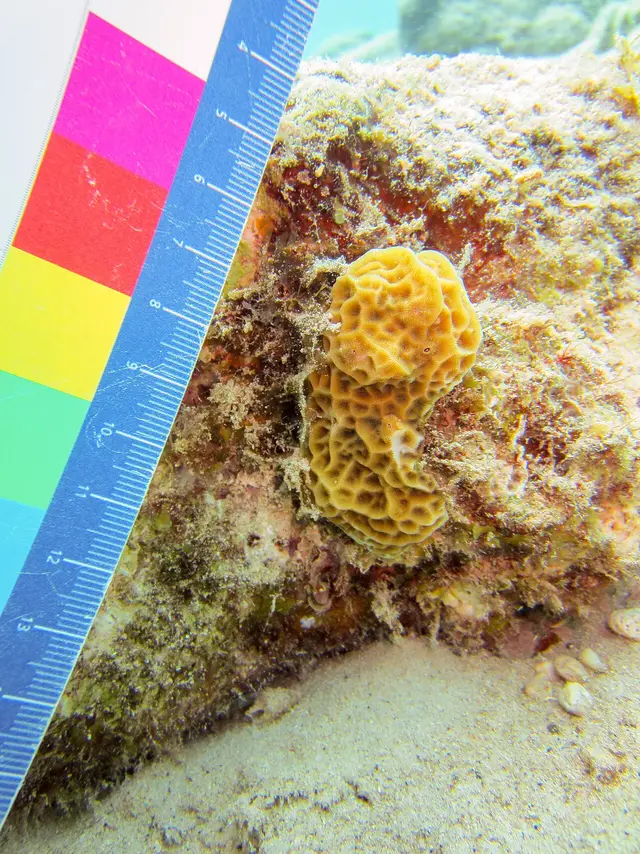
Thin leaf lettuce coral (Agaricia tenuifolia) is a shallow-water stony coral of the Caribbean Sea and Gulf of Mexico that grows in leafy blades. The IUCN Red List rated it Critically Endangered in 2022, based on projected habitat loss, even though the coral itself can be common and fast growing.
How to recognise it
In sheltered water it forms irregular crusts with many upright, leaf-like blades, and the tiny feeding pits sit in winding rows on both faces of each blade. Where waves are stronger, it can grow in rounded colonies instead. Colour is usually pale brown, reddish brown or greenish brown.
Where it lives
It lives on shallow reefs and in reef lagoons, from about 1 to 15 metres down. The IUCN assessment lists 22 countries and territories, among them Mexico, Belize, Honduras, Cuba, Jamaica, the Bahamas, Panama and Colombia. It is described as common in the southern Caribbean and less so in the north.
Pins are Wikidata “endemic to” fields. Orange dots, when present, are GBIF occurrence tiles — survey bias included.
How it lives
Like most reef-building corals, it hosts tiny algae in its tissue that supply much of its food. At night the polyps also catch drifting zooplankton.
It settles readily on bare reef and grows quickly, which is why it has been called a coral weed: it can fill open space before slower, longer-lived corals get a chance. That same habit may help it bounce back after a disturbance.
Why it is in trouble
Heat is the clearest danger. After a severe bleaching event on the Belize barrier reef in the late 1990s, the coral reportedly suffered total mortality there, while other species later recovered. Disease and storms add to the pressure.
The IUCN assessment records a reduction of about 21 percent in the past and projects a reduction of about 80 percent in the future (a generation is put at 10 years), driven by habitat decline. Its threat list includes extreme temperatures, storms and flooding, housing and urban development, sediment from erosion, shipping lanes, tourism and small-scale harvest. NatureServe has rated it only Vulnerable.
What is being done
Part of its range lies inside protected areas, and it is subject to international trade controls. The IUCN lists captive breeding, species recovery, habitat restoration and site protection among relevant conservation actions.
Sources
Written for this catalog in our own words from the sources below, checked against them on 12 November 2026. Population figures are estimates and carry the year they were made. Status and assessment year: IUCN. 2026. The IUCN Red List of Threatened Species. Version 2026-1. iucnredlist.org.