Critically Endangered
Theodoxus baeticus
Theodoxus baeticus
Theodoxus baeticus is a tiny freshwater snail from the Guadalquivir basin in southern Spain, confirmed in a single river stretch near Seville. The IUCN assessed it as Critically Endangered in 2011, but a 2023 taxonomic study treats its original name as doubtful, so whether it is a distinct species is unsettled.
How to recognise it
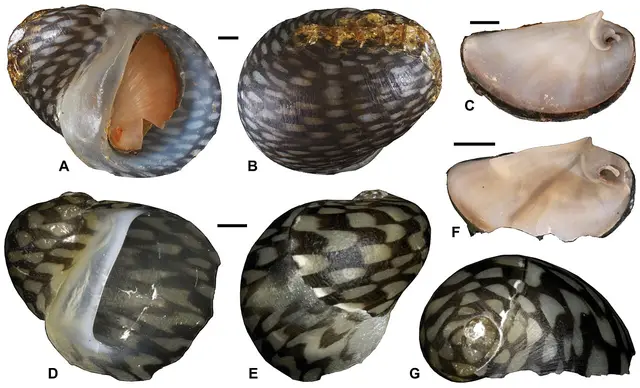
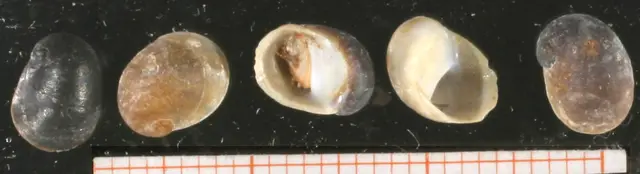
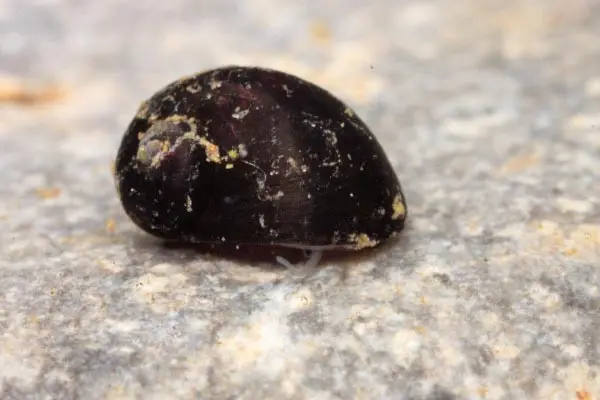
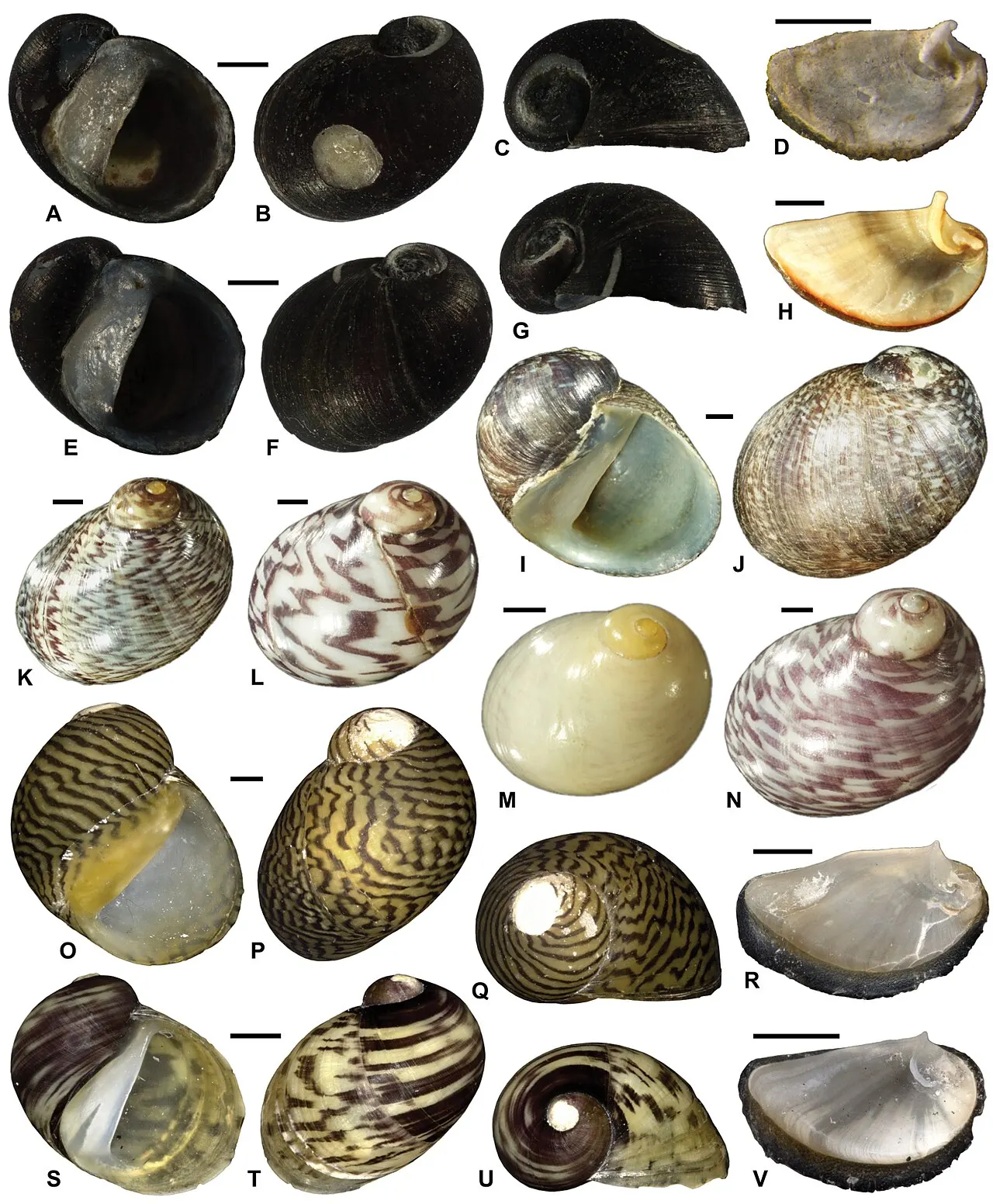
The shell is small, nearly spherical and wider than tall, with up to three whorls. It reaches at most about 7.8 mm high and 9.7 mm wide. Colour varies a lot. Some shells are almost black, while others have a pale background crossed by brown or violet lines, zigzags, broad spiral bands or blotches.
The snail closes its shell with a chalky lid, the operculum. The body and tentacles are whitish and the mantle is blackish. It belongs to the nerite family, Neritidae, and has no common name.
Where it lives
It is described as endemic to southern Spain, with a poorly known distribution. Older records spread it across Andalusia, Murcia and Valencia. A Spanish invertebrate atlas entry, based on 2006 fieldwork and a study of the original type series, confirmed only one locality: a spot where the Guadalquivir meets one of its tributaries near Seville. The IUCN assessment likewise counts one location, in mainland Spain, and restricts the range to Andalusia.
Sampling of the Guadalquivir itself through Seville found none. The Murcia and Valencia populations cannot be assigned to this species without molecular work, and many older populations have disappeared.
Pins are Wikidata “endemic to” fields. Orange dots, when present, are GBIF occurrence tiles — survey bias included.
How it lives
It lives on hard surfaces such as stones in clean, hard, carbonate-rich water. At the surviving site the water was measured at pH 7.7, about 74 percent oxygen saturation and up to 25 degrees C in summer. The snails cluster where the current runs, probably because sediment buries the stones in still stretches and leaves nothing firm to cling to.
Its biology is otherwise unknown.
Why it is in trouble
Only one population is confirmed, and it is sparse. The Spanish atlas team found about 150 snails along nearly 1,000 m of river after four days of searching in 2006. Of 24 previously cited populations plus one new one, 23 could not be confirmed and one was extinct. The IUCN assessment likewise says the species has been lost from more than 22 former sites.
The IUCN lists droughts, herbicides and pesticides, and other changes to the river system among the threats. The Spanish atlas adds overpumped aquifers that feed the tributaries, fertiliser and pesticide use on surrounding farmland, industrial and domestic discharges, dredging and channel works, and the spread of the invasive Asian clam, Corbicula fluminea, which it calls a serious threat.
A further problem is naming. A 2023 taxonomic study of Iberian Theodoxus by Alberto Martinez-Orti and David Osca, using DNA from more than 60 European samples, treated Neritina baetica, the original name behind this species, as a doubtful name. It recognised four Theodoxus species for the region.
What is being done
The IUCN lists invasive species control as a needed action. The Spanish atlas reported no legal protection and no conservation measures for the species when it was written, and recommended a management plan, genetic and morphological study, protection of the occupied stretch, monitoring of discharges, minimum river flows and control of invasive bivalves.
Sources
Written for this catalog in our own words from the sources below, checked against them on 12 November 2026. Population figures are estimates and carry the year they were made. Status and assessment year: IUCN. 2026. The IUCN Red List of Threatened Species. Version 2026-1. iucnredlist.org.