Endangered
Black Nerite
Theodoxus prevostianus
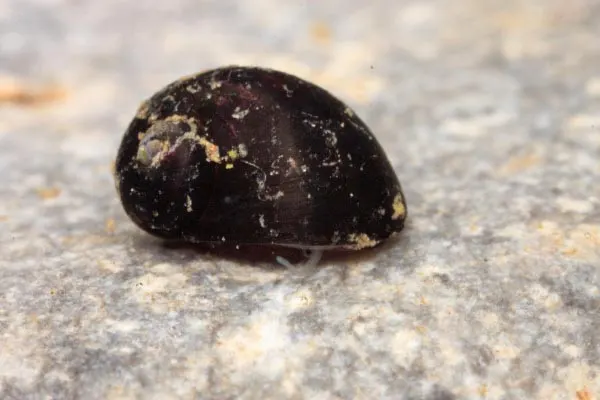
The black nerite (Theodoxus prevostianus) is a freshwater snail under a centimetre long that lives in a few warm springs in central Europe. Its shell is inky black. The IUCN Red List rated it Endangered in 2026. Many of its springs have been lost to development or converted to fishponds.
How to recognise it
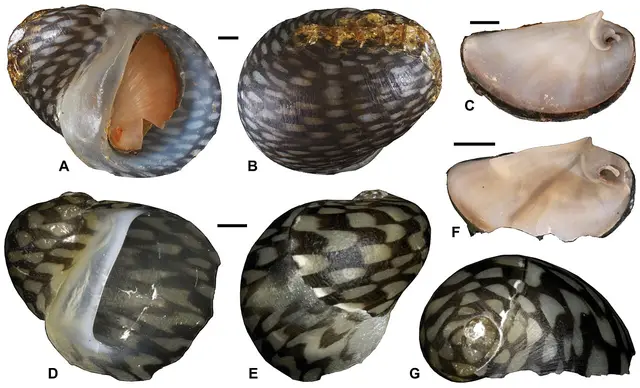
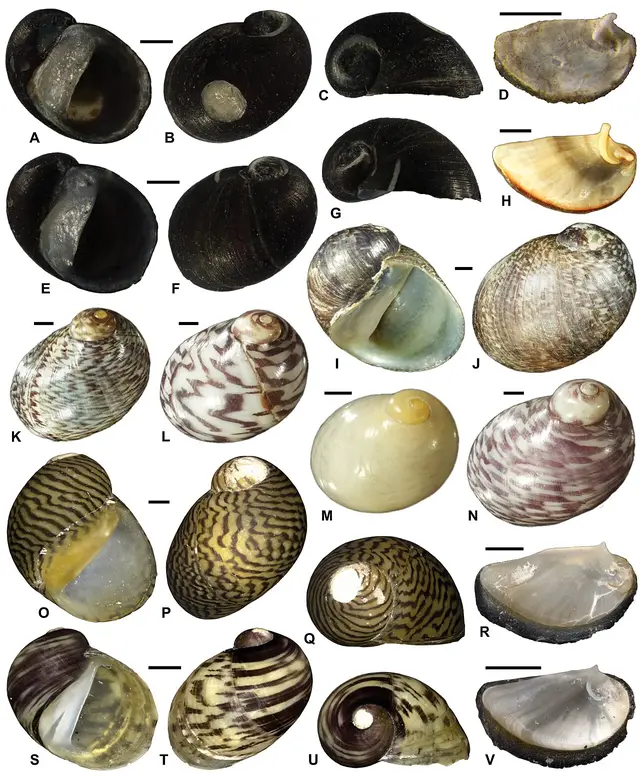
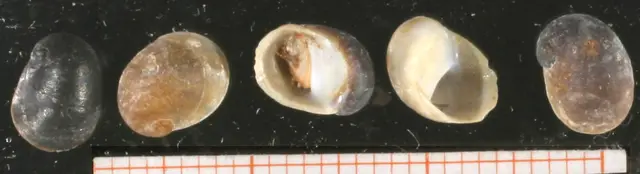
This is a small freshwater snail with a hard lid, or operculum, that seals the shell when the animal pulls inside. The shell grows up to 9.2 millimetres long, according to a 2009 study in Mollusca that measured 555 specimens. That is smaller and a little more elongated than its river relative Theodoxus danubialis, which reaches 13.6 millimetres.
The surviving populations are uniformly inky black, with a magenta sheen or faint patterns in rare cases. One extinct population at Tata in Hungary, which died out in the 1960s, was purple, with zig-zag or white patterns. Some of those snails were moved to Budapest, where they turned darker and lost their patterns after a few generations.
Where it lives
The species belongs to warm springs of the Pannonian region of central Europe, at about 150 to 400 metres above sea level. The 2009 study knew of four remaining populations: Bad Vöslau and Bad Fischau in Austria, Buseca vas in Slovenia and Kőcs in Hungary. The IUCN now counts five locations, covering about 20 square kilometres, and lists the population as severely fragmented.
Many populations have been lost. In Hungary they vanished at Tata, Sály, Miskolctapolca, Diósgyőr and Budapest. In Croatia they vanished at Velika, Podsused and Ivanec Bistranski. Romania's only population, at Răbăgani, went extinct in 2007 after a company illegally excavated the area, captured the thermal streams and built fishponds, according to a 2017 report in Acta Zoologica Bulgarica.
Pins are Wikidata “endemic to” fields. Orange dots, when present, are GBIF occurrence tiles — survey bias included.
How it lives
It lives in thermal springs and the streams that flow from them. Fossils of a similar snail from the Upper Pliocene, more than 1.8 million years old, may come from the common ancestor of this species and the river snail T. danubialis. In the Pleistocene, small snails of this form were common in the rivers of the Pannonian Basin, and later they turned up mainly in the deposits of warm springs.
Whether it is a true species has been debated. Earlier DNA work on one mitochondrial gene had questioned it. The 2009 study weighed shell, radula (feeding ribbon) and operculum differences and concluded that merging it with T. danubialis would be premature. The genetic data could not settle the question either way. The surviving populations may be relicts of two or three separate lineages.
Why it is in trouble
Land and water are the problem. The IUCN lists housing and urban development, tourism and recreation areas, and the taking of surface water for domestic and commercial use. The 2026 assessment found the population decreasing, with continuing decline in the area it occupies and in the number of locations.
The species is also listed on Annex IV of the European Habitats Directive.
What is being done
The IUCN records that 61 to 70 percent of the population lives inside protected areas, and that the species has been successfully reintroduced. Listed conservation actions include reintroduction, site protection, site management and habitat restoration. There was no recovery plan and no systematic monitoring scheme in place at the time of assessment.
Sources
Written for this catalog in our own words from the sources below, checked against them on 12 November 2026. Population figures are estimates and carry the year they were made. Status and assessment year: IUCN. 2026. The IUCN Red List of Threatened Species. Version 2026-1. iucnredlist.org.