Endangered
Striped nerite
Theodoxus transversalis
The striped nerite (Theodoxus transversalis) is a tiny freshwater snail of the Danube basin, once common along the big river and its tributaries. It is listed Endangered by the IUCN (assessed 2026) after disappearing from much of its range, and survives in a handful of cleaner stretches in south-eastern and central Europe.
How to recognise it
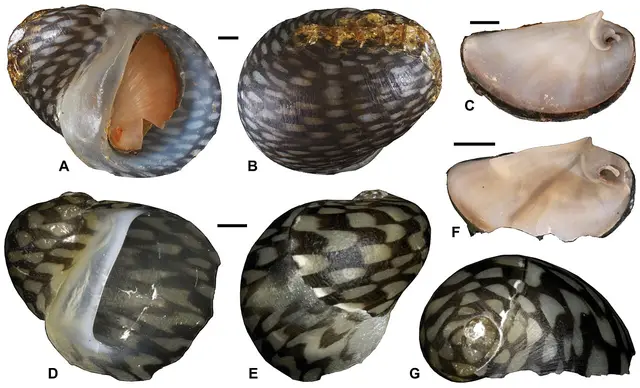
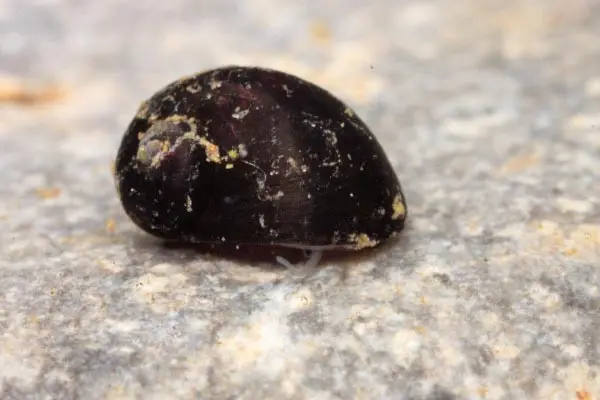
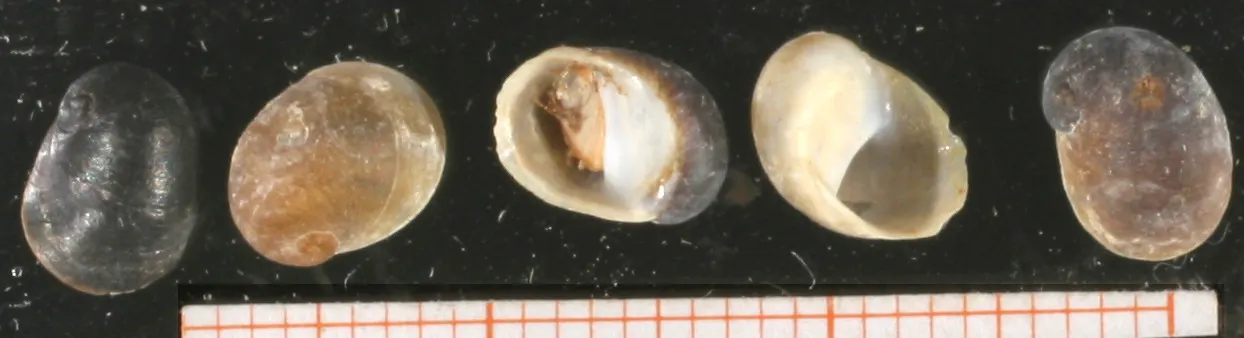
It is a very small, rounded freshwater snail with a lid-like operculum that seals the shell when it withdraws, a trait of the nerite family. Two specimens measured in a 2013 Bulgarian study had shells 7.1 mm and 6.4 mm high, with about two and a half whorls.
It often shares water with relatives. In Serbia's Nisava river it lives alongside Theodoxus danubialis, and the invasive Theodoxus fluviatilis now overlaps with much of its range. Researchers in Bulgaria identified it from shell measurements.
Where it lives
The snail belongs to the Danube drainage, in the middle and lower river and its tributaries. The IUCN lists it as extant in Bulgaria, Hungary, Romania, Serbia, North Macedonia and Greece, possibly extant in Slovakia, and possibly extinct in Austria and Germany. It has been recorded from sea level to about 500 m. The IUCN estimates its area of occupancy at 80 square km.
It lives on solid riverbeds, including sand and gravel banks at the head of Danube islands. A Bulgarian reference cited in a 2013 paper gives its preferred water as well oxygenated (5.5 to 9.5 mg per litre) and slow, with flow of 0.29 to 1.01 m per second. Because it needs clean water, it is treated as a bioindicator.
A genetic survey published in 2012 confirmed only six populations, in Hungary, Bulgaria and Greece. One of them, in the Axios (Vardar) river in Greece, was the first record for the Greek fauna. Later work on Danube islands in Bulgaria (2008 and 2010 samples) and in Romania's Danube Delta has added sites.
Pins are Wikidata “endemic to” fields. Orange dots, when present, are GBIF occurrence tiles — survey bias included.
How it lives
Genetic work places it as the only member of the oldest branch of its genus, which split from the other Theodoxus species around 30 million years ago, in the Early Oligocene. A 2012 study in the North-Western Journal of Zoology found extraordinarily low genetic variety: only three closely related versions of each gene marker tested, across the whole present range.
The researchers read this as the mark of a historical bottleneck followed by rapid expansion in the Holocene. They also suggested it may explain why the species copes worse with polluted or altered water than the related Theodoxus danubialis.
Why it is in trouble
The 2026 Red List assessment (criterion B2ab) records a decreasing population in severely fragmented pieces. Threats named include the invasive Theodoxus fluviatilis, affecting most of the population, along with dams, shipping lanes and, in future, renewable energy development, plus further threats of unrecorded type.
Silting of the riverbed has pushed densities in Hungary's Tisza and Hernad rivers to very low levels, and the 2012 survey judged the Hernad population close to disappearing. A small population in Serbia's Jelenacki stream was threatened by untreated sewage from the nearby town of Irig.
What is being done
The snail is listed in Annexes II and IV of the EU Habitats Directive and in a 1998 Bern Convention resolution. The IUCN says 11 to 20 percent of the population lies in protected areas and that a monitoring scheme is in place, but there is no recovery plan. Habitat restoration and site protection are the recommended actions.
A Rufford Foundation project in Serbia set out to map the remaining populations, assess habitat condition and raise public awareness through lectures, workshops and online outreach.
Sources
Written for this catalog in our own words from the sources below, checked against them on 12 November 2026. Population figures are estimates and carry the year they were made. Status and assessment year: IUCN. 2026. The IUCN Red List of Threatened Species. Version 2026-1. iucnredlist.org.