Critically Endangered
Brown guitarfish
Rhinobatos schlegelii
The brown guitarfish (Rhinobatos schlegelii) is a flat, shark-like ray of the shallow seas of the northwest Pacific, from central Japan to Taiwan. The IUCN Red List rated it Critically Endangered in 2021, estimating an 80 percent population reduction, driven by fishing for its meat and fins.
How to recognise it
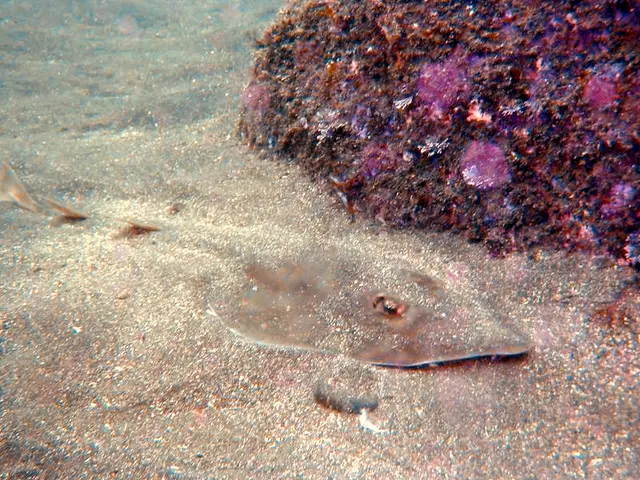
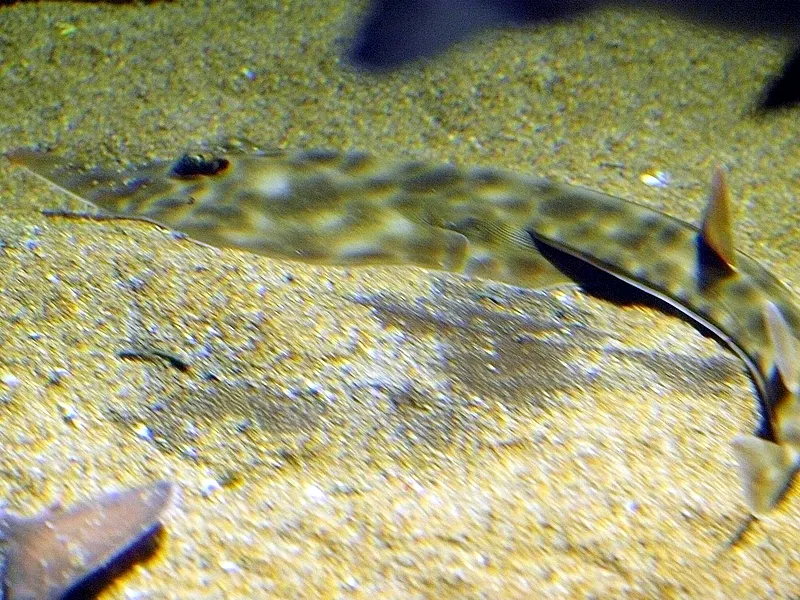
Guitarfishes sit between sharks and rays. This one is medium-sized, reaching about 100 cm in total length. It has a long, wedge-shaped snout with a bulbous tip, large eyes and a sturdy tail. Its skin is covered in small denticles, with small thorns around the eyes, shoulders and along the midline.
The back is pale grey-brown or yellow-brown, often with darker blotches. The underside is white. It is also called the bottlenose or yellow guitarfish. The Taiwan guitarfish (Rhinobatos formosensis) was once treated as a separate species and is now considered the same one.
Where it lives
It occurs in the northwest Pacific, from central Japan to Taiwan. The IUCN assessment lists Japan, China, South Korea and Taiwan. Records from the Philippines and India probably refer to other species.
It lives on soft sand and mud, sometimes near reefs and estuaries, from close inshore to about 230 m on the continental shelf. Divers occasionally see it at sites on Japan's Izu Peninsula and off Chiba, on the south coast of Honshu.
Pins are Wikidata “endemic to” fields. Orange dots, when present, are GBIF occurrence tiles — survey bias included.
How it lives
Little has been recorded about its behaviour. FishBase reports that it feeds on small animals living on the seabed. Females give birth to live young, with litters of up to 14 pups after a gestation of about 12 months. Size at birth is unknown.
The IUCN assessment gives a generation length of about 10 years. Together with a year-long pregnancy, that means a depleted population rebuilds slowly.
Why it is in trouble
Fishing is the main cause. The IUCN assessment lists both accidental and deliberate catch, in large-scale and small-scale or subsistence fisheries. Trawls, gillnets and longlines are reportedly among the gear. The meat is valued in Japan and Korea, and in parts of Japan it is eaten raw as sashimi. Fins are eaten in China, and the dried skin can be traded as leather.
The 2021 assessment estimates a population reduction of about 80 percent, based on an abundance index and levels of exploitation, and records that the cause has not stopped. The species is reportedly rare in Japan and has nearly disappeared from South Korea over the past 20 to 25 years. In one part of Taiwan, where mostly pregnant females are landed, numbers fell by 75 to 96 percent over 30 years. Coastal housing and industrial development also affect some of its habitat.
What is being done
Protection is thin. At the time of the assessment there was no recovery plan, no systematic monitoring and no harvest management plan, and the species was not held in captive breeding. It does occur in at least one protected area.
The assessment also recorded no international trade controls. Since then, parties to the Convention on International Trade in Endangered Species meeting in November 2022 agreed to list guitarfishes in Appendix II, which requires export permits.
Sources
Written for this catalog in our own words from the sources below, checked against them on 12 November 2026. Population figures are estimates and carry the year they were made. Status and assessment year: IUCN. 2026. The IUCN Red List of Threatened Species. Version 2026-1. iucnredlist.org.