Endangered
Ringstraked guitarfish
Rhinobatos hynnicephalus
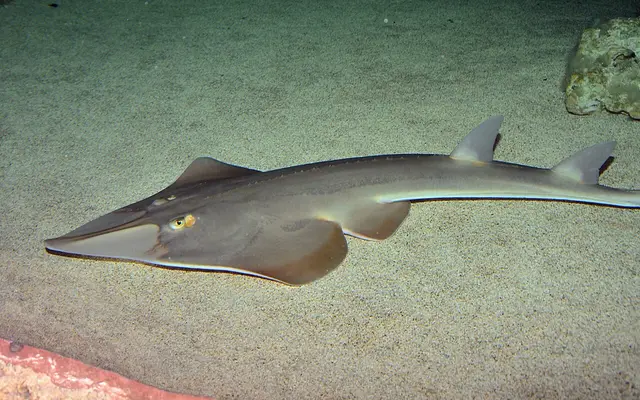
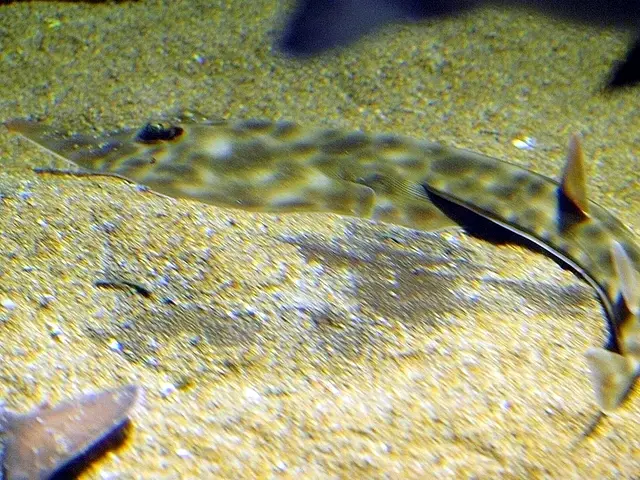
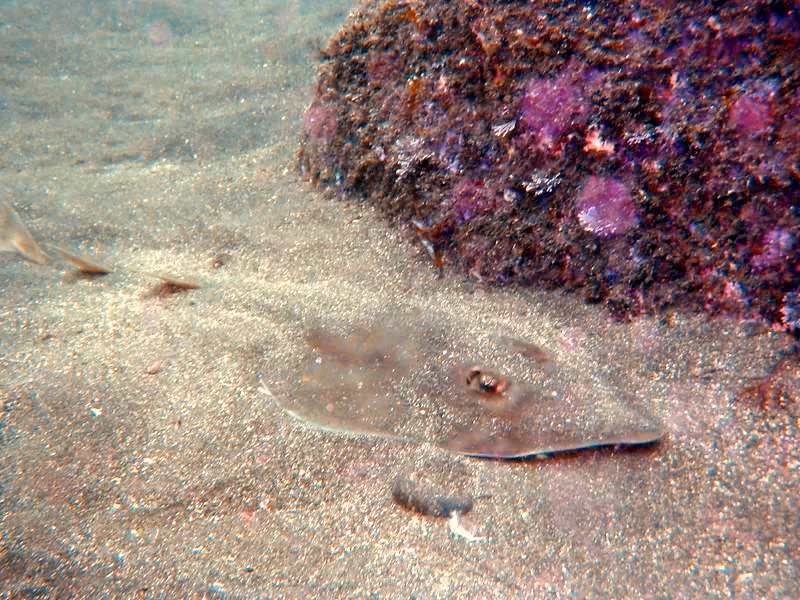
The ringstreaked guitarfish (Rhinobatos hynnicephalus) is a flat-bodied, shark-like ray of shallow coastal seas in the northwest Pacific, from Japan and Korea to Vietnam. The IUCN Red List classed it as Endangered in 2020 because numbers keep falling. Females carry their young for about a year.
How to recognise it
Guitarfishes sit between sharks and rays. They have an elongated body with a flattened head and trunk, small wing-like pectoral fins and a tail shaped like a shark's. This species was named by the naturalist John Richardson in 1846, and it belongs to the family Rhinobatidae.
It is a modest size. Males reach about 53 cm in total length and females about 62 cm, according to FishBase. Males mature at roughly 38 to 40 cm and females at 39 to 44 cm, so a fish only a little longer than a ruler is already an adult.
Where it lives
The range covers the coasts of China, Taiwan, Japan, South Korea and Vietnam. It stays close to shore over soft seabeds of sand, sandy mud and mud, and the Red List assessment also records it in estuaries and around coral reefs. The recorded depth range runs from about 20 to 100 m.
Pins are Wikidata “endemic to” fields. Orange dots, when present, are GBIF occurrence tiles — survey bias included.
How it lives
It feeds on small animals living on the seabed. Reproduction is slow. The young develop inside the mother, and the species is ovoviviparous, meaning the eggs hatch within her body. Litters hold 2 to 9 pups, each about 16 cm long at birth. Off southern China the pregnancy lasts around a year, and pups are born in June or July.
The IUCN puts a generation at about 10 years. FishBase rates the species' resilience as very low, with a population needing more than 14 years to double. That is a big problem for an animal caught in nets.
Why it is in trouble
The main pressure is fishing. The Red List lists both deliberate catches and accidental bycatch, in small-scale and large-scale fisheries. FishBase records minor commercial fisheries, and the flesh has been used as material for kamaboko, a Japanese fish paste. Coastal housing and industrial development are also listed as threats, since the shallow seabed the fish depends on is the same ground that gets built over.
The 2020 assessment records a decreasing population and rates it Endangered under criterion A2cd, which covers a population decline driven by habitat loss and by actual or potential exploitation. It puts the past reduction at 50 to 79 percent. No species recovery plan or systematic monitoring scheme was in place.
What is being done
Protection is thin. The assessment lists trade management, site protection and harvest management among the actions the species needs, but records no harvest management plan, no recovery plan and no monitoring in place. Since then, guitarfishes as a group were added to Appendix II of CITES in November 2022, which requires permits for international trade. FishBase also shows the species under Appendix II.
Sources
Written for this catalog in our own words from the sources below, checked against them on 12 November 2026. Population figures are estimates and carry the year they were made. Status and assessment year: IUCN. 2026. The IUCN Red List of Threatened Species. Version 2026-1. iucnredlist.org.