Endangered
Montipora circumvallata
Montipora circumvallata
Montipora circumvallata is a stony coral of the Red Sea and western Indian Ocean, forming crusts with ridged upgrowths on shallow reefs. Described in 1834, it was rated Least Concern in 2008, but the 2024 IUCN Red List reassessment made it Endangered, projecting a 70 percent decline.
How to recognise it
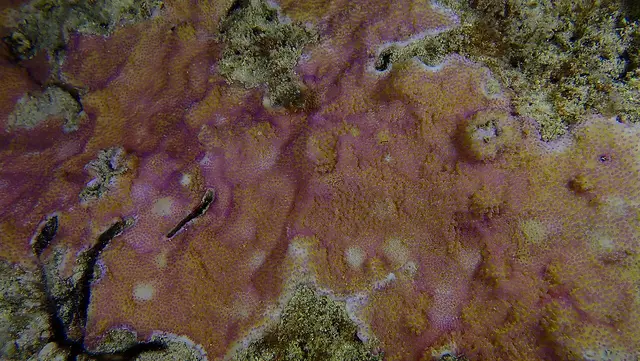
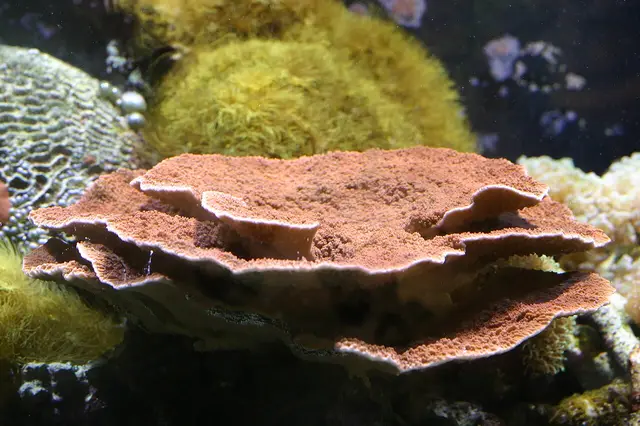
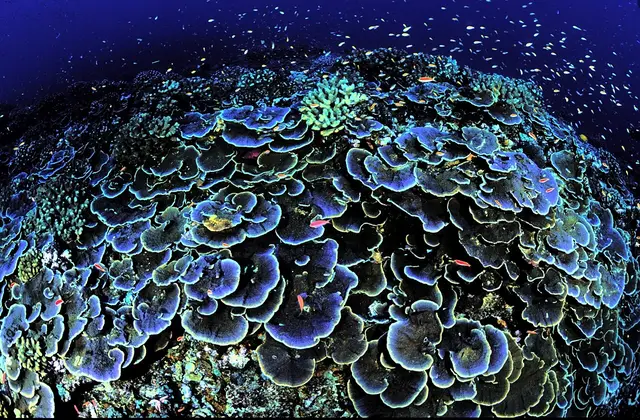
Colonies spread as an encrusting base with irregular upgrowths. The surface carries elongated, slanting bumps that merge into ridges at the ends of the outgrowths, with the polyp cups set between the bumps in vertical rows. Colour is greenish-grey with polyps of a contrasting shade.
Two other Montipora, M. monasteriata and M. undata, look similar. One aquarium reference gives a maximum colony size of about 30 cm.
Where it lives
The Red List range runs around the Red Sea and Gulf of Aden coasts and down East Africa: Egypt, Israel, Jordan, Saudi Arabia, Yemen, Sudan, Eritrea, Djibouti, Somalia, Kenya and Tanzania. It is a reef species of shallow water, found at 2 to 20 m, and often occurs in lagoons.
Its first scientific name, Madrepora circumvallata, was published by Ehrenberg in 1834. One aquarium reference describes the species as usually uncommon.
Pins are Wikidata “endemic to” fields. Orange dots, when present, are GBIF occurrence tiles — survey bias included.
How it lives
Like the rest of its genus, it is a colony of tiny polyps sharing a limestone skeleton and living with symbiotic algae. Montipora is the second most species-rich genus of reef-building coral, with about 85 species. In the genus, polyps are usually extended only at night. Montipora corals are hermaphroditic broadcast spawners, typically spawning in spring, and their eggs already contain the symbiotic algae. These are genus-level facts, not records for this species.
Little has been published on this species in particular. The IUCN uses a generation length of 10 years.
Why it is in trouble
A 2008 assessment found the species of Least Concern. The 2024 reassessment projects a 70 percent population reduction, based on reef area and quality declining and on the effects of pathogens, pollutants and other pressures (criterion A3ce). The area of reef it depends on is recorded as still shrinking, though the population is not considered severely fragmented.
Threats named in the assessment include housing and urban development, commercial and industrial areas, tourism and recreation areas, shipping lanes, soil erosion and silt, storms and flooding, temperature extremes and small-scale harvest. Together they lead to degraded reef, coral death, disturbance and competition.
What is being done
The assessment lists site protection and management, habitat restoration, captive breeding, a genome bank and species recovery among relevant actions. Whether it lives in a protected area is recorded as unknown. It is on CITES Appendix II, so its international trade is monitored.
Sources
Written for this catalog in our own words from the sources below, checked against them on 12 November 2026. Population figures are estimates and carry the year they were made. Status and assessment year: IUCN. 2026. The IUCN Red List of Threatened Species. Version 2026-1. iucnredlist.org.