Endangered
Samoana conica
Samoana conica
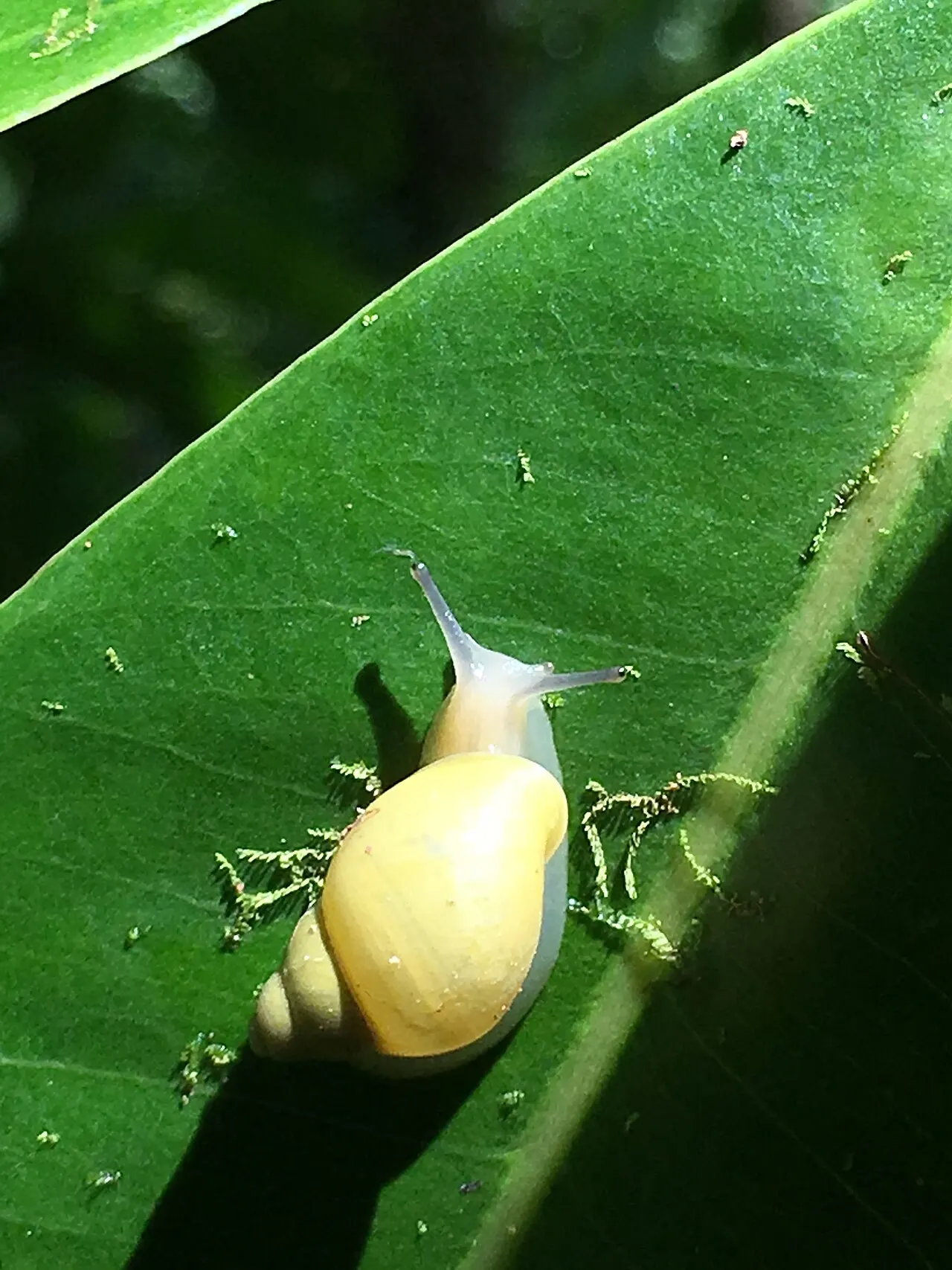
Samoana conica is a small tree snail of the Samoan archipelago. The IUCN Red List rated it Endangered in 2024 and counts only three locations for it. It lives in lowland moist forest, where introduced predatory snails and flatworms, forest clearing and a shrinking range all weigh on it.
Where it lives
Augustus Gould described the species in 1847, and it belongs to the tree snail family Partulidae. It is reportedly endemic to American Samoa, but the IUCN names both American Samoa and the independent state of Samoa in its range, so the exact limits of the distribution are not settled.
The IUCN places it in subtropical or tropical moist lowland forest. Its assessment gives an estimated area of occupancy of just 12 square km and records a continuing decline in the area the snail occupies.
Pins are Wikidata “endemic to” fields. Orange dots, when present, are GBIF occurrence tiles — survey bias included.
How it lives
Very little has been published about this particular species. Partulid snails as a group are mostly active at night, live in trees and feed on both fresh and partly decayed plant material.
The National Park Service's natural history guide to American Samoa says some tree snails there give birth to live young, living 5 to 10 years but producing only 10 to 20 young a year. That describes local tree snails in general, not a measurement for this species, but it shows why slow-breeding snails recover poorly from losses.
Where it stands today
Surveys on Tutuila, Ta'u and Ofu in 1998, run by the Bishop Museum's Samoan Snail Project, found S. conica still alive. It was the second most common of the four partulid species recorded, after Eua zebrina. The project's researchers still regarded all four species as endangered.
The IUCN lists the population trend as unknown. Earlier IUCN assessments, in 1994 and 1996, also treated it as threatened.
Why it is in trouble
Introduced predators are the best-documented danger to American Samoa's native snails. The rosy wolf snail (Euglandina rosea) was brought in during 1980 to control the giant African snail, and it attacks native snails that evolved without such a hunter. It is thought to have been introduced only to Tutuila and Ta'u. A predatory flatworm, Platydemus manokwari, was released on Upolu in 2003 and turned up on Tutuila and Ta'u around 2004. The park guide calls it an even more voracious snail eater than Euglandina.
The IUCN lists small-holder farming as an ongoing threat that affects most of the species' range, because clearing forest removes the trees these snails live in. The National Park Service guide names habitat loss and invasive species as the two main reasons local snails are declining.
What is being done
The IUCN lists control of invasive species as a conservation action for this snail, though it records no conservation measures already in place. A 2021 recovery implementation strategy for American Samoa calls for coordinated snail surveys, control programmes for Euglandina and Platydemus, and a feasibility study on moving snail populations to islands where predators pose less risk. It does not single out this species.
Sources
Written for this catalog in our own words from the sources below, checked against them on 12 November 2026. Population figures are estimates and carry the year they were made. Status and assessment year: IUCN. 2026. The IUCN Red List of Threatened Species. Version 2026-1. iucnredlist.org.
- IUCN Red List assessment, Samoana conica (2024)
- IUCN Red List API taxon record, Samoana conica
- Wikipedia, Samoana conica
- Bishop Museum Samoan Snail Project, objectives and achievements
- US Fish and Wildlife Service species page, Eua zebrina
- National Park Service, Natural History Guide to American Samoa
- US Fish and Wildlife Service, American Samoa recovery implementation strategy 2021