Endangered
Montipora vietnamensis
Montipora vietnamensis
Montipora vietnamensis is a stony reef coral described from Vietnamese waters and recorded across the Indo-West Pacific, from Vietnam and Indonesia to Palau and Australia. It lives in shallow water, down to about 15 m. The Red List moved it from Vulnerable to Endangered in 2024 because of a projected decline.
How to recognise it
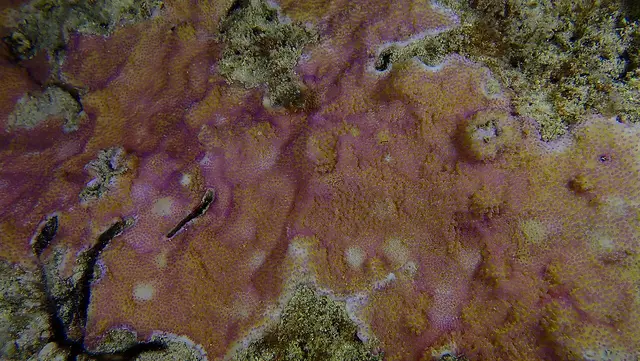
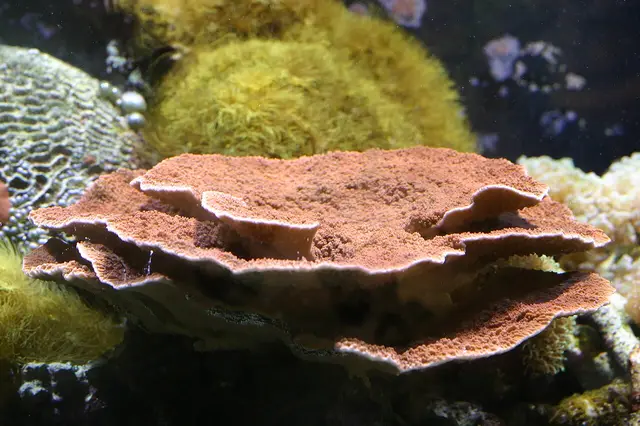
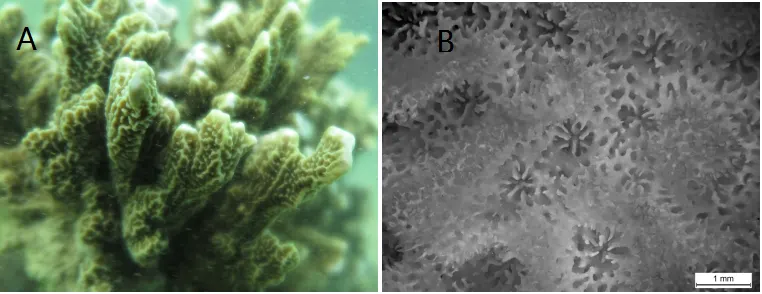
Colonies have an encrusting or plate-like base from which short, tightly packed branches rise. The colour is dark brown, usually with white ridges on the skeleton between the coral pits and white branch tips. The individual pits (corallites) are large and prominent. A 2022 genome paper by Wang and colleagues calls it an uncommon but distinctive species.
Where it lives
Veron described the species in his 2000 reference work Corals of the World. The type specimen came from Vietnam's exclusive economic zone, and the name reflects that. The Red List now records it from 18 countries and territories, among them Vietnam, Indonesia, the Philippines, Taiwan, Cambodia, Thailand, Malaysia, Papua New Guinea, the Solomon Islands, Palau and Australia, as well as the Paracel and Spratly Islands.
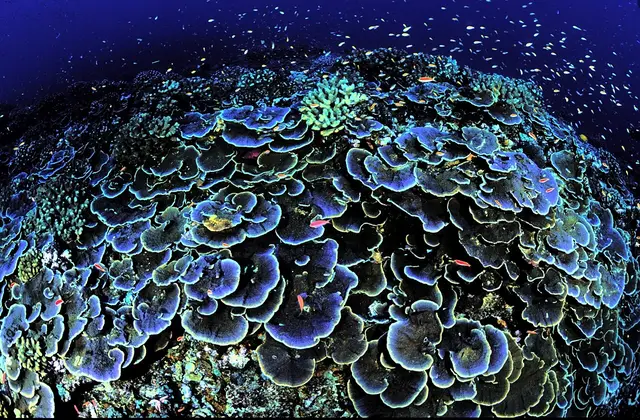
It grows on coral reef and on rocky subtidal reef, at depths of roughly 1 to 15 m, and is also reported from rocky shores. It is a zooxanthellate coral, meaning it carries symbiotic algae in its tissue.
Pins are Wikidata “endemic to” fields. Orange dots, when present, are GBIF occurrence tiles — survey bias included.
Why it is in trouble
The 2024 assessment (criterion A3ce) projects a decline in the population and records a continuing decline in the area of habitat. It lists a spread of threats: temperature extremes, storms and flooding, coastal housing and commercial development, sediment washed onto reefs, shipping lanes, tourism and recreation, and unintended damage from small-scale harvesting. Each is scored as low impact on its own.
The species was assessed as Vulnerable in 2008. The category rose to Endangered with the 2024 reassessment. A generation is estimated at 10 years, and no population size is given.
What is being done
The Red List says it is unknown whether the species occurs in any protected area. The actions it lists as needed include site protection and management, habitat restoration, species recovery, captive propagation and a genome resource bank. Researchers have sequenced the complete mitochondrial genome of the coral from specimens collected at Sanya, Hainan, published in the Biodiversity Data Journal in 2022, a tool for work on the taxonomy of this group. The species is also listed in CITES Appendix II.
Sources
Written for this catalog in our own words from the sources below, checked against them on 12 November 2026. Population figures are estimates and carry the year they were made. Status and assessment year: IUCN. 2026. The IUCN Red List of Threatened Species. Version 2026-1. iucnredlist.org.