Endangered
Coregonus macrophthalmus
Coregonus macrophthalmus
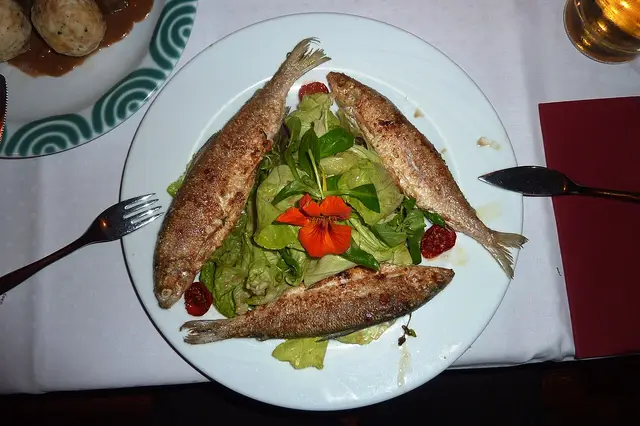
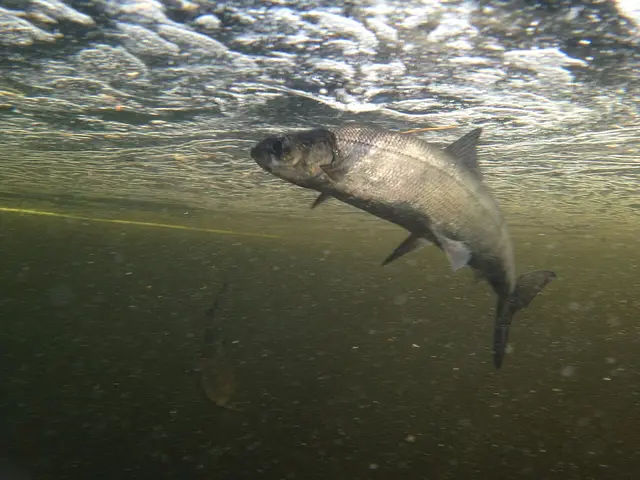
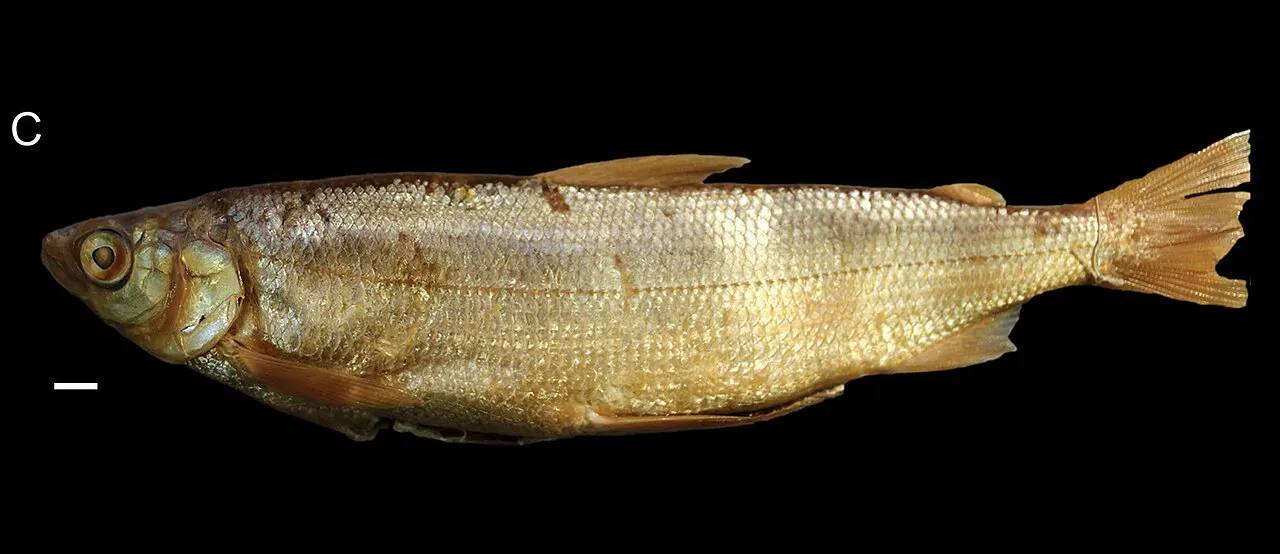
The Gangfisch (Coregonus macrophthalmus) is a small whitefish found only in Lake Constance, where Germany, Switzerland and Austria meet. The IUCN Red List rated it Endangered in 2024 and records a falling population. It stays closer to shore than its better-known relative, the blue whitefish.
How to recognise it
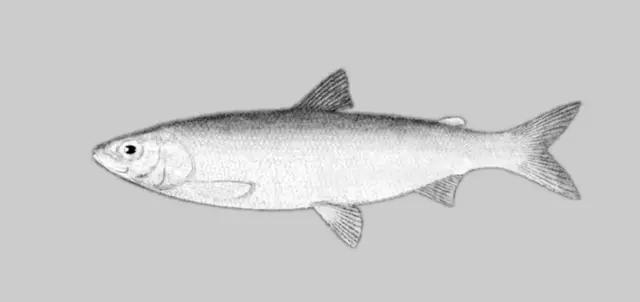
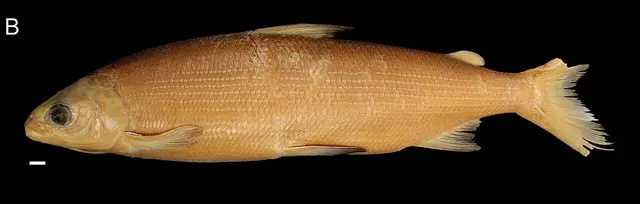
The Gangfisch is a modest-sized salmonid. FishBase gives a maximum length of about 30 cm, and a German reference puts it near 32 cm, well short of the 50 cm the lake's blue whitefish can reach. It is hard to tell from that relative by eye. Counts of the comb-like gill rakers help: roughly 35 to 44 in the Gangfisch against 33 to 39 in the blue whitefish. The ranges overlap, which is why the two are so easily confused.
Where it lives
The species is found nowhere except Lake Constance, which the IUCN counts as a single location. It is a freshwater fish of large permanent lakes. Where the blue whitefish lives in the upper layers of open water, the Gangfisch usually stays near the shore.
Pins are Wikidata “endemic to” fields. Orange dots, when present, are GBIF occurrence tiles — survey bias included.
How it lives
Gangfische eat insects and plankton. They spawn late in the year, in November and December, burying eggs in unguarded nests near the shore or in the Rhine where it flows into the lake. The IUCN lists a generation length of about 3 years, and the fish does not migrate.
Why it is in trouble
The IUCN assessment treats the population as shrinking and its range as restricted. Ongoing threats include habitat alteration, harmful effects of other species (competition is one of the listed stresses) and introduced genetic material that leads to hybridisation. Past pressures, such as nutrient pollution, sewage and accidental catch in large fisheries, are marked as unlikely to return.
The wider lake has changed too. Cleaner water has cut the plankton that whitefish feed on. The three-spined stickleback, introduced by people in the 1950s, had taken over the open water by 2012, and it competes with whitefish for food and eats their newly hatched larvae. Average whitefish weights in the lake fell from about 420 g to about 230 g. These reports concern Lake Constance whitefish in general, mainly the blue whitefish, and do not name the Gangfisch.
What is being done
The IUCN records a recovery plan, a monitoring scheme, a harvest management plan, and conservation sites identified across the whole range. Lake Constance's international fisheries commission closed whitefish fishing from 1 January 2024 for three years, aimed chiefly at the blue whitefish.
In September 2025 the head of the Langenargen fisheries research station reported more eggs on the lake bed and more larvae, with stickleback numbers down to about a fifth of their earlier average since summer 2024. In June 2026 the commission agreed a partial easing: from 1 May to 31 August 2027, nets may be set on Tuesdays to Thursdays, with limited net numbers and mesh sizes meant to take larger, older fish.
Sources
Written for this catalog in our own words from the sources below, checked against them on 12 November 2026. Population figures are estimates and carry the year they were made. Status and assessment year: IUCN. 2026. The IUCN Red List of Threatened Species. Version 2026-1. iucnredlist.org.
- IUCN Red List assessment, Coregonus macrophthalmus (2024)
- FishBase, Coregonus macrophthalmus
- yumda.com, Bodenseefelchen
- heidelberg24, Bodensee Felchen article
- Schwaebische, Beobachtung am Bodensee gibt Grund zur Hoffnung (14 Sept 2025)
- vol.at, Felchen-Fangverbot am Bodensee koennte ab 2027 fallen (18 June 2026)
- SRF, Felchen-Fangverbot im Bodensee wird leicht gelockert (19 June 2026)