Endangered
Osbeck's grenadier anchovy
Coilia mystus
Osbeck's grenadier anchovy (Coilia mystus) is a slim, tapering anchovy of East Asian coasts and estuaries, from the Yangtze delta and southern China to Vietnam and the Korean peninsula. The IUCN Red List rated it Endangered in 2018, mainly because of heavy fishing and the damming and pollution of its estuaries.
How to recognise it
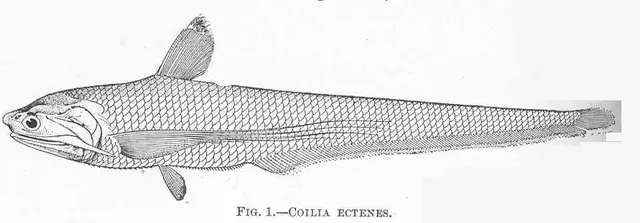
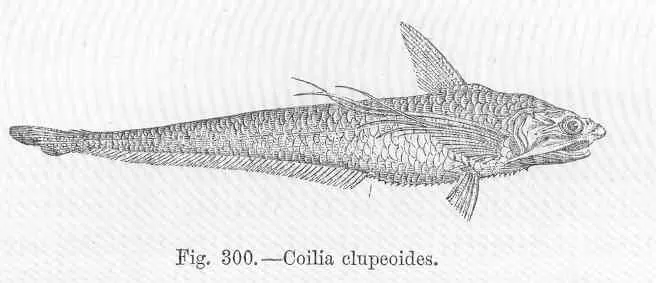
This is a long, slim fish with flattened sides that tapers toward the tail. It has no spines in its fins, and its anal fin carries about 80 soft rays. Large individuals reach about 21 cm in standard length, and the oldest recorded age is 5 years.
Telling the members of this genus apart is hard. FishBase notes that very few records rest on reliable identifications, and that older records from the north of the range may refer to a related species, Coilia nasus. Some older range and catch data are therefore less reliable than they look.
Where it lives
The Red List places the species in China (including Hong Kong and Macao), Vietnam, North Korea and South Korea. It lives in estuaries and open coastal water, shallower than about 10 m. FishBase lists it as amphidromous, meaning it moves between brackish or fresh water and the sea, and the IUCN classes it as a full migrant.
It is best studied in the Yangtze Estuary, where adults spawn in brackish water and do not enter fresh water above the Jiangyin section of the river.
Pins are Wikidata “endemic to” fields. Orange dots, when present, are GBIF occurrence tiles — survey bias included.
How it lives
In the Yangtze Estuary, a 2021 study in Frontiers in Marine Science reports a spawning season from late April to September, peaking in late May and June, with the South Branch as the main spawning ground. A 2011 study puts the main season a little earlier, March to August. Eggs are clear and round, about 0.83 to 1.03 mm across, with several oil droplets.
That 2011 study, in the Journal of Applied Ichthyology, examined 1,072 females caught between May 2006 and September 2007. A single female carried roughly 3,100 to 36,800 eggs, depending on her weight and age, and the fish appeared to spawn in a single batch. The IUCN gives a generation length of about 3 years.
Why it is in trouble
The 2018 assessment lists dams (large and small), sewage, run-off, other changes to the estuary, and fishing at both large and small scales. The population trend is decreasing, and the Endangered listing rests on criterion A2bd, an observed drop in numbers based on an index of abundance and on actual or potential levels of exploitation.
Annual catches in the Yangtze Estuary exceeded 1,500 tonnes in the 1990s, according to the 2021 Frontiers paper, and the 2011 study reported a sharp fall in harvest from the late 1990s. Females in that study produced more but smaller eggs than in earlier work, which that study reads as possible compensation for overfishing. The 2021 paper, based on egg surveys in 2019 and 2020, attributes the decline to overfishing and environmental degradation. It also reports that China stopped issuing special fishing licences for wild populations of the species in 2019 because of severe depletion.
What is being done
The IUCN lists habitat and natural process restoration and harvest management as the actions needed, and records none as in place.
Egg densities in the 2021 surveys varied widely, up to 2.72 per cubic metre in May 2020 against a peak of 0.07 in August 2019, so spawning intensity swings a lot between seasons.
Sources
Written for this catalog in our own words from the sources below, checked against them on 12 November 2026. Population figures are estimates and carry the year they were made. Status and assessment year: IUCN. 2026. The IUCN Red List of Threatened Species. Version 2026-1. iucnredlist.org.
- IUCN Red List assessment, Coilia mystus (2018)
- FishBase, Coilia mystus
- Reproductive biology of Coilia mystus from the Yangtze Estuary: responses to overexploitation (J. Appl. Ichthyol. 2011)
- Frontiers in Marine Science 2021, spawning habitat of Coilia mystus in the Yangtze Estuary
- GBIF backbone, Coilia mystus