Endangered
Coilia nasus
Coilia nasus
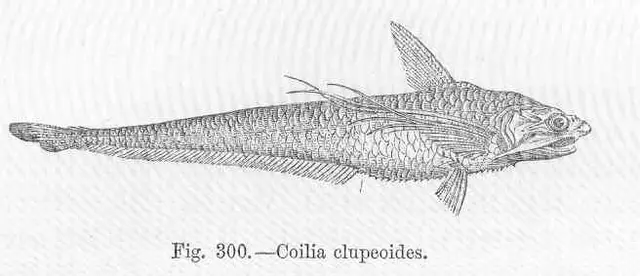
Coilia nasus, the Japanese grenadier anchovy or Chinese tapertail anchovy, is a long, tapering fish of East Asian estuaries and rivers. Some fish migrate up the Yangtze each spring to spawn. The IUCN Red List assessed it as Endangered in 2018, with fishing, dams and pollution among the listed threats.
How to recognise it
This is a slim anchovy that can reach 41 cm in total length, making it one of the largest in its genus. It lives in salt, brackish and fresh water, at depths down to about 50 m.
Where it lives
It is found in the north-west Pacific, from Guangdong in China to the west coast of the Korean Peninsula and the Ariake Sea in south-western Japan. The IUCN lists it for China (including Hong Kong and Macao), Japan, and both North and South Korea. It uses open coastal water, estuaries and rivers.
Some populations stay in freshwater lakes all their lives. Others live at sea and run up rivers to breed.
Pins are Wikidata “endemic to” fields. Orange dots, when present, are GBIF occurrence tiles — survey bias included.
How it lives
Migratory fish enter the Yangtze from the East China Sea, with adults moving upstream from about mid April and numbers in Poyang Lake peaking in late June. The study sampled the spawning season from March to July. Fish sampled in 2020 to 2021 and 2023 to 2024 were aged 1 to 4 years, and the species typically matures at about one year old. The IUCN puts a generation at roughly three years.
Why it is in trouble
It is a prized food fish and, reportedly, one of the most expensive fish sold in China. That demand drove heavy fishing. Yangtze catches peaked at about 4,142 tonnes in 1973, averaged about 2,904 tonnes in the 1980s, and fell to an average of 116.6 tonnes from 2010 to 2013.
The IUCN lists subsistence and large-scale harvest, small and large dams, sewage and run-off as threats. A 2025 study in Frontiers in Marine Science also names overfishing, pollution and water infrastructure, and notes that the dominant spawning fish shifted from 2 to 3 years old in the 1970s to 1 to 2 years old by 2018.
What is being done
China stopped issuing special fishing licences for the species on 1 February 2019, and a ten-year ban on commercial fishing in the Yangtze and connected waters began on 1 January 2021. The IUCN lists harvest management and habitat restoration among actions for the species.
A 2025 study in the Jiangxi section of the river and Poyang Lake found the ratio of fishing mortality to natural mortality falling from 2.6 in 2019 to 0.37 in 2024. The researchers read this as an early sign of stock recovery, though the record is short.
Sources
Written for this catalog in our own words from the sources below, checked against them on 12 November 2026. Population figures are estimates and carry the year they were made. Status and assessment year: IUCN. 2026. The IUCN Red List of Threatened Species. Version 2026-1. iucnredlist.org.