Endangered
Acropora glauca
Acropora glauca
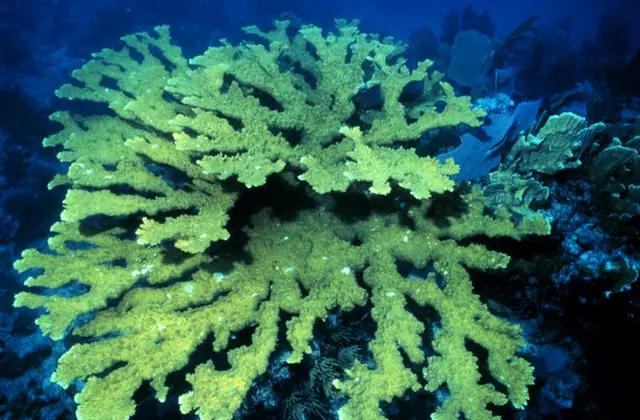
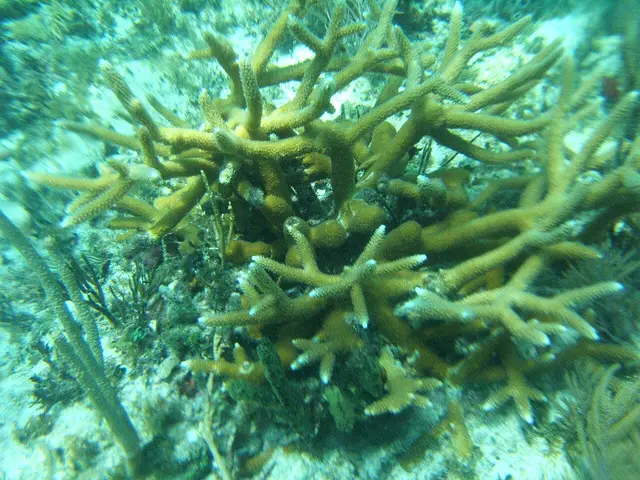
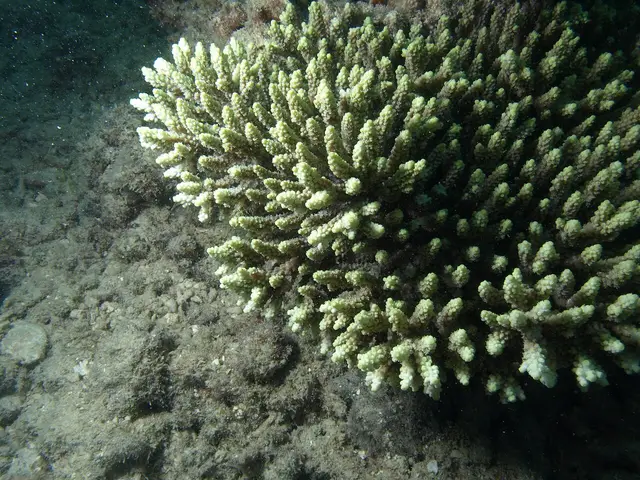
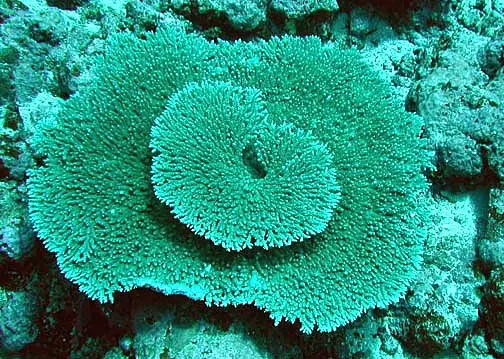
Acropora glauca is a table-like branching coral of shallow Indo-Pacific reefs, often brown, cream or green, and most common in subtropical waters. The IUCN Red List moved it from Near Threatened (2008) to Endangered in 2024, projecting a population drop of about 59 percent.
How to recognise it
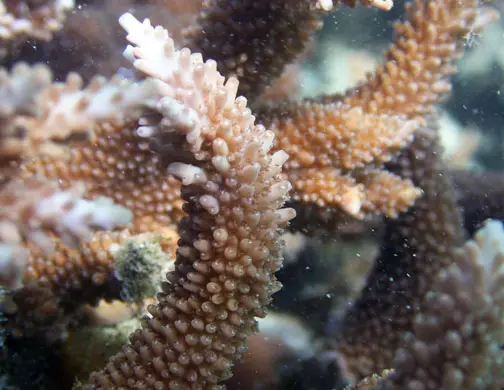
The base of a colony is made of flat, heavily fused branches, and from that base grow irregular upright branchlets. Colonies often stack into tiers of plates, and some are a single solid plate with no upright branchlets at all. Axial corallites (at the branch tips) and radial corallites (along the sides) look much alike, and the radial ones have wide openings and thick lips.
Colour is brown, cream or green. The coral most often compared with it is Acropora solitaryensis, and Corals of the World also points to A. branchi, A. orbicularis, A. retusa, A. arabensis and A. clathrata.
Where it lives
It is found across the central Indo-Pacific, north to Japan, and has also been recorded from East Africa and Madagascar. In Australia the range runs from the Houtman Abrolhos Islands in Western Australia, through the eastern Indian Ocean and the Great Barrier Reef, south to the Solitary Islands in New South Wales, and out to Lord Howe Island.
The Red List lists 39 countries and territories, from Oman and Yemen to South Africa, South-East Asia, Japan, Australia and Pacific islands such as Fiji, Samoa and French Polynesia. Corals of the World reports confirmed or strongly predicted records in 77 marine ecoregions, none in the Atlantic. Its recorded depth range is roughly 5 to 20 m on coral reef, and Corals of the World describes it as common on rocky foreshores in subtropical locations and rare elsewhere. It is common in the Solitary Islands Marine Park.
Pins are Wikidata “endemic to” fields. Orange dots, when present, are GBIF occurrence tiles — survey bias included.
Why it is in trouble
The Red List rates it Endangered under criterion A3ce, with a decreasing population. It projects a reduction of about 59 percent, based on decline in habitat area or quality and on the effects of pathogens, pollutants, competitors or parasites. The assessment uses a generation length of 10 years and records an ongoing decline in area.
Listed threats include temperature extremes, storms and flooding, sediment from soil erosion, housing and urban development, commercial and industrial development, shipping lanes, tourism and recreation, and small-scale harvest. In October 2026 a study in Nature reassessed 892 reef-building coral species and found 44 percent of the 774 with enough data to be threatened, with ocean warming the main driver.
What is being done
The Red List names site protection and management, habitat and natural process restoration, species recovery, captive breeding or propagation and a genome resource bank among the actions in place or needed. Whether the species lives in any protected area is recorded as unknown, although it does occur in the Solitary Islands Marine Park. All stony corals are in CITES Appendix II, so trade requires permits.
Sources
Written for this catalog in our own words from the sources below, checked against them on 12 November 2026. Population figures are estimates and carry the year they were made. Status and assessment year: IUCN. 2026. The IUCN Red List of Threatened Species. Version 2026-1. iucnredlist.org.