Endangered
Acropora acuminata
Acropora acuminata
Acropora acuminata is a table-forming reef coral of the Indo-Pacific, listed by the IUCN from the Red Sea and Indian Ocean across to Micronesia and Polynesia. The IUCN Red List moved it to Endangered in 2024, up from Vulnerable, with warming seas and heat-driven bleaching the main concern.
How to recognise it
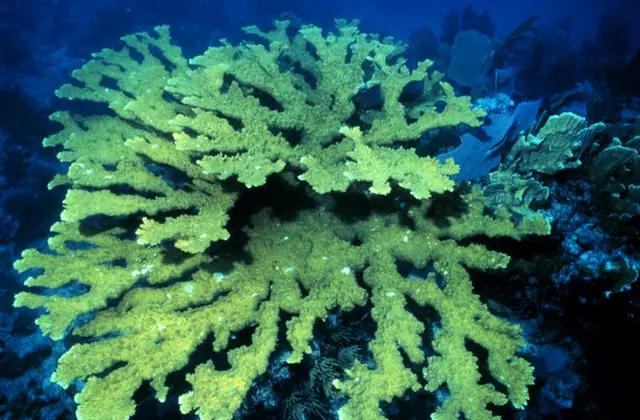
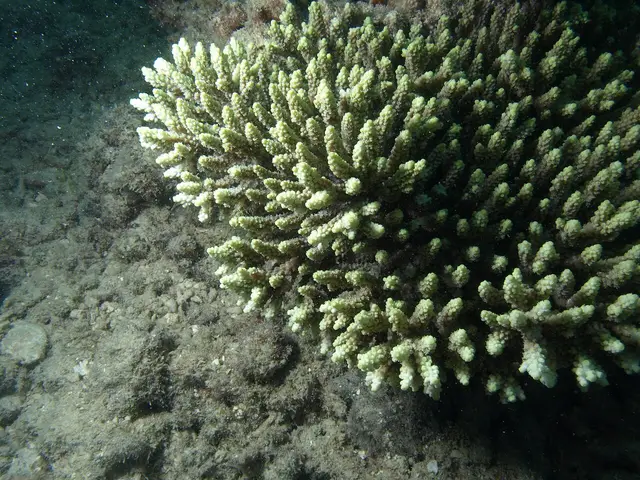
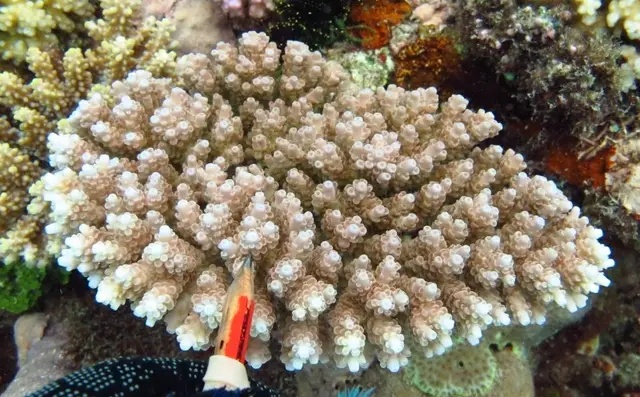
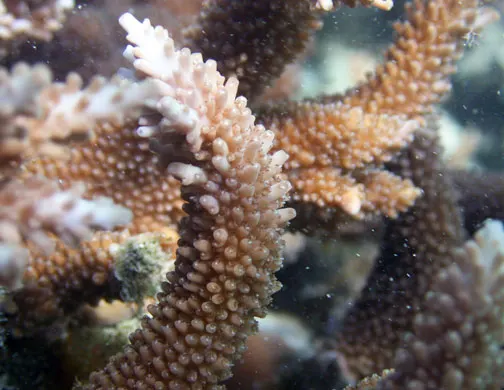
Colonies grow as flat tables built mainly from horizontal branches that taper to points. Descriptions give the colour as brown or pale blue. On the horizontal branches the corallites (the small cups that each hold a polyp) are hard to see, while the upright branches reportedly carry two kinds, including a large tube-shaped form. It is said to look much like another table coral, Acropora hoeksemai, so identifying it in the water takes care.
Verrill described it in 1864 as Madrepora acuminata. Acropora diffusa, Madrepora diffusa and Madrepora nigra are now treated as junior synonyms of it. Colonies carry both male and female sex cells. It has no widely used common name.
Where it lives
It lives on shallow coral reefs, on both upper and lower reef slopes, in clear or turbid water. The IUCN gives a depth range of 3 to 40 m, with the species most common at 5 to 25 m. In inshore northwest Australia it has even been recorded in the intertidal zone.
The IUCN lists more than 50 countries and territories where it is found, from Egypt, Saudi Arabia, Sudan and Eritrea in the Red Sea, through Mauritius, the Maldives and Sri Lanka, to Indonesia, the Philippines, Papua New Guinea, Australia, Fiji, Palau and French Polynesia. No total population figure exists.
Pins are Wikidata “endemic to” fields. Orange dots, when present, are GBIF occurrence tiles — survey bias included.
How it lives
In French Polynesia the species spawns during a single lunar period between September and November, while colonies in northwest Western Australia spawn in March and April. Most Acropora corals first reproduce at around 4 years old, and the IUCN infers a generation length of about 10 years for this one. Longevity is not known.
Why it is in trouble
Like most Acropora, this coral is sensitive to heat. The IUCN lists temperature extremes, storms and flooding, sediment washing onto reefs, coastal development, tourism, shipping, air pollution and problem species among its pressures, and it judges the population to be decreasing. Its open table form is reportedly vulnerable to crown-of-thorns starfish, which eat coral, and to disease. Collection for the aquarium trade is also reported as a threat, and the species is on CITES Appendix II, which controls international trade.
Its Red List history tracks the wider crisis on reefs. It was Vulnerable in 2008 and 2014, then Endangered in 2024. The coral reassessment announced in November 2024 covered 892 reef-building species and found that 44 percent of the 774 with enough data are threatened. IUCN's coral specialists report that 191 of 279 Indo-Pacific Acroporidae species are Endangered. They add that the true share is probably higher, because the assessment used data through 2020 and was completed before the global bleaching event of 2023 to 2025.
What is being done
The IUCN's list of actions for this coral is general: restoring reef habitat, managing and protecting reef sites, species recovery, captive breeding and propagation, and storing genetic material. Whether the species occurs in a protected area is recorded as unknown. Climate change is the main driver, so local measures can only buy time.
Sources
Written for this catalog in our own words from the sources below, checked against them on 12 November 2026. Population figures are estimates and carry the year they were made. Status and assessment year: IUCN. 2026. The IUCN Red List of Threatened Species. Version 2026-1. iucnredlist.org.