Endangered
Oman Cownose Ray
Rhinoptera jayakari
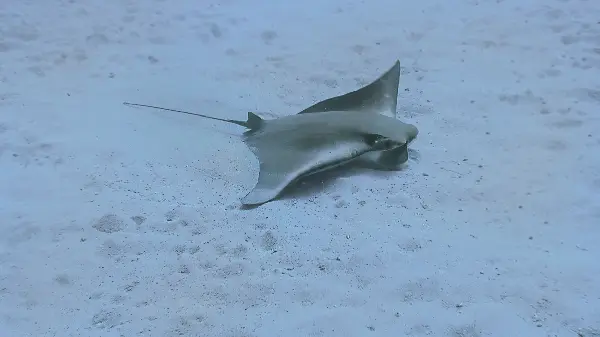
The Oman cownose ray (Rhinoptera jayakari) is a brownish-grey ray of shallow Indo-West Pacific seas, recorded from Mozambique and the Arabian region to South-East Asia and Japan. The IUCN Red List classed it as Endangered in 2021 because fishing has cut its numbers sharply, and it is still caught across its range.
How to recognise it
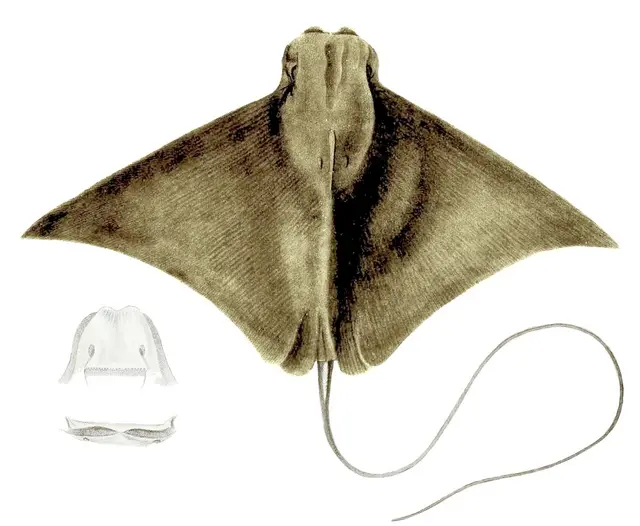
This is a medium-sized ray with a brownish-grey back. The largest recorded reach about 90 cm across the disc, and males mature at around 78 cm. Females give birth to a single pup at a time.
It is easy to mistake for the Javanese cownose ray (Rhinoptera javanica), which shares part of its range. That confusion is one reason population data are patchy. Genetic findings also hint at two closely related forms under this one name, possibly differing in head and tail shape and in how stocky the body is.
Where it lives
It was first described in 1895 from Muscat, Oman. The IUCN assessment lists more than thirty countries and territories, from Egypt, Eritrea, Somalia, Kenya, Tanzania and Mozambique, through the Red Sea and Arabian Gulf states, Iran, Pakistan, India, Sri Lanka and the Maldives, to Thailand, Indonesia, the Philippines, China, Taiwan and Japan. It may be locally extinct in Viet Nam and Cambodia.
It lives from the surface down to about 50 m, over sand and sandy mud, around coral reefs, in estuaries, lagoons and tidal mud flats, and in open water above the seabed. It often gathers in large shoals.
Pins are Wikidata “endemic to” fields. Orange dots, when present, are GBIF occurrence tiles — survey bias included.
How it lives
Little is written about its daily life. Its diet has not been described, the length of pregnancy is unknown, and nobody has worked out how old it gets. Embryos are nourished first by yolk and later by a fluid from the mother's uterus.
With one pup per litter, FishBase rates it as having low resilience to fishing, with a population doubling time of roughly 4.5 to 14 years. The IUCN estimates a generation at about 10 years, a figure borrowed from the larger American cownose ray.
Why it is in trouble
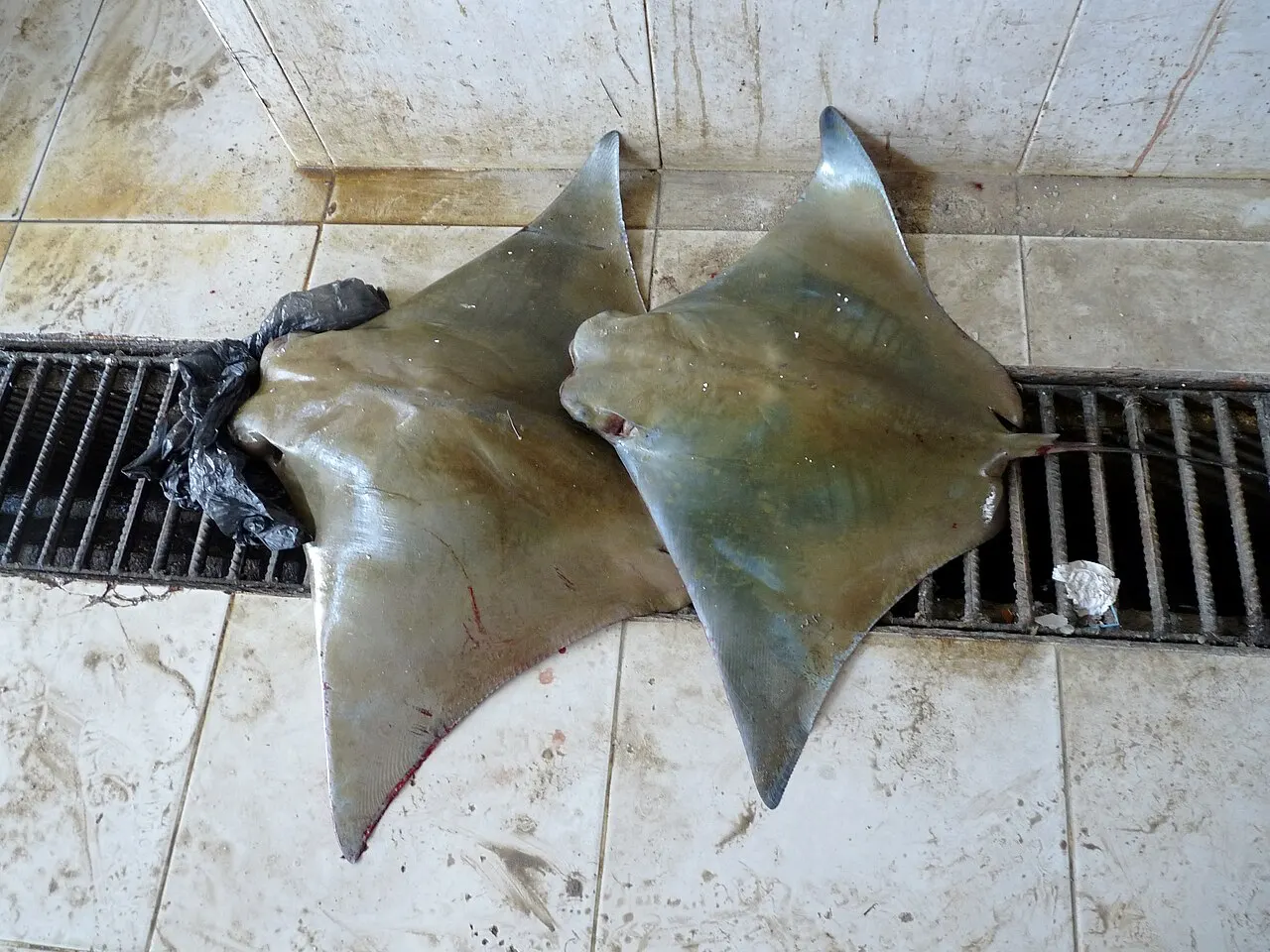
Fishing is the main problem. Across its range it is taken both on purpose and as bycatch by trawls, purse seines, gillnets, set nets, longlines and other gear. The meat is eaten fresh, salted or dried, and rays are also used for fish meal. In Pakistan the wings of adults are frozen and exported, and in India ray meat is in rising demand. In the Gulf of Oman the species has little value and is probably thrown back.
The IUCN suspects a population reduction of 50 to 79 percent over three generations (about 30 years), based on exploitation and a decline in habitat quality. Landings data from several countries imply declines of 40 to 98 percent over that period, though they are not a direct count. Urban development and agriculture have also degraded its shallow habitats. A 2019 national assessment for the United Arab Emirates rated it Vulnerable, citing serious declines in cownose ray landings in Pakistan and a suspected loss of at least 30 percent over about 30 years.
What is being done
Protection is thin. The IUCN notes that it occurs in at least one protected area, but there is no recovery plan, no systematic monitoring and no harvest management plan, and it is not covered by international trade controls. The assessment says no specific measures are in place for the species, and lists harvest and trade management, species recovery and site protection among the actions needed.
Sources
Written for this catalog in our own words from the sources below, checked against them on 12 November 2026. Population figures are estimates and carry the year they were made. Status and assessment year: IUCN. 2026. The IUCN Red List of Threatened Species. Version 2026-1. iucnredlist.org.