Endangered
Flapnose ray
Rhinoptera javanica
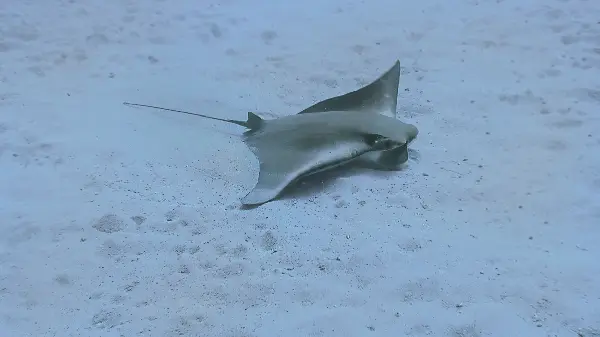
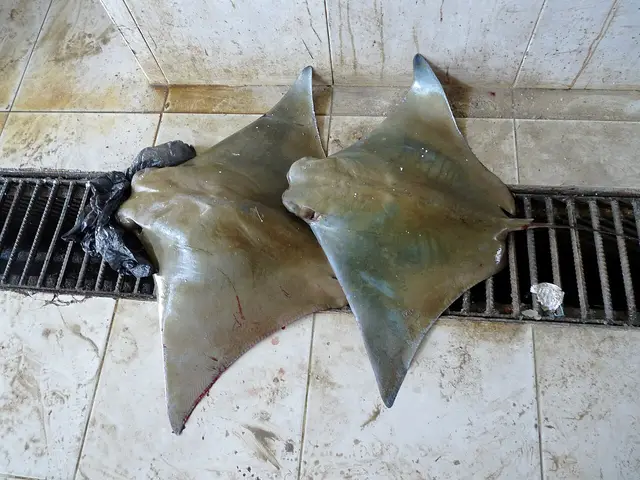
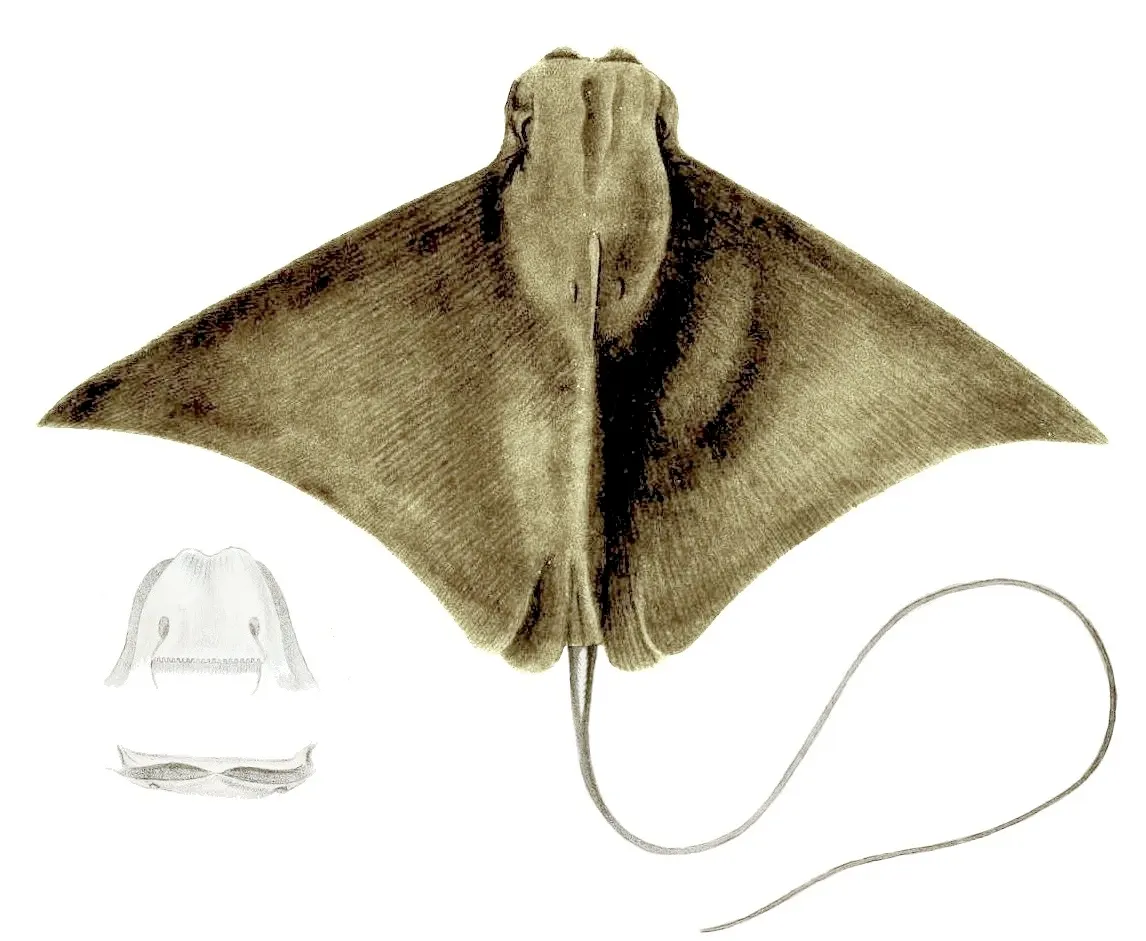
The flapnose ray, also called the Javanese cownose ray, is a large, broad-winged ray of warm Indo-Pacific coasts, from Oman to Japan. It's listed as Endangered on the IUCN Red List (assessed in 2021) because fishing has cut its numbers sharply across much of its range.
How to recognise it
This is a cownose ray, a member of the family Rhinopteridae, and it was described scientifically by Johannes Müller and Friedrich Henle in 1841. The group takes its name from the pair of lobes at the front of the head, which give the face a cow-like look. Reported disc widths reach at least 165 cm.
It is usually found over the continental shelf, often close inshore. It is harmless to people.
Where it lives
The flapnose ray ranges across the Indo-West Pacific, from Oman to the Philippines and north to Japan. The Red List records it from Oman, the United Arab Emirates, Iran, Pakistan, India, Bangladesh, Sri Lanka, Myanmar, Thailand, Cambodia, Viet Nam, Malaysia, Singapore, Brunei, Indonesia, Timor-Leste, the Philippines, China, Taiwan and Japan. Its presence in Australian waters is listed as possible rather than confirmed.
It uses bays, estuaries, coastal lagoons, seagrass beds, sandy and sandy-mud bottoms and coral reefs, and it also moves through open water. The Red List gives a depth range of 0 to 50 m.
Pins are Wikidata “endemic to” fields. Orange dots, when present, are GBIF occurrence tiles — survey bias included.
How it lives
Much of its biology is poorly known. It feeds on clams, oysters and crustaceans. Unlike the great migrating schools of some other cownose rays, it is usually found alone or in small groups, though schools of up to 500 have been reported.
Females give birth to live young after the embryos are first fed on yolk and then on uterine fluid. Litters are small, reported as one or two pups, and it is unclear whether a female breeds every year or every second year. Slow reproduction makes the species slow to bounce back. The Red List puts one generation at about 14.5 years.
Why it is in trouble
Fishing is the main problem. Flapnose rays are caught on purpose and as bycatch in trawls, purse seines, gill nets, set nets, tangle nets, longlines and other gear, and the meat is eaten or turned into fishmeal. The 2021 assessment found population declines of 50 to 79 percent in various regions over three generations (44 years). Fishing pressure is intense in Chinese and Vietnamese waters, where fish stocks have been heavily over-exploited.
Habitat loss adds pressure. In the Arabian Gulf, dredging, land reclamation, desalination plants and industry have disturbed the shallow areas the ray relies on, and cownose ray landings in Pakistan have fallen seriously. A separate national assessment for the United Arab Emirates (2019) rated it Vulnerable.
What is being done
Protection is thin. The ray occurs in at least one protected area, but the Red List records no recovery plan, no harvest management plan and no systematic monitoring scheme, and the species isn't covered by international trade controls. Harvest management, trade management and better monitoring of populations and catches are listed as needs.
Sources
Written for this catalog in our own words from the sources below, checked against them on 12 November 2026. Population figures are estimates and carry the year they were made. Status and assessment year: IUCN. 2026. The IUCN Red List of Threatened Species. Version 2026-1. iucnredlist.org.