Critically Endangered
Rhinoptera marginata
Rhinoptera marginata
The Lusitanian cownose ray (Rhinoptera marginata) is a large, diamond-shaped eagle ray of warm coastal waters off West Africa and the eastern Mediterranean. The IUCN Red List rated it Critically Endangered in 2021, estimating an 80 percent reduction in numbers, driven by fishing.
How to recognise it
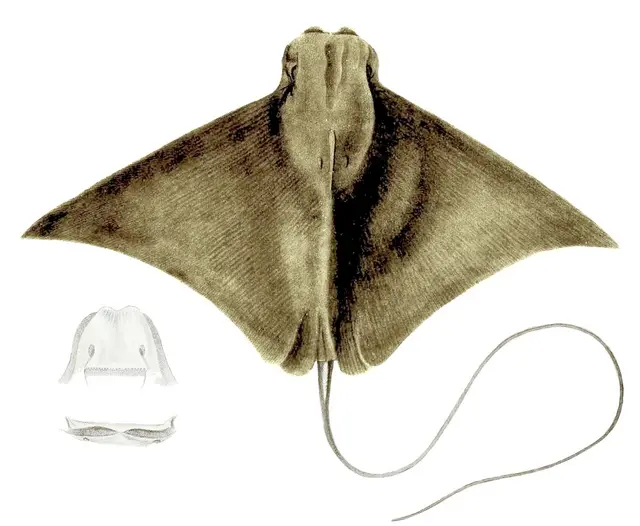
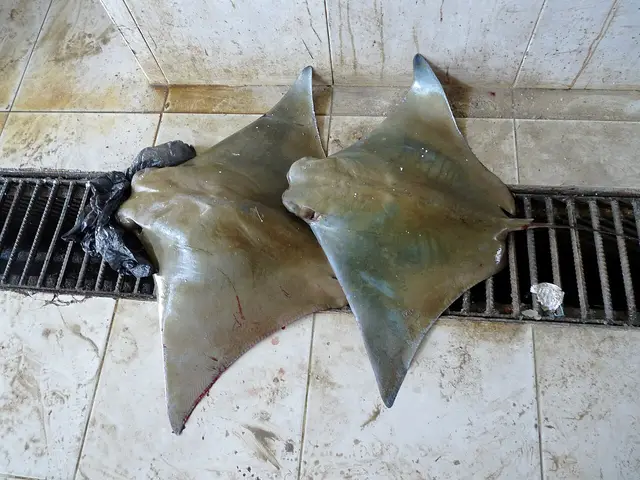
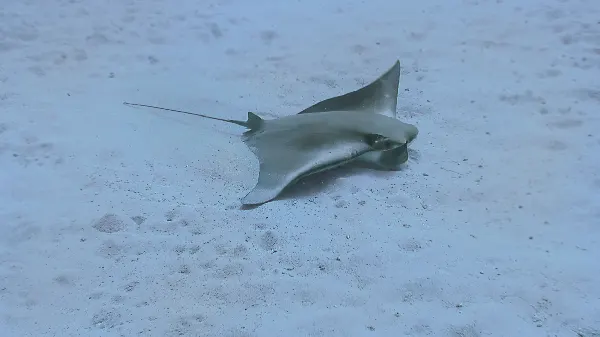
This is a medium to large ray with a diamond-shaped disc much wider than it is long. The head sticks out from the disc, with a concave front edge, and the snout is divided into two lobes.
The upper surface is brownish-green to bronze and the underside is white. The tail is slender and whip-like, with one dorsal fin and one or more spines at its base. Disc width is usually 50 to 102 cm, with a maximum of about 200 cm.
Where it lives
It ranges along the eastern Atlantic coast from southern Spain or Portugal (sources differ) south to Central Africa, and into the Mediterranean. It is reportedly common in shallow waters off western Africa. The IUCN assessment lists around 40 countries and territories, from Morocco and Mauritania through Ghana, Nigeria and Angola.
The assessment gives its habitats as open coastal water, sandy and sandy-mud bottoms and estuaries, from the surface to about 100 m. In the Mediterranean it is very rare, with single or sporadic captures in the east and apparently none in the west. Recent records include Antalya Bay, Turkey (2021) and Egypt (2020). It is considered locally extinct in the upper Tyrrhenian Sea (last recorded 1972) and the Adriatic (1948).
Pins are Wikidata “endemic to” fields. Orange dots, when present, are GBIF occurrence tiles — survey bias included.
How it lives
It feeds on bottom-living molluscs, crustaceans and fishes. It often forms large groups that swim near the surface, and it can damage commercial oyster and clam beds.
Females give birth to live young after a gestation of up to a year. Litters are small, reported as up to 6 pups, each about 23 cm across at birth. Females mature at roughly 66 to 80 cm disc width. The IUCN assessment gives a generation length of 27.5 years, so recovery is slow once numbers drop.
Why it is in trouble
Fishing is the main threat. It was once a targeted commercial species and is now mostly caught as bycatch in industrial, small-scale and subsistence fisheries, with pelagic and bottom trawls and gillnets among the gear. FishBase describes it as commercially fished but seldom marketed. The IUCN assessment estimates a population reduction of about 80 percent, based on levels of exploitation, and records that the cause has not ceased.
Coastal development and small-scale aquaculture are also listed as threats. A separate 2016 assessment of the Mediterranean alone rated it Data Deficient.
What is being done
In February 2024 the Convention on the Conservation of Migratory Species of Wild Animals, meeting in Samarkand, agreed to list the species on Appendix II. Its Mediterranean population was put on Appendix I.
At the time of the 2021 assessment there was no recovery plan, no monitoring scheme and no harvest management plan, and the species was not subject to international trade controls.
Sources
Written for this catalog in our own words from the sources below, checked against them on 12 November 2026. Population figures are estimates and carry the year they were made. Status and assessment year: IUCN. 2026. The IUCN Red List of Threatened Species. Version 2026-1. iucnredlist.org.