Critically Endangered
Rhampholeon acuminatus
Rhampholeon acuminatus
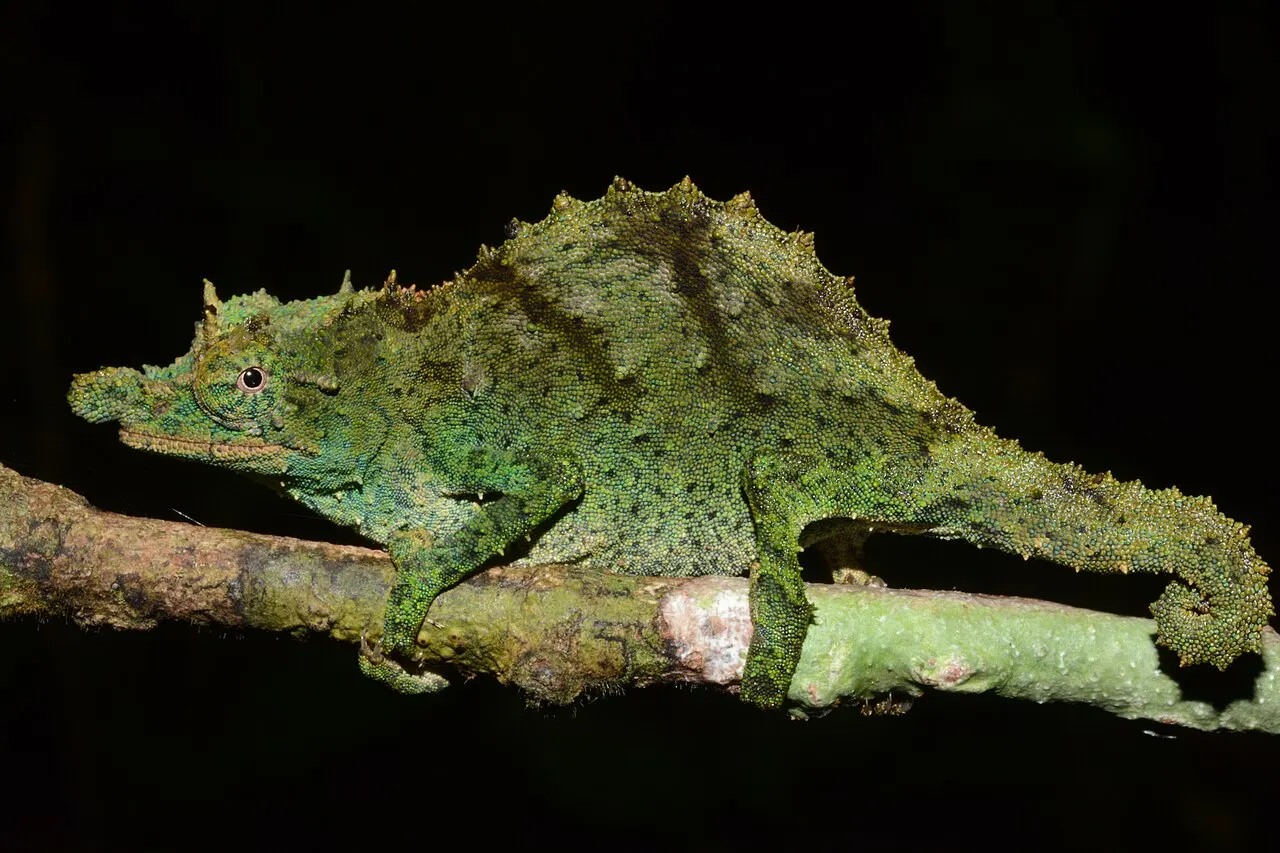
The Nguru pygmy chameleon (Rhampholeon acuminatus) is a tiny, spiny chameleon known only from the Nguru Mountains of Tanzania. Described to science in 2006, it was rated Critically Endangered by the IUCN in 2014. Farming clearances in its mountain forest and collection for the pet trade are the main concerns.
How to recognise it
This is a small chameleon. Adults measure about 47 to 57 mm from snout to vent, and the longest known total length is 82 mm, with the tail making up about 25 to 30 percent of that.
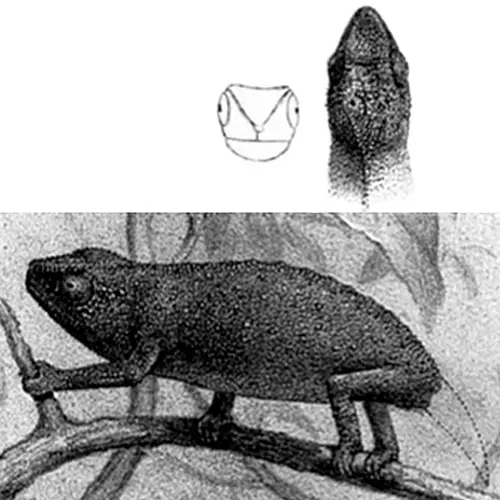
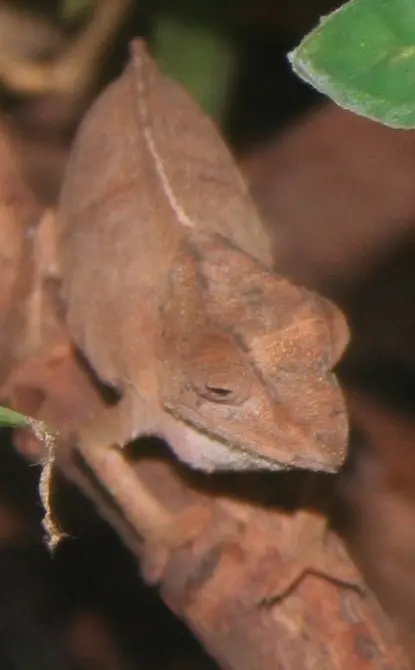
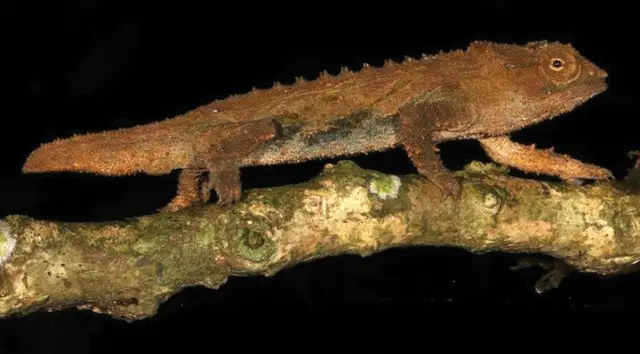
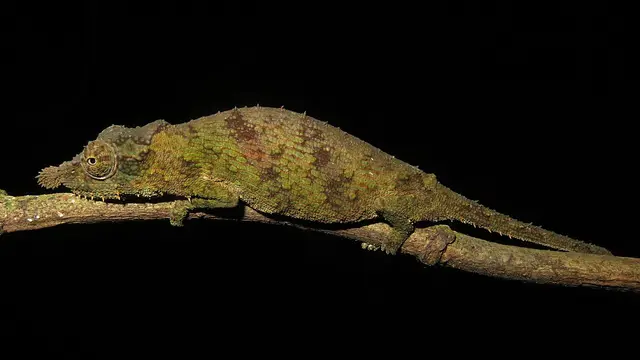
It lives up to its Latin name, which comes from a word meaning to sharpen. Spiny projections cover the head and body, there is a prominent casque and a raised crest along the back, and the snout carries a flattened, disc-shaped process. It lays eggs.
Where it lives
The species was described in 2006 by Mariaux and Tilbury, in a study of pygmy chameleons from Tanzania's Eastern Arc mountains. The type locality is Komkore Forest above Ubili village, in the Nguru South Catchment Forest Reserve in Morogoro region, at 1,500 to 1,600 m.
The Red List treats the whole population as living at a single location, in moist montane forest, with an estimated area of occupancy of 28 square kilometres and an extent of occurrence of 45 square kilometres. It lives in leaf litter on the forest floor and is sometimes found perched in low bushes. The assessment estimates that 91 to 100 percent of the population lies inside protected areas.
Pins are Wikidata “endemic to” fields. Orange dots, when present, are GBIF occurrence tiles — survey bias included.
What surveys have found
A 2025 thesis from Mbeya University of Science and Technology recorded 57 individuals in the Mkingu Nature Forest Reserve. About 88 percent were in montane forest at 1,400 m or higher, 12 percent in submontane forest between 700 and 1,400 m, and none in lowland areas. Numbers tracked elevation, canopy cover and humidity.
That is a count of animals seen, not a population estimate. The Red List gives no population size, and lists the population trend as unknown.
Why it is in trouble
The Red List names two threats across the whole range: small-holder farming, causing slow but significant declines, and intentional use of the species itself. It lists the species as used for pets or display. Because the chameleon lives on the forest floor, clearing of that floor for shade crops degrades its habitat even inside the protected forest.
Farming is the clearer pressure. A survey of five villages bordering Mkingu Nature Forest Reserve, published in the MUST Journal of Research and Development, found 88.3 percent of respondents cleared land for crops such as cardamom, cassava, beans and maize. A conservation grant page says cardamom growing has significantly reduced suitable habitat.
The pet trade looks smaller but is poorly measured. The Red List says the species is imported in limited quantities, two to three times every few years, and that the true extent of collection is uncertain. It is not listed under CITES, so international trade is unregulated.
People nearby also know little about the animal. In the village survey only a few respondents could identify it, and 97 percent said no education programme about it existed.
What is being done
As of the assessment, no recovery plan or systematic monitoring scheme existed, though the forest holds protected areas. The Red List calls for trade and harvest management, for listing the species under CITES, and for research on population size, trends, harvest and trade.
In May 2024 the Mohamed bin Zayed Species Conservation Fund awarded a grant of 4,940 US dollars to a researcher at the Nelson Mandela African Institution of Science and Technology. It is meant to produce an action plan for the species and fund education work with communities around the Nguru Mountains.
Sources
Written for this catalog in our own words from the sources below, checked against them on 12 November 2026. Population figures are estimates and carry the year they were made. Status and assessment year: IUCN. 2026. The IUCN Red List of Threatened Species. Version 2026-1. iucnredlist.org.
- IUCN Red List assessment, Rhampholeon acuminatus (2014)
- Reptile Database, Rhampholeon acuminatus
- Wikipedia, Rhampholeon acuminatus
- MUST Journal of Research and Development, village survey
- Mbeya University of Science and Technology thesis (2025)
- Mohamed bin Zayed Species Conservation Fund, Nguru spiny pygmy chameleon grant