Endangered
Mount Namuli Pygmy Chameleon
Rhampholeon tilburyi
The Mount Namuli pygmy chameleon (Rhampholeon tilburyi) is a tiny leaf-litter chameleon known only from the forests of Mount Namuli in northern Mozambique. Described in 2014, it was assessed as Critically Endangered that year and as Endangered in 2019, with a declining population and four known locations.
How to recognise it
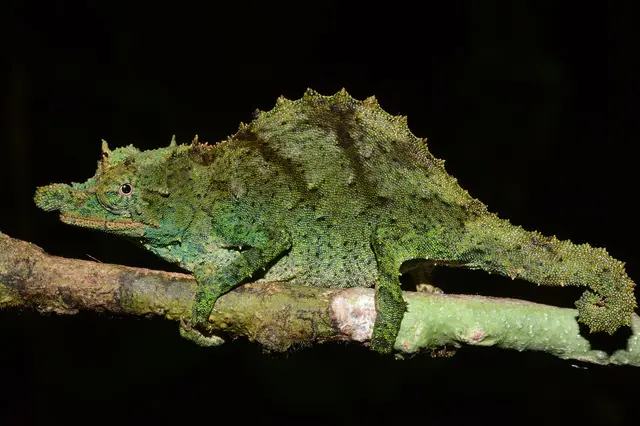
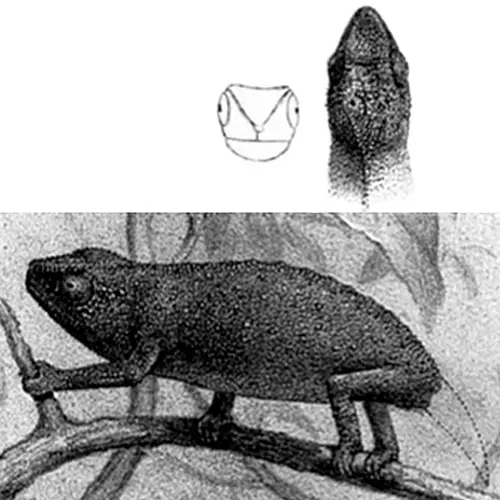
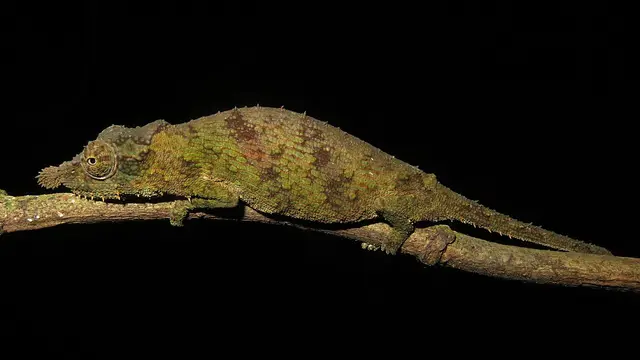
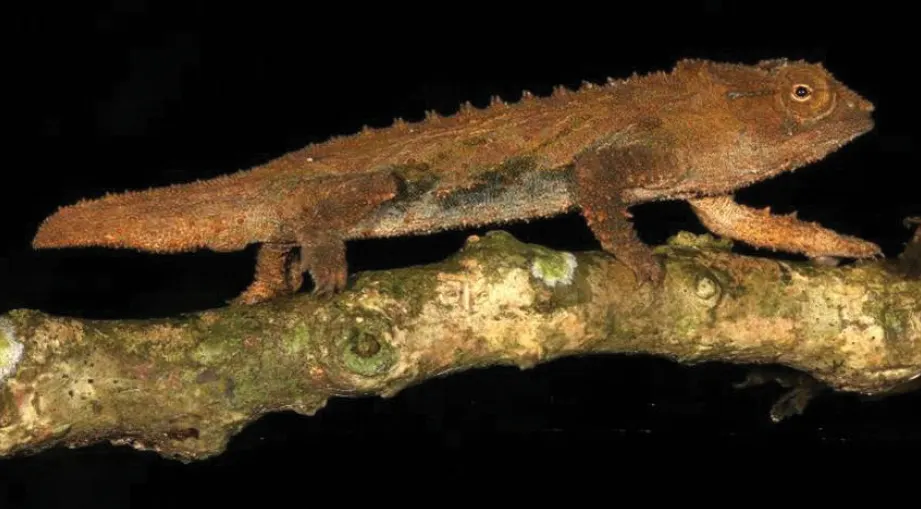
It's a small chameleon. The largest male in the original description measured 52.1 mm from snout to tail tip, while the largest female reached 70.7 mm. Females grow noticeably bigger than males, and males have a proportionately longer tail and a more sharply angled head.
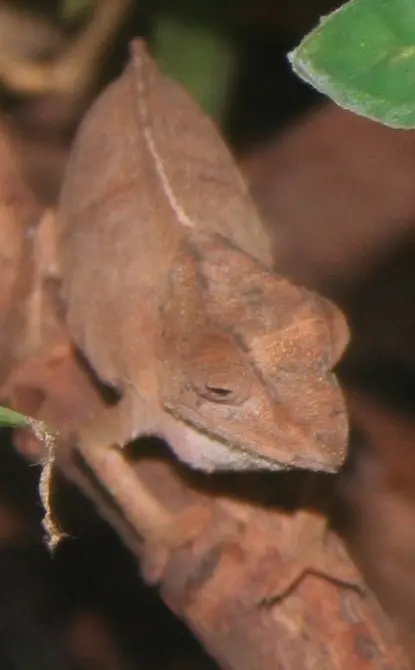
One male photographed in life was tan to brown with an orange flush along the flanks, a greenish wash over the back, two diagonal lines down the sides and an orange-red eye. Colour varies a little between animals. Adult males keep a sharply angled snout in front of the eyes, with a small knob at the tip. Compared with its close relatives, the species is smaller, has a weak crest and a narrower head.
Where it lives
It belongs to a group of pygmy chameleons on isolated mountains, or sky islands, in northern Mozambique, where each mountain has its own species. This one is found only on the Namuli massif, in Zambézia Province. The first specimen, a female, was collected by a local guide in 1998 in Ukalini Forest, at about 1,550 m. Later animals came from the Muretha Plateau (about 1,800 m) and from overgrown tea plantings near Gurué at roughly 840 m.
The IUCN assessment gives an elevation range of 817 to 1,650 m, slightly narrower than the localities in the original description, and describes the habitat as moist montane forest. Its estimated area of occupancy is 72 square kilometres.
Pins are Wikidata “endemic to” fields. Orange dots, when present, are GBIF occurrence tiles — survey bias included.
How it lives
Most animals in the original series were collected at night, perched 30 to 50 cm above the ground in forest beside a stream. Others have been found sheltering on small trees and epiphytic ferns. It lays eggs: the first female was carrying seven. Insect fragments, including beetle wing cases, were found in her stomach, and little else is known of its diet or breeding.
Why it is in trouble
A 2014 satellite estimate put the Namuli forest patch at only 13 square kilometres, and none of the forests in that study had official protection. The two biggest blocks on Namuli, Manho (about 1,000 to 1,100 hectares) and Ukalini (about 100 hectares), were being cleared for potato growing. Some chameleons live in old tea plantings that have grown wild and crept up the slopes, but the main forest is shrinking.
The 2019 Red List assessment lists large-scale farming, small-holder farming and grazing, more frequent or intense fires and unintentional harvest effects as threats. It treats the population as severely fragmented, counts four locations and records a continuing decline in the area occupied. The rating was Critically Endangered in 2014 and Endangered in 2019.
What is being done
The Red List assessment records no protected area covering the species and no conservation sites identified. It lists habitat restoration, site protection and management, resource protection and training as the actions needed.
The species came to light through expeditions organised by Julian Bayliss, a consultant for Fauna and Flora International, who said in 2014 that the high mountains of northern Mozambique were only starting to be explored and that he expected many more discoveries.
Sources
Written for this catalog in our own words from the sources below, checked against them on 12 November 2026. Population figures are estimates and carry the year they were made. Status and assessment year: IUCN. 2026. The IUCN Red List of Threatened Species. Version 2026-1. iucnredlist.org.