Endangered
Pickersgill's Reed Frog
Hyperolius pickersgilli
Pickersgill's reed frog (Hyperolius pickersgilli) is a thumbnail-sized frog from the coastal wetlands of KwaZulu-Natal, South Africa, and nowhere else. Its reed beds are being drained and built over. The IUCN Red List assessment published in 2026 lists it as Endangered, and a zoo breeding programme releases captive-bred frogs.
How to recognise it
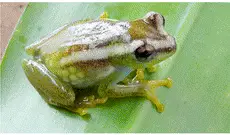
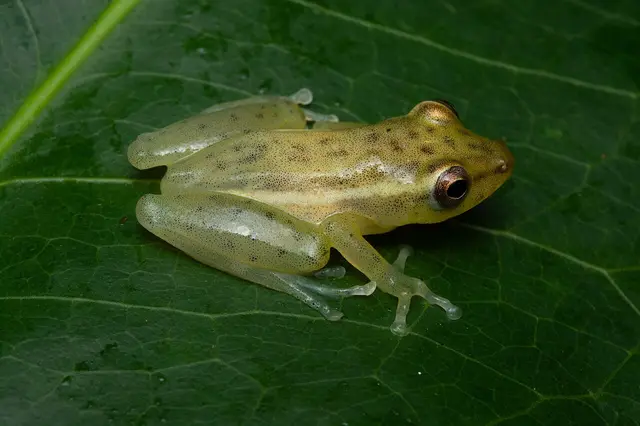
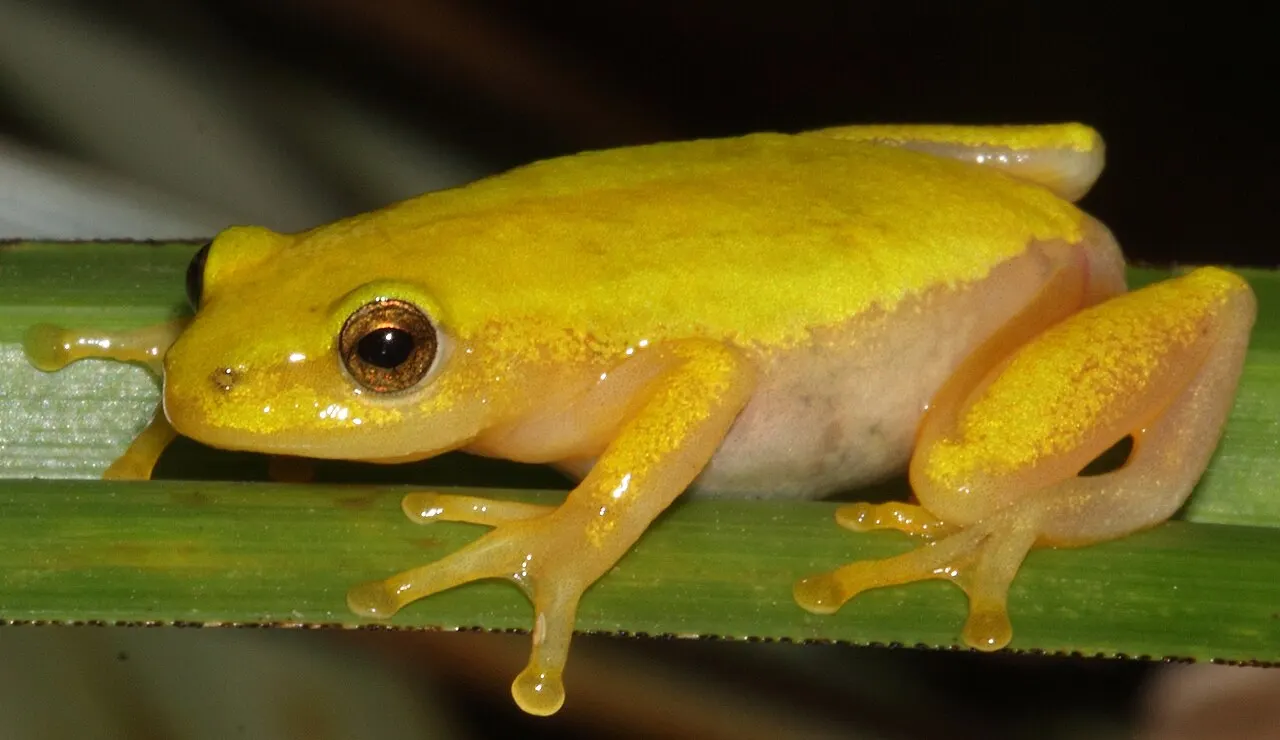
This is a small frog. Males rarely grow beyond about 22 mm from snout to vent, and females can reach roughly 30 mm. The snout is pointed, the eardrum is hidden under the skin and the toes are webbed.
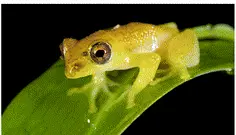
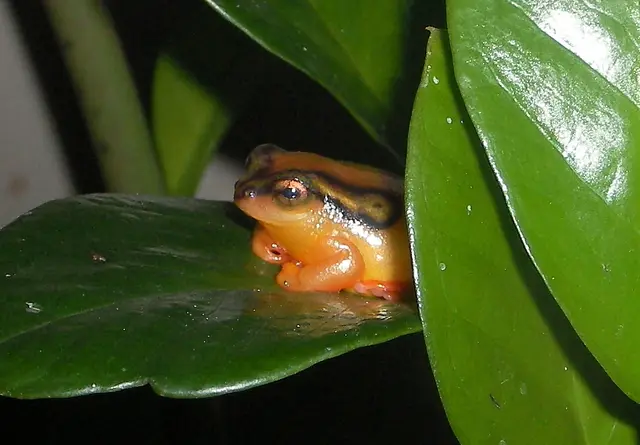
Colour depends on sex and age. Juveniles and males are light to dark brown, with a pale, dark-edged stripe running from the snout over each eye and down the flanks to the groin. Males have a yellowish throat. Females turn green once they reach about 20 to 22 mm, and the side stripes fade away.
Sound is often the only clue. The male's call is a quiet, slow creak that can pass for an insect, and the frog stays hidden in dense vegetation, so it can go undetected even where it lives.
Where it lives
The species is found only in a narrow strip of the KwaZulu-Natal coast, between Sezela in the south and St Lucia in the north. Records lie within about 16 km of the sea and no higher than 380 m above sea level.
It is fussy about habitat. It needs permanent wetlands with very dense reed beds, with deep standing water of roughly 20 to 60 cm. Males call from low, thick plants such as snakeroot, and eggs are laid on taller broad-leaved plants such as common reed, bulrush and sedges. A draft national management plan (put out for public comment in 2016) counted 21 or 22 known sites, and only two lay inside protected areas, iSimangaliso Wetland Park and Umlalazi Nature Reserve. The 2026 Red List assessment treats the range as five separate locations, with an extent of occurrence of about 7,752 square kilometres and an occupied area of just 240 square kilometres.
Pins are Wikidata “endemic to” fields. Orange dots, when present, are GBIF occurrence tiles — survey bias included.
How it lives
Males call from dusk into the early hours of the morning, and breeding happens in well-hidden vegetation. Outside the breeding season, frogs can move up to about 2 km from their breeding wetland to forage and spend the winter. How many frogs are left is unknown. The only figure in the management plan was a cautious estimate of about 2,000 adults at one pond at Mount Moreland, from call surveys between 2011 and 2014.
Why it is in trouble
The main problem is loss of wetland. Coastal KwaZulu-Natal has been heavily built up and farmed, and wetlands have been drained for housing, industry and agriculture. The site where the species was first found, at Mount Edgecombe in 1978, and its type locality at Avoca near Durban are both gone under development. Sugar cane and eucalyptus plantations removed many other sites by draining wetlands or drying them out, and alien plants and pesticide pollution add to the pressure.
The Red List assessment gives the population trend as decreasing. It lists agro-industry farming, mining and quarrying, plantations, housing, roads, sewage and water abstraction among the threats, with mining the one scored as a medium impact. Because the remaining populations are small and isolated, frogs struggle to move between wetlands. An early genetic study from 2015 found good gene flow and high diversity between populations so far, though more sampling was needed.
What is being done
A national Biodiversity Management Plan for the species was drafted and published for public comment in June 2016. Its aim is to protect key habitats, work with private landowners, clear alien vegetation and, in the long run, improve the frog's status to Least Concern.
Johannesburg Zoo began a breeding programme in January 2012 with 30 frogs from two sites. In 2017 the zoo, with Ezemvelo KZN Wildlife, collected 20 more breeders from one site. About 200 captive-bred frogs were released in Mount Moreland and Prospecton in September 2018, the first release of its kind in South Africa, and about 50 more at River Horse Valley, eThekwini, in March 2019. The zoo says roughly 800 captive-bred frogs have been released so far, including 400 in 2020.
Sources
Written for this catalog in our own words from the sources below, checked against them on 12 November 2026. Population figures are estimates and carry the year they were made. Status and assessment year: IUCN. 2026. The IUCN Red List of Threatened Species. Version 2026-1. iucnredlist.org.