Critically Endangered
Hyperolius tanneri
Hyperolius tanneri
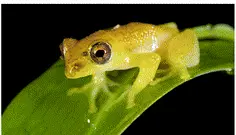
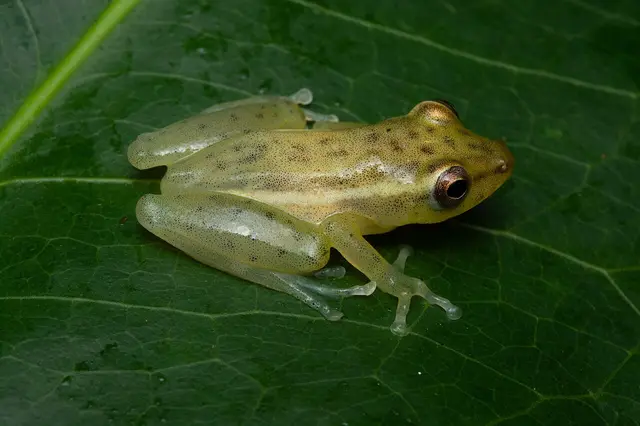
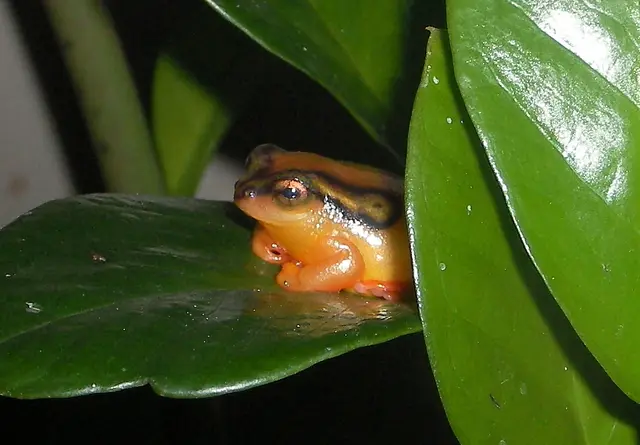
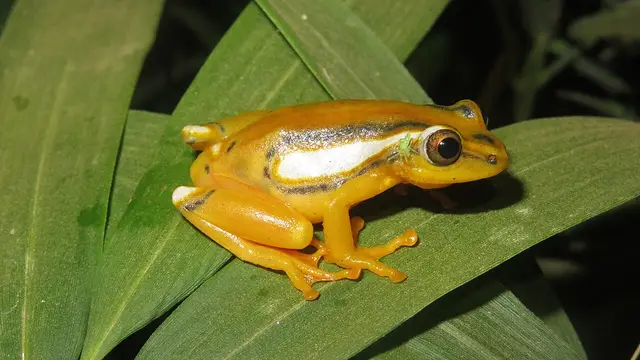
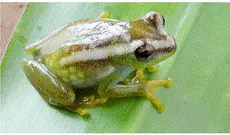
Tanner's reed frog (Hyperolius tanneri) is a small green frog found only in the West Usambara Mountains of northeastern Tanzania. It lives in a tiny patch of montane forest and swamp. The IUCN Red List rated it Critically Endangered in 2015, with a decreasing population.
How to recognise it
Males are about 20 to 23 mm long and females about 29 to 34 mm. The back is green with pale stripes along the sides, the fingers and toes are yellow, and the throat and belly are blue-green. Males have a large, smooth flap of skin on the throat.
It looks like the related spiny reed frog (Hyperolius spinigularis) but lacks that frog's black throat and belly spines.
A name with a tea estate in it
Arne Schiotz described the species in 1982. The name honours John and Lucie Tanner, who owned a tea estate at Mazumbai, where the frog was first found, and welcomed visiting zoologists. A later respelling of the name to tannerorum is considered unjustified, so the original spelling stands.
Where it lives
The IUCN records two sites within a single threat-defined location: one near the Mazumbai Forest Reserve at 1,410 m and one in the Shume-Magambo Forest Reserve at 1,920 m. Despite searches, it has been found nowhere else in the area. The assessment estimates its overall range at 56 square kilometres and the area it actually occupies at 5.
It is known only from undisturbed montane forest. The IUCN also lists swamps and permanent streams as habitat, and describes the frog as not migratory.
The only known breeding site is a small forest swamp beside a stream at Mazumbai, where the frog is thought to reproduce by larval development. A similar swamp exists at Shume-Magambo. The IUCN says the frog is not difficult to find at either site.
Pins are Wikidata “endemic to” fields. Orange dots, when present, are GBIF occurrence tiles — survey bias included.
Why it is in trouble
The 2015 assessment records a decreasing trend, assumed from ongoing habitat loss, and a continuing decline in the area the frog uses. It says forest in the West Usambaras is being lost to agricultural expansion, logging and spreading human settlement. The threats scored in the structured record, both ongoing, are small-holder farming and housing.
With so few sites, the loss of one swamp could remove a large share of the population. No population size is published.
What is being done
The IUCN lists resource and habitat protection as the action needed. The frog occurs in or near the Mazumbai and Shume-Magambo Forest Reserves, but the assessment says more habitat protection is needed, especially outside the reserves, and that further surveys are necessary to understand its population and range.
Sources
Written for this catalog in our own words from the sources below, checked against them on 12 November 2026. Population figures are estimates and carry the year they were made. Status and assessment year: IUCN. 2026. The IUCN Red List of Threatened Species. Version 2026-1. iucnredlist.org.