Critically Endangered
Davenport's Reed Frog
Hyperolius davenporti
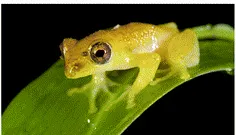
Davenport's reed frog (Hyperolius davenporti) is a tiny frog known from a single forest reserve in the Livingstone Mountains of southern Tanzania. It was only described in 2015, and the IUCN Red List rated it Critically Endangered in 2016. Unusually for its genus, it has small black spines on its underside.
How to recognise it
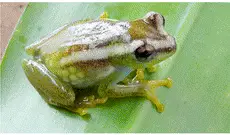
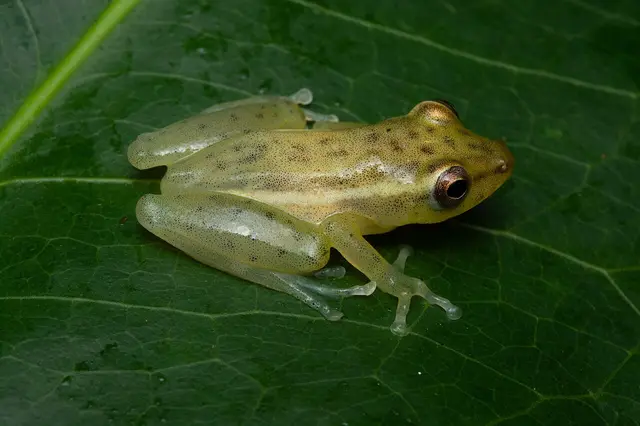
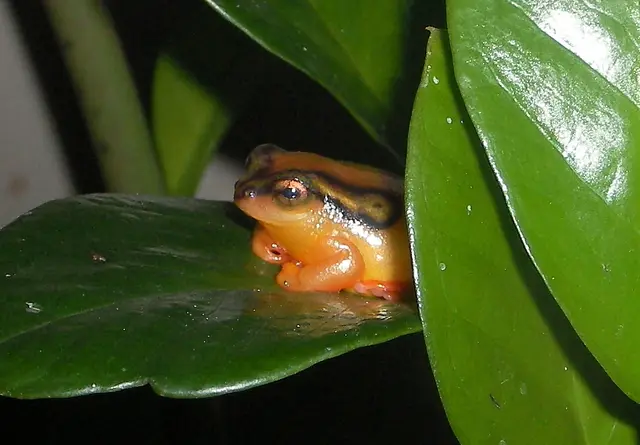
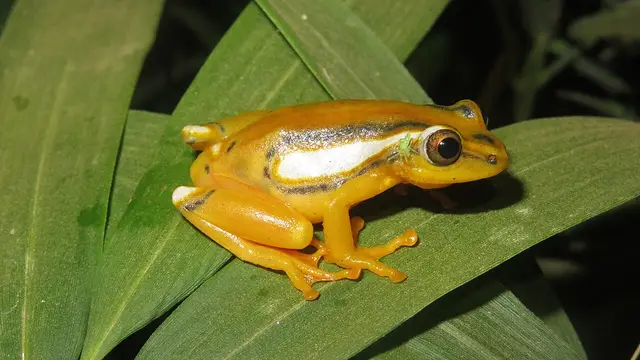
This is a very small frog. In the original description, ten males averaged 18.9 mm from snout to the end of the body, and two females averaged 27.0 mm. Most specimens are brown on the back, sometimes mottled dark brown, with white stripes edged in darker brown along the sides. The underside is a pale cream.
The standout feature is on the belly. The holotype has black skin spines (small hard points) on the chin, throat, belly and undersides of the thighs, about 50 of them on the throat flap. The describers call spines on the underside unique among reed frogs of the genus Hyperolius. The throat flap also lacks the double lobe seen in the related Hyperolius spinigularis, which helps separate the two.
Where it lives
The species is endemic to Tanzania. All known animals come from Sakara Nyumo Forest Reserve in the Livingstone Mountains, in the Southern Highlands, at about 2,010 m above sea level. The IUCN counts one location and an extent of occurrence of 28 square km.
The frogs were collected in shallow ponds at the forest edge, in a large swampy area, and were not found in open ground. The IUCN lists montane moist forest and inland marshes and swamps as its habitat.
Pins are Wikidata “endemic to” fields. Orange dots, when present, are GBIF occurrence tiles — survey bias included.
How it lives
Very little is known. The survey that found the frog lasted only five days, with the first specimen collected on 14 January 2011. No advertisement or territorial calls were heard or recorded, and the 2015 description does not describe tadpoles. One young frog was collected that had not finished changing from tadpole to adult. Breeding has not been studied.
Why it is in trouble
With one site and a small range, the species has little room for error. The IUCN assessment, published in 2016, records the population as decreasing and the area it occupies as still shrinking. It lists small-holder farming, shifting agriculture, housing and urban areas, and unintended effects of small-scale harvesting as ongoing threats.
The 2015 description notes that the Livingstone Mountains hold a number of fragmented forest patches where the frog might also occur, but it is known only from the one reserve and more sampling is needed. No population count exists.
What is being done
The IUCN notes that the frog occurs in at least one protected area, and lists site protection and habitat protection as the conservation actions recorded. No species-specific recovery programme or monitoring scheme is documented in the sources available.
Sources
Written for this catalog in our own words from the sources below, checked against them on 12 November 2026. Population figures are estimates and carry the year they were made. Status and assessment year: IUCN. 2026. The IUCN Red List of Threatened Species. Version 2026-1. iucnredlist.org.