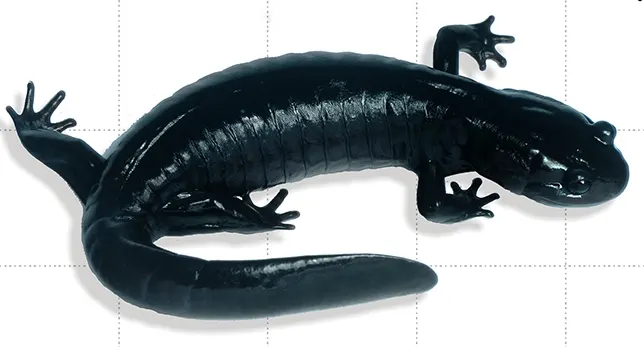
Endangered
Odaigahara salamander
Hynobius boulengeri
The Odaigahara salamander (Hynobius boulengeri) is a stream salamander found only in the forested mountains of Japan's Kii Peninsula, on Honshu. The IUCN Red List lists it as Endangered (assessed 2021) because its range is small, fragmented and shrinking.
How to recognise it
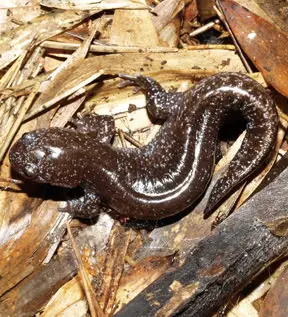
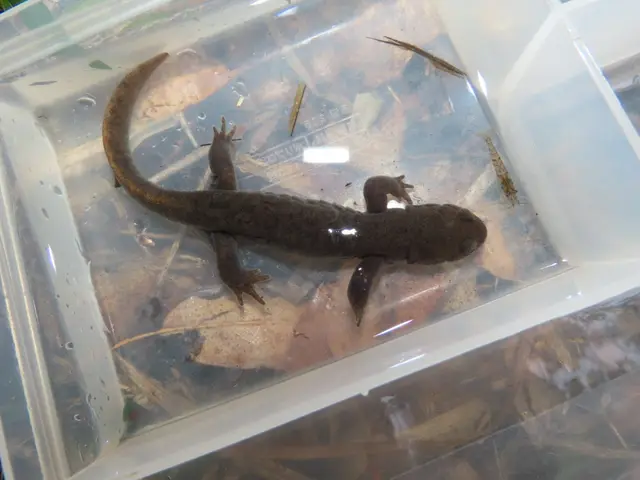
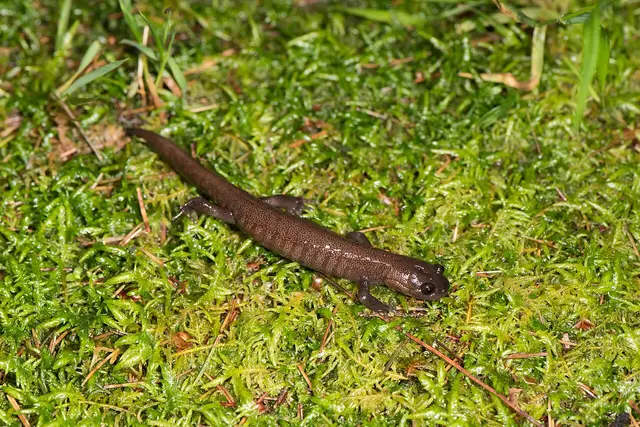
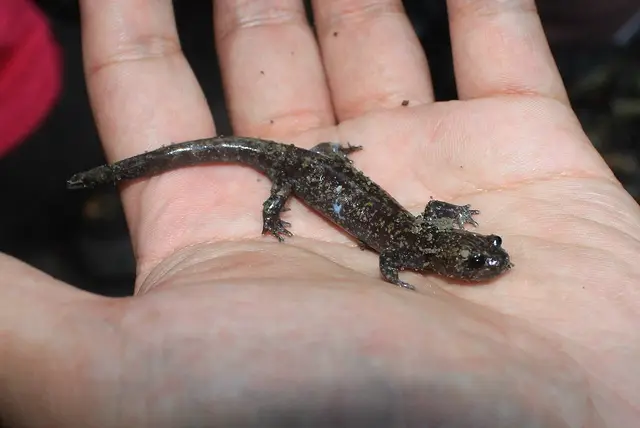
This is a fairly large, unmarked salamander. Adults measure roughly 14 to 20 centimetres in total length, and the tail is flattened from side to side. Descriptions of the colour differ: a Japanese encyclopedia entry says slate grey, while the Mie forest office calls it a deep bluish purple.
The larvae look quite different. They are translucent and greyish, and they blend in with the rocks of the stream bed. Its type locality is Mount Odaigahara, and it was first described in 1912 by Thompson under a different genus, Pachypalaminus.
Where it lives
It lives in valleys of the Kii mountains in Nara, Mie and Wakayama prefectures, from about 150 to 1,700 metres above sea level. The IUCN puts the extent of its range at roughly 3,244 square kilometres and treats the population as severely fragmented.
Older field guides stretched its range to Shikoku and Kyushu. Those populations have since been split off. The Shikoku salamander (Hynobius hirosei) was restored as a separate species in 2007, and three Kyushu forms were described as new species in 2014, which leaves the Kii Peninsula as the home of the true Odaigahara salamander.
Pins are Wikidata “endemic to” fields. Orange dots, when present, are GBIF occurrence tiles — survey bias included.
How it lives
It needs both streams and forest. Larvae live under stones in mountain streams that never dry up, and they metamorphose after somewhere between six months and two years. Adults leave the water and live in leaf litter and under fallen logs nearby, so a stream with no surrounding forest isn't enough.
Breeding reportedly starts in February at low altitudes and as late as May higher up. A clutch is said to hold about 19 to 63 eggs. In a Mie forest office stream survey, first-year larvae averaged 3 to 4 centimetres long and about half a gram.
Why it is in trouble
The IUCN records a decreasing population and a continuing decline in the area of habitat. A Japanese encyclopedia entry names plantation forestry and tourism development as problems for upland populations, and erosion-control dams and logging as damage to breeding streams lower down. The IUCN lists roads as a low-impact threat and dams as a threat of unknown size.
Collection is rated low impact, but the IUCN records the species as used in the national and international pet and display trade. Warming is another worry for an animal that prefers cool streams, since its range is expected to shrink as temperatures rise. Japan's Ministry of the Environment rates it Vulnerable, and Mie Prefecture has listed it as Vulnerable since December 2006.
What is being done
Mie Prefecture designated the salamander a natural monument on 15 December 1958, without tying the designation to a specific area. Each July, staff from prefectural offices and the national forest agency survey the Osugidani National Forest in Mie; the 2016 outing was the eighth since 2009. In a roughly 90 minute search that year, 18 participants found nine young larvae and one subadult, and no adults.
The IUCN lists site protection, harvest and trade management, and policy measures as the actions needed.
Sources
Written for this catalog in our own words from the sources below, checked against them on 12 November 2026. Population figures are estimates and carry the year they were made. Status and assessment year: IUCN. 2026. The IUCN Red List of Threatened Species. Version 2026-1. iucnredlist.org.