Endangered
Abe's Salamander
Hynobius abei
Abe's salamander (Hynobius abei) is a small, stocky salamander found only in a few pockets of western Honshu, Japan. The IUCN Red List rated it Endangered in 2021. It breeds in cold forest pools in early winter, and its remaining populations are small and scattered.
How to recognise it
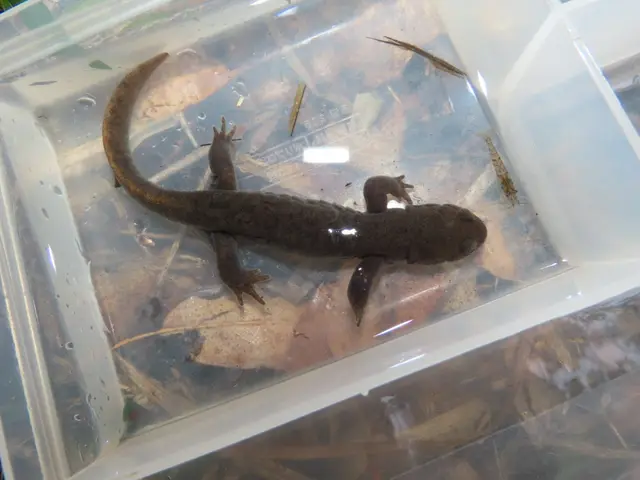
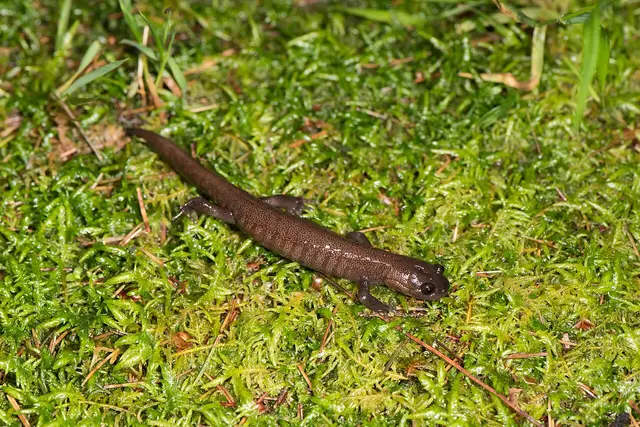
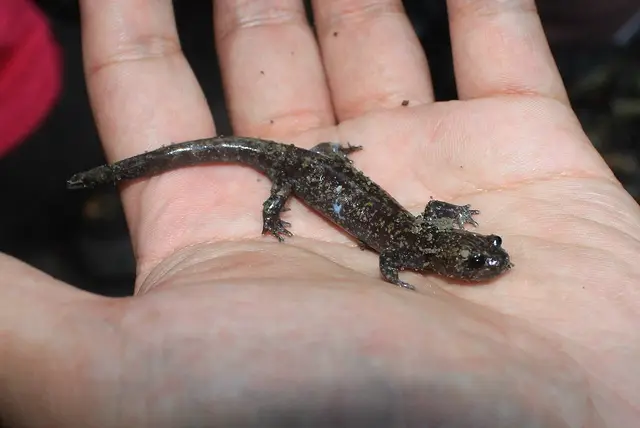
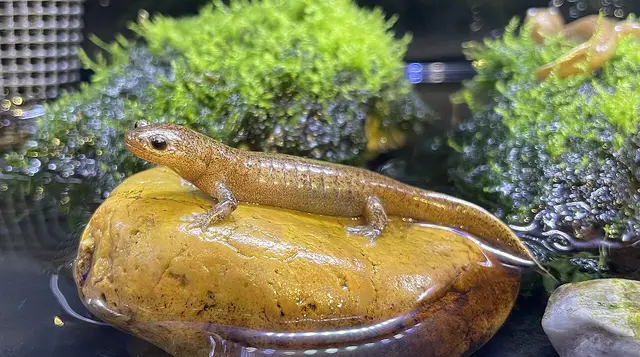
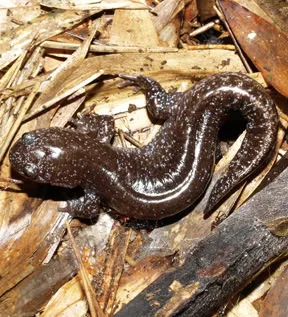
Adults are 47 to 71 mm from snout to vent and 82 to 122 mm in total, with a thick body, short limbs and 11 to 13 grooves along each flank. The back is reddish brown to dark brown, with small pale spots on the sides and legs.
Breeding males change shape. The tail becomes tall and flattened like a fin, and the jowls swell until the head looks somewhat triangular.
Where it lives
The species is endemic to Japan. It was described in 1934, and the type locality lies in what is now Kyotango, Kyoto Prefecture. It is known from Fukui, Kyoto and Hyogo prefectures, with later finds in Ishikawa (new sites there in 2004).
It lives in secondary broad-leaved forest, bamboo stands and woodland edges, from about 34 to 920 m above sea level. The IUCN counts only three locations and describes the population as severely fragmented.
Pins are Wikidata “endemic to” fields. Orange dots, when present, are GBIF occurrence tiles — survey bias included.
How it lives
Breeding starts in November and December, around the time snow begins to fall. Females lay a pair of egg sacs holding 26 to 109 eggs in total, tucked under leaf litter in shaded pools, ditches and springs. Eggs hatch in about February, and larvae grow slowly through winter before speeding up after the thaw.
Most larvae transform in mid-summer, though some overwinter and transform later. Males usually start breeding at about 4 years old and females at about 6. Adults eat spiders and earthworms, and the larvae eat small invertebrates and sometimes each other.
Why it is in trouble
Every known population is small. Farmland, roads, housing, ski resorts and golf courses have taken or cut up its forest, and one population was wiped out by road construction. Illegal dumping and collection for the pet trade add to the pressure.
Introduced American crayfish eat the larvae, and raccoons prey on adults. In Ishikawa the adult population was estimated at 200 or fewer for 2004 to 2008. Japan's national Red List reportedly rates the species Critically Endangered.
What is being done
Japan designated it a national endangered wild species in 1995, and Kyoto Prefecture protects the species and its type locality as a natural monument. Habitat protection zones were created in Kyotango in 2006 and in Toyooka. The Toyooka zone was revoked in 2018 and later re-designated with a larger boundary. At least one population lives inside a protected area.
Sources
Written for this catalog in our own words from the sources below, checked against them on 12 November 2026. Population figures are estimates and carry the year they were made. Status and assessment year: IUCN. 2026. The IUCN Red List of Threatened Species. Version 2026-1. iucnredlist.org.