Endangered
Lakamora rainbowfish
Melanotaenia lakamora
The Lakamora rainbowfish is a small, colourful freshwater fish from two lakes in the forested hills of southern West Papua, Indonesia. Males are mauve with orange stripes and red fins. The IUCN Red List classed it as Endangered in 2020, mainly because it lives in just two locations.
How to recognise it
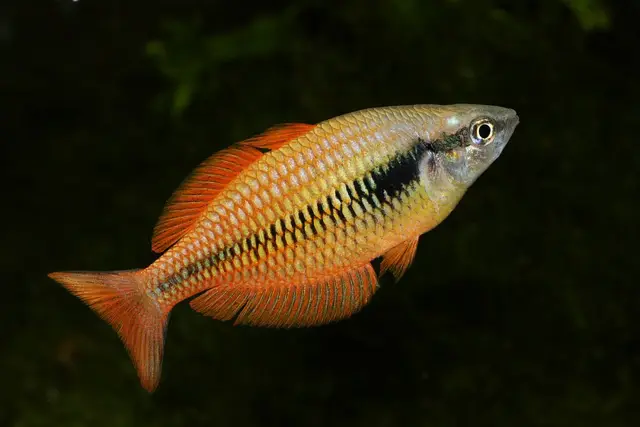
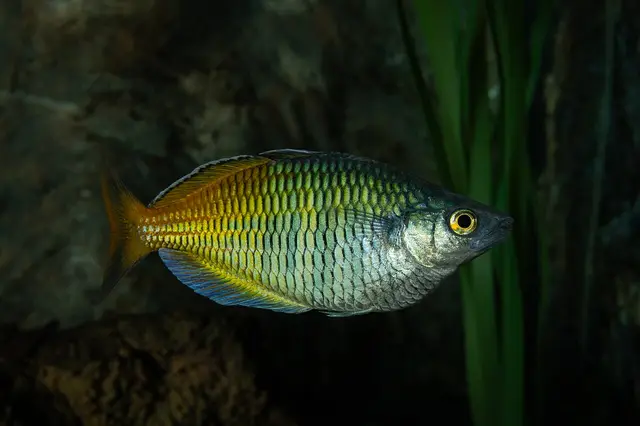
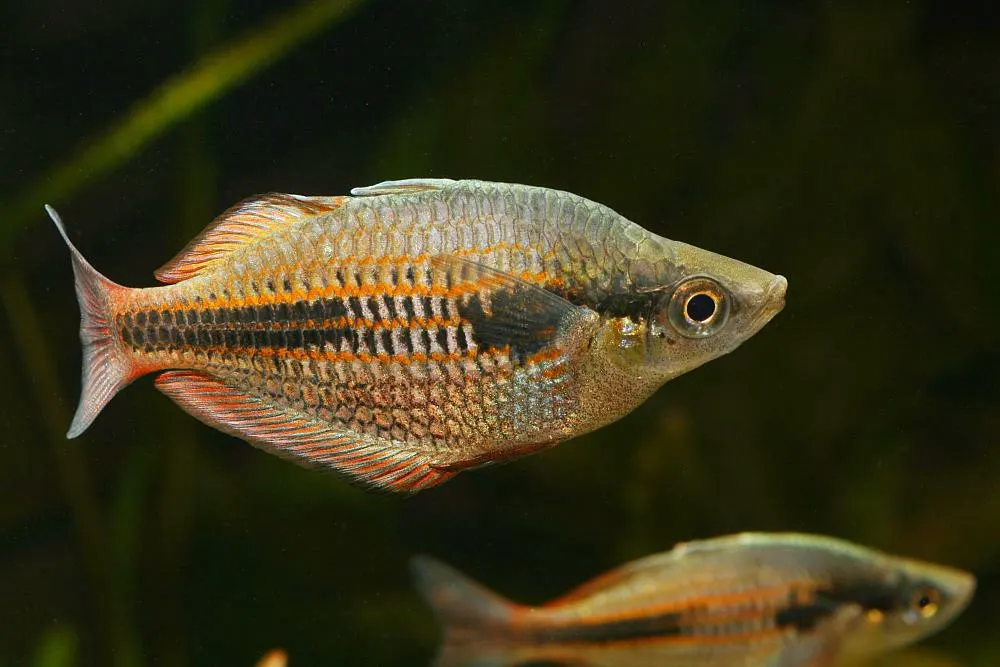
This is a small fish, reaching about 5.5 to 6 cm. Adult males are mostly mauve, with silvery white on the breast and lower head. Four rows of scales along the middle of the body are separated by bright orange stripes, and a broad blackish to dark blue stripe runs along each flank. The dorsal and anal fins are bright red.
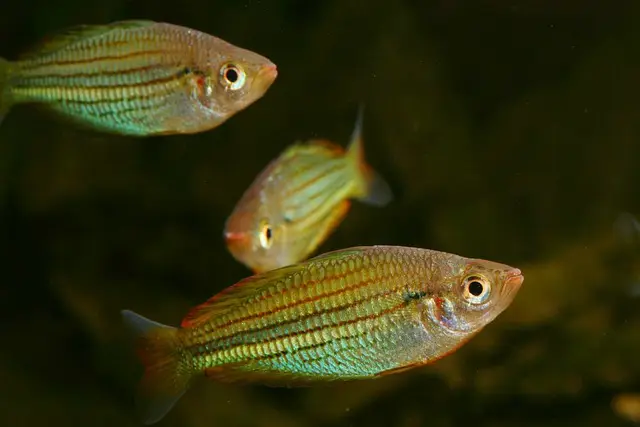
Spawning males flush an intense red and show a white to pale blue stripe on the forehead. Females are plainer, bronze above and whitish below, with a narrow dark stripe and mostly clear fins. Males also have longer, more drawn-out dorsal fin rays.
Where it lives
The species is known only from Lake Lakamora and the neighbouring Lake Aiwaso, in the south of West Papua (formerly Irian Jaya). Both lakes sit just inland from Triton Bay, east of the Bomberai Peninsula and about 50 km east of the town of Kaimana. Steep forested hills surround them.
Lakamora is a long lake, roughly 6 to 7 km from end to end and 1 to 3 km wide. Aiwaso is roughly circular, about 2.5 km across, and sits a few hundred metres away behind a ridge about 100 m high. With a third lake, Kamakawaiar, they are known as the Triton Lakes. The Red List counts two locations for the fish, puts its extent of occurrence at 155 square km and lists permanent freshwater lakes as its habitat.
Pins are Wikidata “endemic to” fields. Orange dots, when present, are GBIF occurrence tiles — survey bias included.
Why it is in trouble
The Red List ties the fish's Endangered status to its tiny range. The one threat it records is habitat shifting and alteration, ongoing across the whole species, with its severity listed as unknown. The population trend is recorded as stable, and no population size has been estimated.
How the lakes are changing has not been documented in detail. Even so, a species confined to two lakes is vulnerable, because a single event in either lake could affect a large share of the whole population.
What is being done
Site or area protection is the one conservation action listed in the assessment. The fish was first formally described in 1996 by Gerald Allen and S. J. Renyaan, in a paper that named three new rainbowfishes from the Triton Lakes. The aquarium collector Heiko Bleher gathered live specimens from Lake Lakamora in 1995.
Sources
Written for this catalog in our own words from the sources below, checked against them on 12 November 2026. Population figures are estimates and carry the year they were made. Status and assessment year: IUCN. 2026. The IUCN Red List of Threatened Species. Version 2026-1. iucnredlist.org.