Endangered
Bosemani Rainbow
Melanotaenia boesemani
Boeseman's rainbowfish (Melanotaenia boesemani) is a bright orange and blue fish found only in the Ayamaru Lakes and their streams on the Bird's Head Peninsula of West Papua, Indonesia. Popular with aquarium keepers, it was rated Endangered by the IUCN in 2020 after heavy collecting and habitat change.
How to recognise it
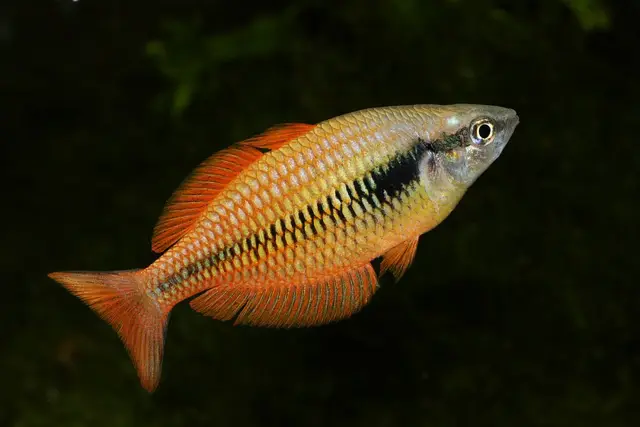
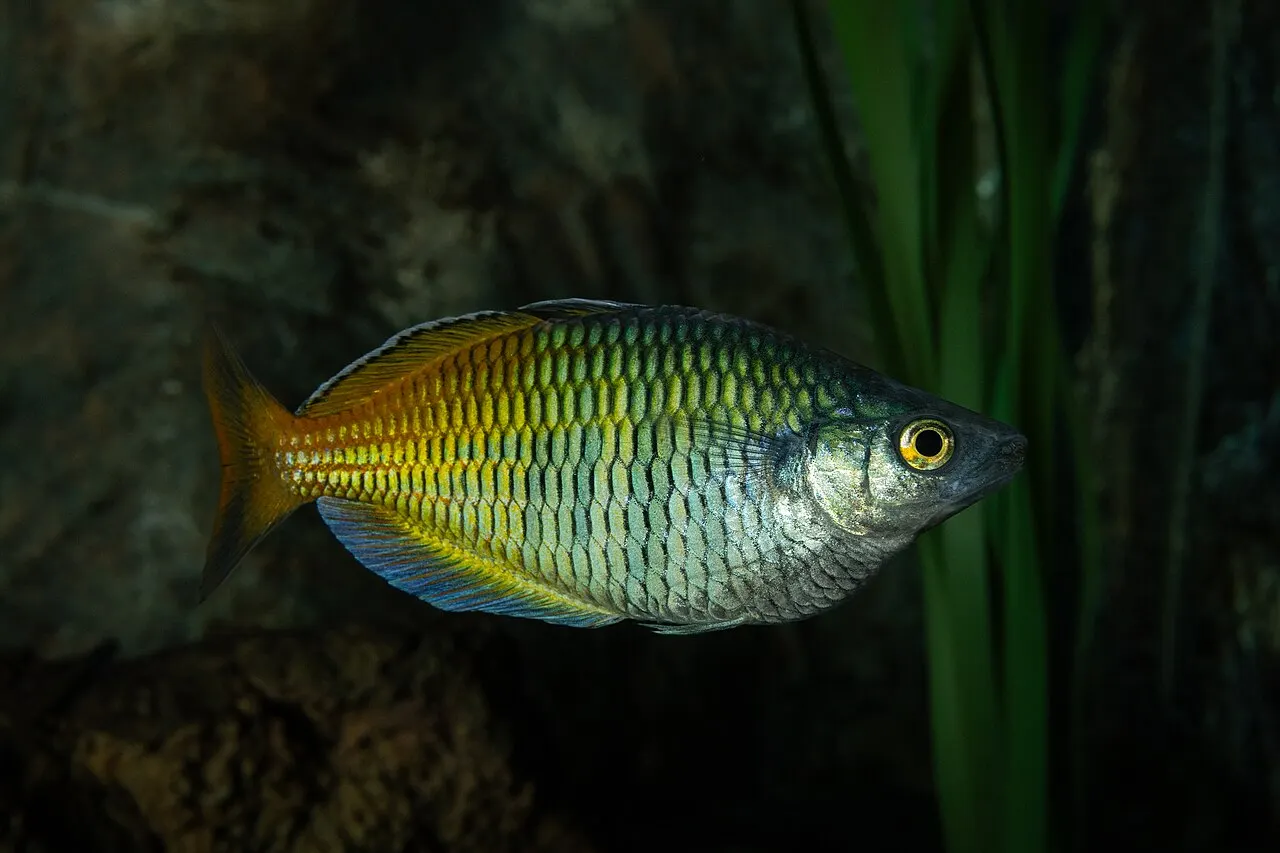
The front half of the body is bluish-grey to purple, while the rear half is orange-red, and in some fish the two zones meet in a nearly sharp line. The colours shift in intensity and are often more vivid at night.
Aquarium fish that are well fed often pass 10 cm in length. The species was described in 1980 by Allen and Cross and named after the Dutch ichthyologist Marinus Boeseman, who collected the type specimens.
Where it lives
It's restricted to the Ayamaru Lakes (sometimes spelled Ajamaru), Uter Lake and the streams that feed them, in the mountainous interior of the Bird's Head. The IUCN counts just two locations and an extent of occurrence of about 480 square kilometres, and lists permanent lakes and streams as its habitat.
Pins are Wikidata “endemic to” fields. Orange dots, when present, are GBIF occurrence tiles — survey bias included.
How it lives
It's an omnivore that will eat most foods offered but prefers meatier items. In aquariums it typically lives 5 to 8 years depending on water temperature, and some keepers report 13 to 15. It has a friendly temperament and does best in groups with at least as many females as males.
Why it is in trouble
Collecting for the aquarium trade hit the wild population hard. A hobbyist writer in Amazonas magazine (2014), citing a 2004 source, put the take at an estimated 60,000 males a month for Jakarta exporters by 1989, and also says up to a million fish a year have been caught, without a date. Villagers who worked in the trade about three decades earlier said they were paid about 1,000 rupiah per male.
The IUCN assessment names competing and predatory species and habitat alteration, and codes the small-scale harvest as a past threat unlikely to return. The Amazonas writer described a predatory Channa fish said to have been brought from Java about four years before, common carp in the lakes, and logging and a new government road around the shore.
What is being done
The Amazonas writer says Indonesia placed some controls on the trade, without detail. The IUCN lists site protection as a relevant action but records no conservation measures in place. A local project, Save Ayamaru Lakes, aims at education and a community-backed conservation law.
Farms around Jakarta now raise the fish for the trade. A 2015 study in Tropical Conservation Science compared fish from six farms with wild populations and found similar genetic diversity, so no major inbreeding. Farmers did report duller males and slower growth, which the researchers suspected came from poor water quality rather than genetics.
Sources
Written for this catalog in our own words from the sources below, checked against them on 12 November 2026. Population figures are estimates and carry the year they were made. Status and assessment year: IUCN. 2026. The IUCN Red List of Threatened Species. Version 2026-1. iucnredlist.org.