Endangered
Fly River rainbowfish
Melanotaenia sexlineata
The Fly River rainbowfish (Melanotaenia sexlineata) is a small, striped freshwater fish known from forest creeks around the upper Fly River in Papua New Guinea. The IUCN rated it Endangered in 2020, after earlier assessments of Vulnerable and Data Deficient. It is also popular among aquarists.
How to recognise it
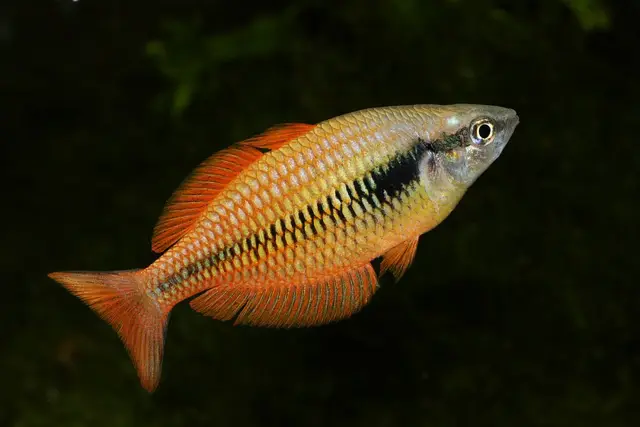
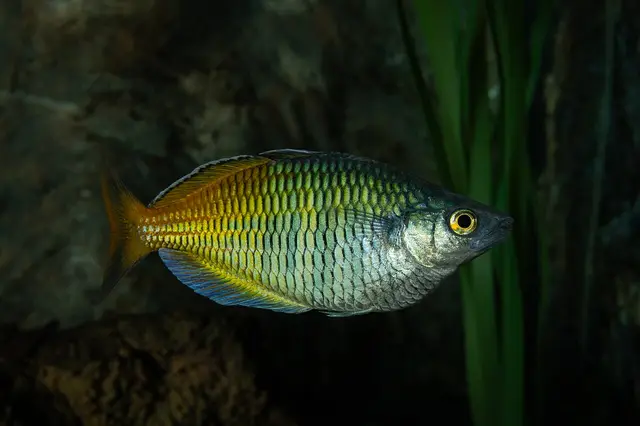
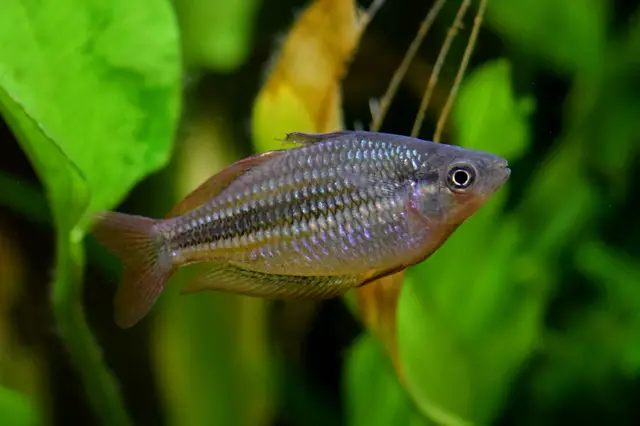
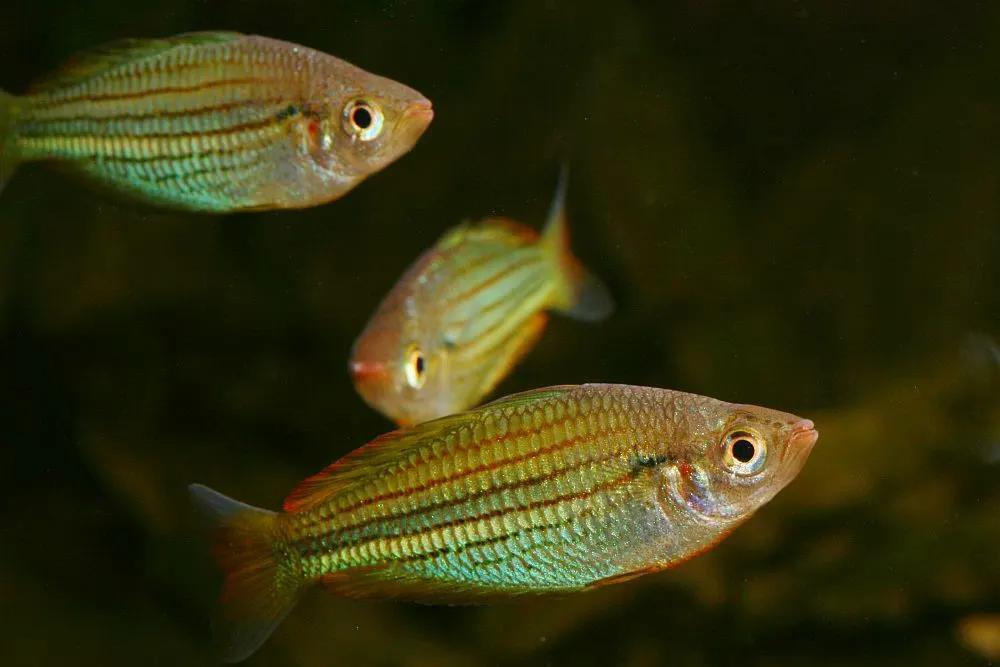
A lemon-green body crossed by five to eight narrow black stripes, with a darker band along the middle of the flank, marks this species. It's deeper-bodied than the related Papuan rainbowfish (Melanotaenia papuae) and the Maccullochi rainbowfish (Melanotaenia maccullochi). Males often have red lips, and females look like a muted version of the male.
It stays small. The largest reported length is about 8 cm, and most are under 7 cm. The species name means six-lined, for the six well-defined dark lines along the body.
Where it lives
The fish is known only from the Fly River system in Papua New Guinea, and most specimens come from creeks just north of Kiunga along the Kiunga to Tabubil road. The full range is unknown. The IUCN estimates its extent of occurrence at about 1,500 square km, with 2 to 5 locations, at no more than about 200 m elevation.
Its home is small, shallow forest creeks with clear, tea-coloured water. Water at some collecting sites measured pH 6.1 to 7.4 and about 25 C. Some creeks shrink to pools in the dry season until the rains return.
Pins are Wikidata “endemic to” fields. Orange dots, when present, are GBIF occurrence tiles — survey bias included.
How it lives
It is an omnivore and an egg layer. In aquariums, males display to females and drive them over fine-leaved plants, and spawning continues over days or weeks, with a few eggs released at a time. Eggs hatch in roughly 8 to 10 days at aquarium temperatures. It eats both plant and animal food, and little else has been written about its behaviour in the wild.
A confused history
Stuart Campbell collected the first specimens in 1937 from a tributary of the upper Fly. Ian Munro described the species in 1964, and Gerald Allen moved it to Melanotaenia in 1980. Allen brought live fish from the upper Fly to Australia in 1982, where they were bred and passed on, and Heiko Bleher collected others and took them to Europe in the early 1980s.
Names have been tangled. Fish from the Port Moresby district, including some type specimens, were later recognised as the Papuan rainbowfish, and some Lake Bosset fish were Maccullochi rainbowfish. A 2005 survey by the Ok Tedi Mining Company found it at four sites on the middle and upper Fly.
Why it is in trouble
The 2020 assessment judged the population to be decreasing, with the area it occupies still shrinking. It lists housing and urban development as affecting most of its range, and mining and quarrying as affecting a smaller part. It also lists an unspecified species as a threat, with competition and direct mortality among the effects. The other effects it names are conversion and degradation of the creek ecosystems.
The IUCN records no conservation actions in place.
Sources
Written for this catalog in our own words from the sources below, checked against them on 12 November 2026. Population figures are estimates and carry the year they were made. Status and assessment year: IUCN. 2026. The IUCN Red List of Threatened Species. Version 2026-1. iucnredlist.org.