Endangered
Lithophyllon concinna
Lithophyllon concinna
Lithophyllon concinna is a mushroom coral, a free-living, disc-shaped stony coral of Indo-Pacific reefs, reaching about 17 cm across. Once rated Least Concern, it was reassessed as Endangered in 2024 because warming seas and coral bleaching are expected to cut its numbers sharply by 2050.
How to recognise it
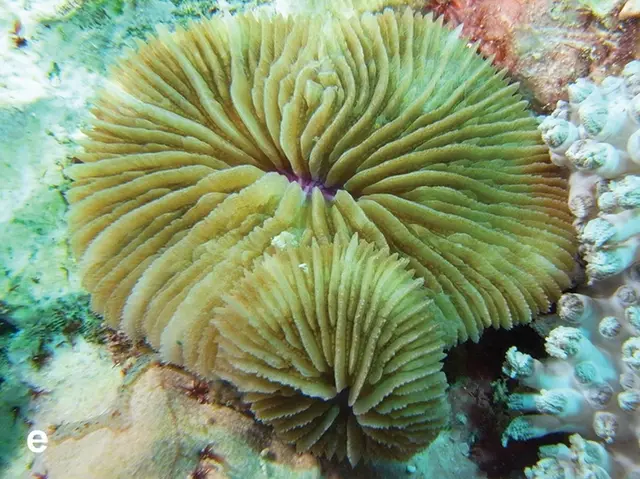
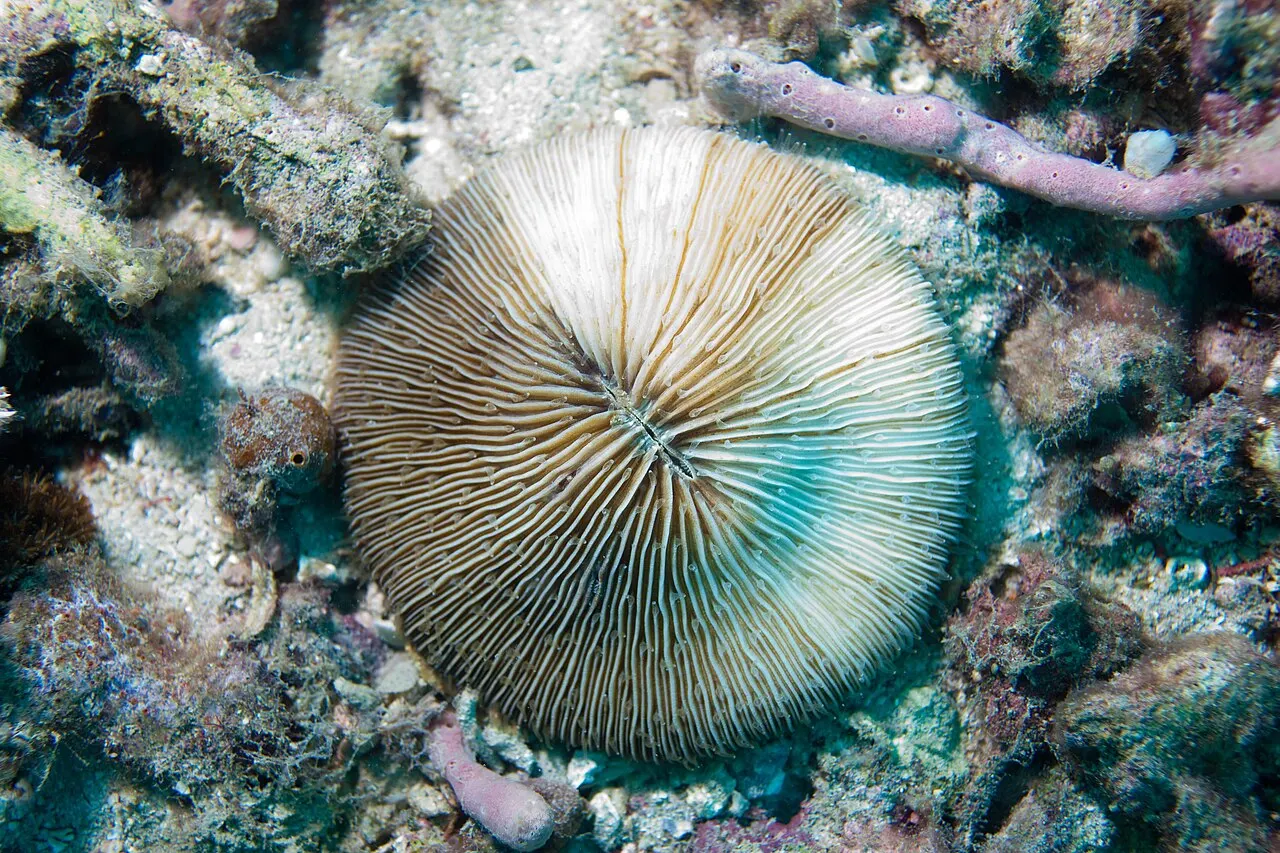
This is a solitary coral, not a colony. A single polyp sits on a flat, rounded skeleton that grows to about 16 or 17 cm across, depending on the source. It looks like an upturned mushroom cap lying on the reef.
The species was long known as Fungia concinna, and that name still turns up in aquarium listings. Other older names, including Fungia serrulata and Verrillofungia concinna, are now synonyms. Hobby sites call it mushroom coral or disk coral.
Where it lives
It is a coral of tropical reefs. The IUCN describes a range from the Red Sea, Gulf of Aden and western Indian Ocean through the central Indo-Pacific to northern, western and eastern Australia, southern Japan, the South and East China Seas, and the Hawaiian Islands and Johnston Atoll. Its range list includes Kenya, Madagascar, Oman, Indonesia, the Philippines, Palau, Fiji and French Polynesia.
Its recorded depth range is 1 to 52 m, but it is mostly found between 2 and 30 m. The IUCN describes it as living on reef slopes. Hobby sources add that it prefers sandy or rubble bottoms.
Pins are Wikidata “endemic to” fields. Orange dots, when present, are GBIF occurrence tiles — survey bias included.
How it lives
Adults of this species are free-living, meaning they are not fixed to the reef and can move over the bottom. Algae living in the coral's tissue supply most of its food, and aquarium guides say small meaty foods can be added. In mushroom corals generally, the single polyp comes out to feed at night.
The IUCN infers a generation length of about 10 years from the coral's size and growth rate. It calls the species common, though global population data for it are limited.
Why it is in trouble
The IUCN judges the species highly susceptible to bleaching. In one study almost half of the individuals were bleached, and it was hit hard again after the 2010 bleaching event in the South Andaman Islands. Coral reefs worldwide are expected to face severe bleaching every year as seas warm.
Using bleaching projections, the IUCN suspects a decline of at least 62 percent over the next three generations, by 2050. That projection is the basis for the Endangered listing under criterion A3c in 2024. Over the past three generations the suspected decline was under 25 percent, and the species was rated Least Concern in 2008 and 2014. Other pressures include coastal development, tourism, shipping, sedimentation and storms.
What is being done
Parts of its range overlap marine protected areas. All stony corals are listed on CITES Appendix II, which regulates international trade. The IUCN recommends further research on population, trends and ecology, new and expanded protected areas, recovery management, and artificial propagation and gamete freezing as possible tools for coral conservation.
The IUCN records it as not known whether the species occurs in a protected area.
Sources
Written for this catalog in our own words from the sources below, checked against them on 12 November 2026. Population figures are estimates and carry the year they were made. Status and assessment year: IUCN. 2026. The IUCN Red List of Threatened Species. Version 2026-1. iucnredlist.org.