Endangered
Ukwiva Reed Frog
Hyperolius ukwiva
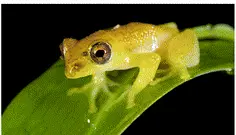
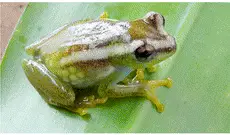
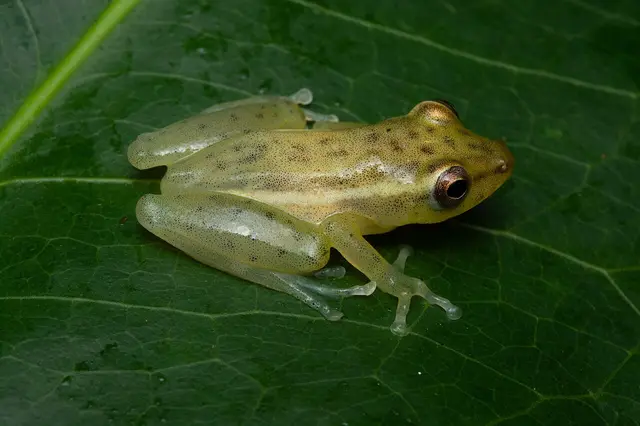
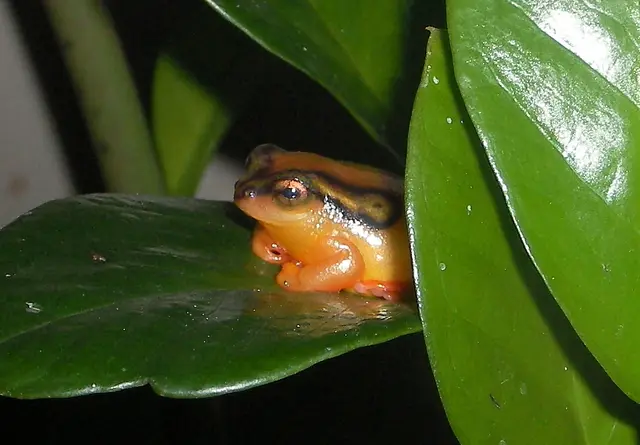
The Ukwiva reed frog (Hyperolius ukwiva) is a small, brown-and-yellow frog known only from the Ukwiva Forest Reserve in the Rubeho Mountains of Tanzania. Scientists described it in 2015 from three animals, and the IUCN rated it Endangered in 2016. Males have a throat flap with tiny spine-like bumps.
How to recognise it
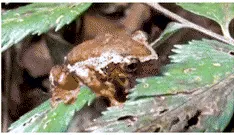
This is a modest-sized reed frog with a horizontal pupil and fingers and toes that end in rounded, fleshy discs. Field notes on the three animals collected describe a brown back with two pale grey-brown stripes running from the nose to the hind legs, and a yellow belly.
It belongs to the spiny-throated group of reed frogs. In males the throat forms a flap that is bilobed and wider than it is tall, with tiny spine-like bumps concentrated toward the front and middle. Females are the larger sex, growing past 25 mm. The female holotype measured 28 mm in body length.
Where it lives
The species is known from one place, the Ukwiva Forest Reserve in the Rubeho Mountains, part of Tanzania's Eastern Arc chain. The type specimens were collected at about 2,060 m on 5 and 6 November 2006, in and around the edge of montane forest.
The reserve covers 54,635 hectares and holds the Rubeho range's largest block of evergreen montane forest on the eastern slopes. Surveys across the mountains have been fairly extensive, so the frog's tiny range may be real and not just a gap in sampling. The Red List treats it as a single location with an extent of occurrence of about 1,179 square kilometres, mapped to the montane grassland and forest mosaic. It lists montane forest, high-altitude grassland and inland wetlands as habitats.
Pins are Wikidata “endemic to” fields. Orange dots, when present, are GBIF occurrence tiles — survey bias included.
How it lives
Very little is known. No calls were detected or recorded when the type series was collected, and only one of the three frogs was a male, so its advertisement call has not been described. The IUCN presumes that it breeds through larval development in shallow, temporary swamps, and lists it as not a migrant.
Why it is in trouble
The 2016 Red List assessment (criteria B1ab(iii)) records an ongoing decline in habitat area and a decreasing population trend. The threats it lists are small-holder farming and shifting agriculture, taking of surface water for farms and homes, housing development, and unintentional harm from small-scale harvesting. The text adds wetland drainage for arable land, fire used to maintain pasture, and wood extraction.
Because the whole species sits in one reserve, any one problem there could affect all of it.
What is being done
The frog occurs in the Ukwiva Forest Reserve, which the assessment says gives it relatively good protection despite ongoing use of forest resources. The species is likely to depend on that protection for survival. The assessment names habitat protection and site protection as needed actions and calls for research on its population size, distribution, trends and ecology. No species-specific programme is recorded.
Sources
Written for this catalog in our own words from the sources below, checked against them on 12 November 2026. Population figures are estimates and carry the year they were made. Status and assessment year: IUCN. 2026. The IUCN Red List of Threatened Species. Version 2026-1. iucnredlist.org.