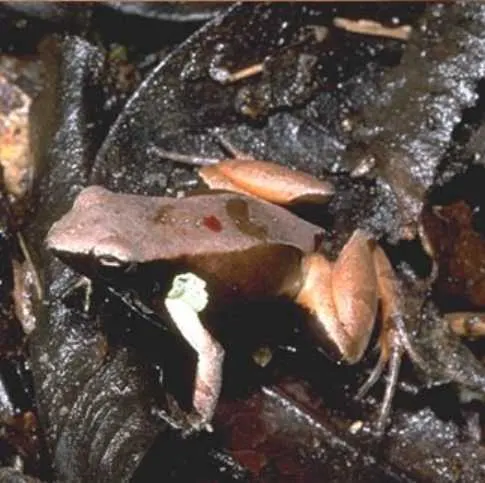
Endangered
Haraldmeier's mantella
Mantella haraldmeieri
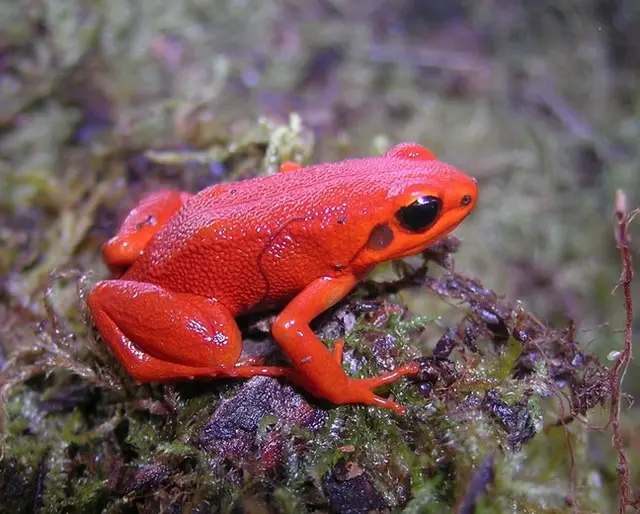
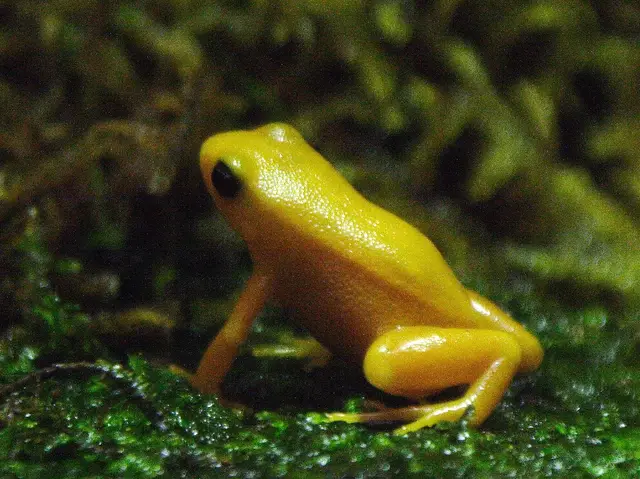
Haraldmeier's mantella (Mantella haraldmeieri), also called the Tolagnaro golden frog, is a small poison frog found only in south-eastern Madagascar. It lives in rainforest and along streams at middle elevations. The IUCN Red List assessed it as Endangered in 2016, with a decreasing population and a shrinking forest range.
What it is
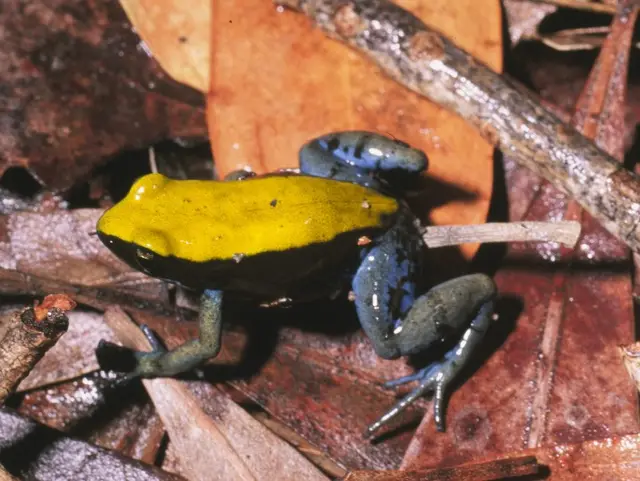
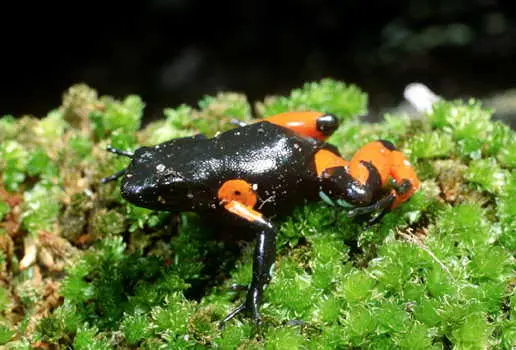
Mantellas are small, day-active frogs that build up alkaloids in their skin and wear bright warning colours. The genus lives only in Madagascar, and its members measure roughly 18 to 31 mm from snout to vent. A 2009 Zootaxa paper on mantella tadpoles lists Haraldmeier's mantella in the Mantella cowani group, alongside M. cowani, M. baroni and M. nigricans, based on earlier molecular studies.
Busse described it in 1981 as a subspecies of the Madagascan mantella, Mantella madagascariensis. It is now treated as a full species, and the IUCN lists the old name as a synonym.
Where it lives
The IUCN gives Madagascar as its only country. It records the frog at between one and five locations, at elevations of about 300 to 950 m, across an estimated extent of occurrence of roughly 3,400 square kilometres. It occurs in at least one protected area.
Its habitats are moist lowland forest and permanent streams and rivers. The population hasn't been counted, but the IUCN judges it to be decreasing and the area it occupies to be shrinking.
Pins are Wikidata “endemic to” fields. Orange dots, when present, are GBIF occurrence tiles — survey bias included.
How it lives
Very little is recorded. The 2009 Zootaxa paper notes that tadpoles of the species in the cowani group, this one included, had never been found in the wild, even where adult frogs were calling. Captive mantellas of the group do go through a tadpole stage.
Why it is in trouble
Forest loss is the central problem. The 2016 assessment lists small-scale grazing, small-scale farming, shifting agriculture and housing as ongoing threats, each rated low impact. The stresses it records are ecosystem conversion and degradation, plus some direct mortality.
The Red List rating has worsened. The species was Vulnerable in 2004 and 2008, then moved to Endangered in 2016.
Trade and protection
Mantellas as a genus are highly priced in the pet trade, and large numbers are exported from Madagascar each year, according to the 2009 paper. How much of that trade involves this species isn't stated. Mantella species as a group are listed on CITES Appendix II, and the IUCN records Haraldmeier's mantella as subject to international trade controls. No species-specific recovery programme is documented.
Sources
Written for this catalog in our own words from the sources below, checked against them on 12 November 2026. Population figures are estimates and carry the year they were made. Status and assessment year: IUCN. 2026. The IUCN Red List of Threatened Species. Version 2026-1. iucnredlist.org.