Endangered
Golden mantella
Mantella aurantiaca
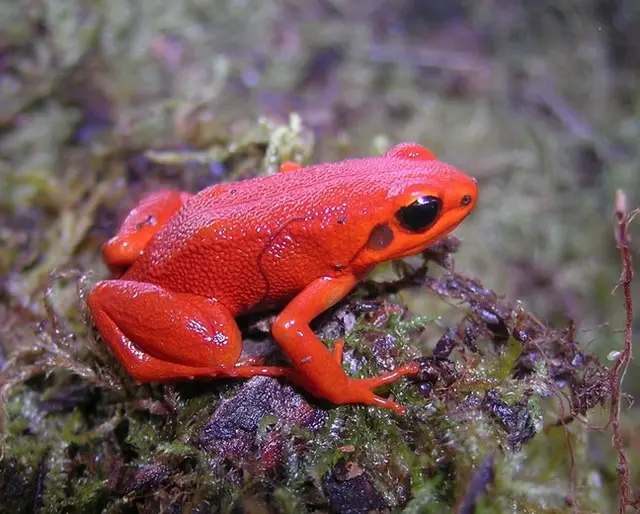
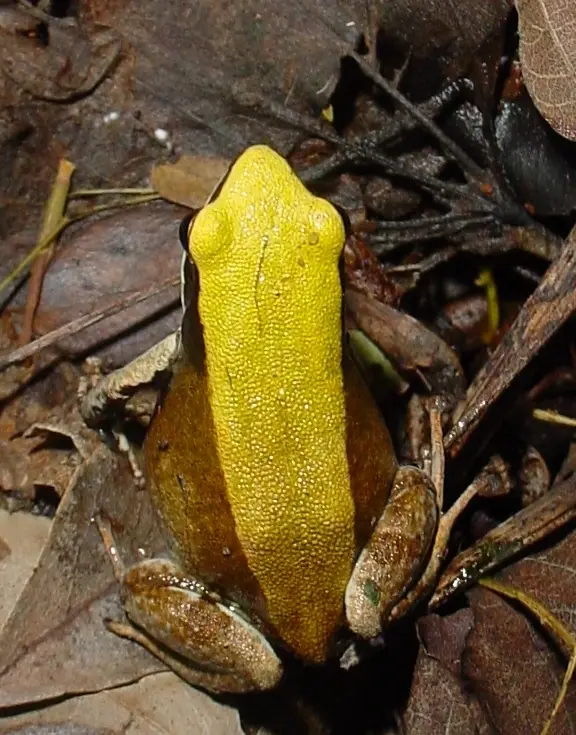
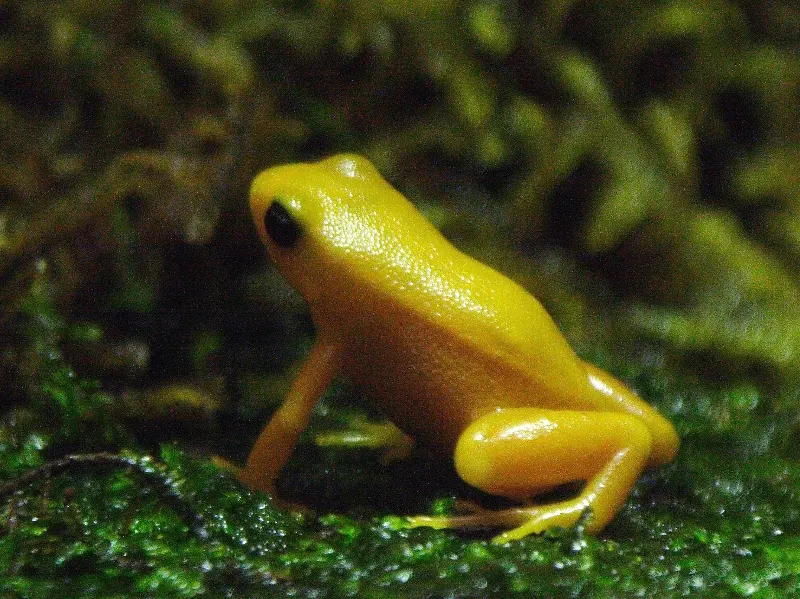
The golden mantella is a bright yellow to orange frog, roughly 2 to 3 cm long, found only in a few patches of forest and swamp near Moramanga in eastern Madagascar. It is listed as Endangered on the Red List (2020 assessment) because its range is tiny and still shrinking.
How to recognise it
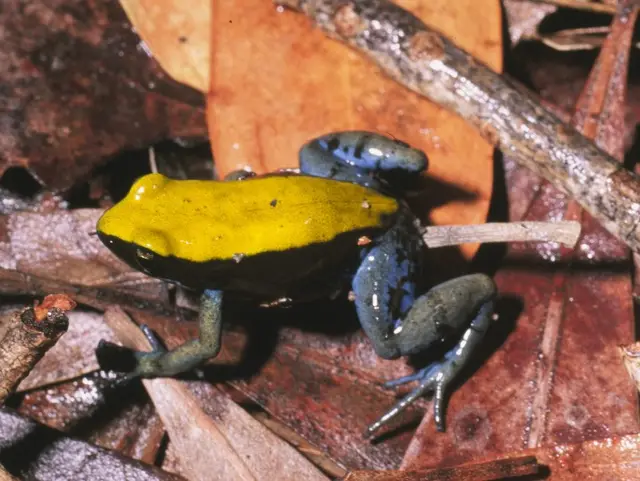
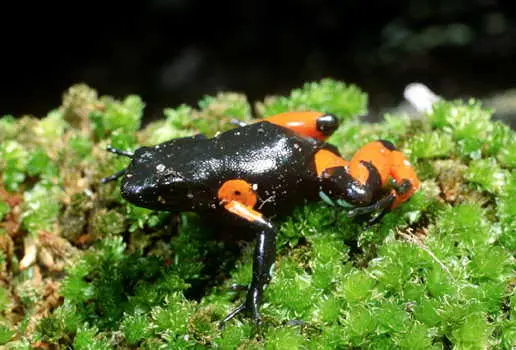
Adults usually measure about 20 to 26 mm, though one source gives closer to 3 cm. The skin is a uniform yellow, orange or sometimes red, with red flash marks on the inner legs, and the eardrum is small but visible. The colour works as a warning: the skin carries alkaloid toxins, as in other mantellas.
Where it lives
It occurs in three small areas around Moramanga: the Beparasy and Ambohibary communes, the Torotorofotsy wetland northwest of Andasibe, and the Ambakoana area. The Red List assessment counts two locations, an area of occupancy of about 152 square kilometres, an extent of occurrence of roughly 700 square kilometres, and an altitude of about 870 to 1,065 m.
It lives on the forest floor and uses small pools and swamp edges for breeding. Surveys by the Malagasy group Madagasikara Voakajy, reported in 2013, found 31 ponds with confirmed populations among 50 identified in the Mangabe area.
Pins are Wikidata “endemic to” fields. Orange dots, when present, are GBIF occurrence tiles — survey bias included.
How it lives
Activity is strongly seasonal. The frogs are mostly inactive from May to October and are out in daylight in summer. Males call from hidden spots near water with a repeated click. Groups reportedly hold about twice as many males as females.
Eggs are laid on land in damp leaf litter beside the water, and rain later washes the tadpoles in. Adults eat tiny invertebrates such as mites, ants, flies and springtails, and the skin toxins are thought to come from that diet. A snake and a skink have been seen preying on the frogs at Torotorofotsy.
Why it is in trouble
The Red List assessment lists mining and quarrying, shifting agriculture, small farms, housing, mine seepage and collection for the pet trade as threats, and records continuing decline in range and habitat. The British Herpetological Society points to pond and forest damage from legal and illegal mining, and to ponds turned into rice fields. A 2020 Mongabay report adds chytrid fungus, recorded in Madagascar in a 2015 study, and an invasive Asian toad.
The Red List rated the frog Critically Endangered in 2004 and 2008. The 2020 assessment puts it at Endangered and still records a decreasing population.
What is being done
A quota of 550 golden mantellas a year for export has been in place since 2012, and in 2013 the British Herpetological Society noted that Madagascar still had to show such harvests were sustainable. The species is in CITES Appendix II.
In 2012 the Malagasy community group Mitsinjo began working with the Ambatovy nickel mine on captive breeding, at its centre beside Andasibe-Mantadia National Park. It started with 162 frogs taken from about 10 of 38 ponds on the mine site and produced over 1,200 healthy first-generation frogs in 2012 and 2013. In April 2017 more than 1,500 captive-bred frogs were released into ponds near the mine, and a follow-up team found some had moved over 2 km. Survival studies were still unpublished in 2020.
Sources
Written for this catalog in our own words from the sources below, checked against them on 12 November 2026. Population figures are estimates and carry the year they were made. Status and assessment year: IUCN. 2026. The IUCN Red List of Threatened Species. Version 2026-1. iucnredlist.org.