Endangered
Cowan's mantella
Mantella cowanii
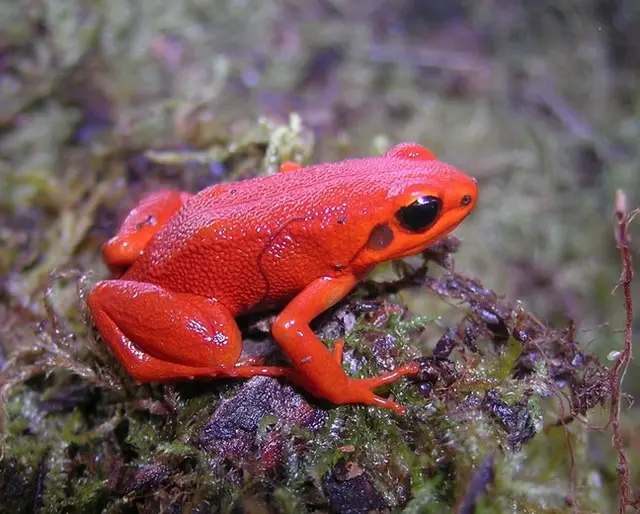
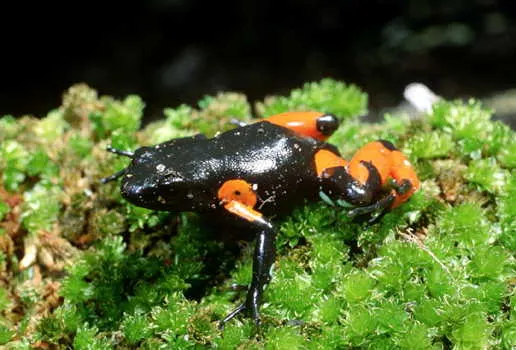
Cowan's mantella (Mantella cowanii), also called the harlequin mantella, is a small black and orange poison frog from the central highlands of Madagascar. The IUCN Red List rated it Endangered in 2014. A 2024 PeerJ study led by Devin Edmonds suggests it may now qualify as Critically Endangered.
How to recognise it
The frog is boldly marked in black and orange, a warning pattern. Like other mantellas it gets toxic alkaloids from the small prey it eats and carries them in its skin. It is one of the largest species in its genus.
A close relative, Baron's mantella (Mantella baroni), looks similar, and the calls of the two sound nearly identical. At one site near Antoetra the frogs turned out to be mostly Baron's mantella and hybrids, which makes surveys tricky.
Where it lives
The species is endemic to Madagascar and lives at only a handful of sites in the central highlands. The IUCN's 2014 assessment gave an area of occupancy of about 253 square km and elevations of 1,000 to 2,000 m. A 2024 survey put its sites at about 1,380 to 2,120 m.
It lives along mountain streams with big boulders and wet, mossy rock faces. Some sites keep patches of gallery forest, while others are almost treeless. The highlands were once a mosaic of grassland, woodland and humid forest, but most of the area is now secondary grassland used for grazing and farming.
Pins are Wikidata “endemic to” fields. Orange dots, when present, are GBIF occurrence tiles — survey bias included.
How it lives
The frogs are mainly active at dawn and dusk, and they can only be detected in the rainy season. The 2024 fieldwork ran from late November to mid-January. Egg masses are small, 20 to 57 eggs, but the eggs are the largest in the genus. No eggs, tadpoles or newly metamorphosed frogs have ever been found in the wild.
Compared with other mantellas, Cowan's mantella lives slowly. Adult annual survival was estimated at 53 to 62 percent, and frogs first caught as adults in 2015 were recaptured in 2022 and 2023, so the species can live at least 9 years in the wild, well beyond the 3 years that earlier estimates suggested. A slow life makes it harder for a population to recover from losses.
Why it is in trouble
Collection for the pet trade is the best documented blow. Several thousand frogs recorded as this species were exported between 1994 and 2003, and legal trade ended when the export quota was set to zero in 2004. According to a European breeder cited in 2024, more than 100 were illicitly offered for sale in Germany in 2017, and an unknown number again in 2021.
The 2024 PeerJ study surveyed 11 of the 13 known localities and found frogs at 8. The three sites with no frogs are probably empty. At Fohisokina, the most accessible site, the adult population fell by more than 80 percent between 2015 (about 137 adults) and 2023. The study suggested fire in November 2020, possible poaching and disease as contributors, though no disease was confirmed.
It also reported two new populations and a worst-case total of fewer than 500 adults. Habitat degradation and the upslope spread of Baron's mantella add to the pressure.
What is being done
Only one site, Antsirakambiaty in the Itremo Massif Protected Area, is legally protected. Fohisokina is managed by its community with an NGO, and the rest are unprotected. The species is listed in Appendix II of CITES, and the IUCN assessment records a recovery plan and some captive management.
A species action plan covers 2021 to 2025. Madagasikara Voakajy, Chester Zoo and the University of Kent have supported field research, and a PhD study recommended a captive breeding programme as a safety net. The 2024 PeerJ study recommends continued monitoring and a reassessment of the Red List status.
Sources
Written for this catalog in our own words from the sources below, checked against them on 12 November 2026. Population figures are estimates and carry the year they were made. Status and assessment year: IUCN. 2026. The IUCN Red List of Threatened Species. Version 2026-1. iucnredlist.org.