Endangered
Zhe-long's Leopard Gecko
Goniurosaurus zhelongi
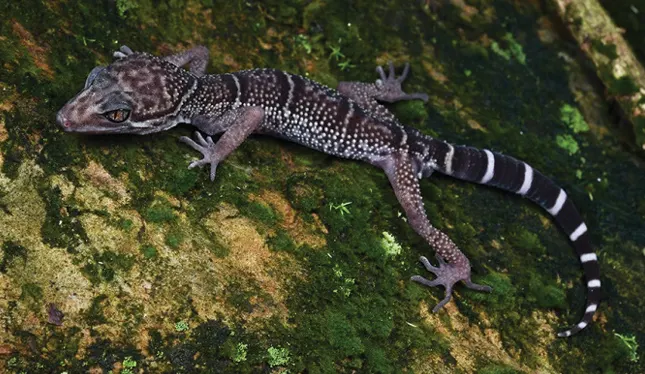
Zhe-long's leopard gecko (Goniurosaurus zhelongi) is a ground-dwelling gecko known only from northern Guangdong, China. The IUCN Red List assessed it as Endangered in 2019. Adults are dark brownish-black with thin cream bands, and the whole known range is a single location in hill forest.
How to recognise it
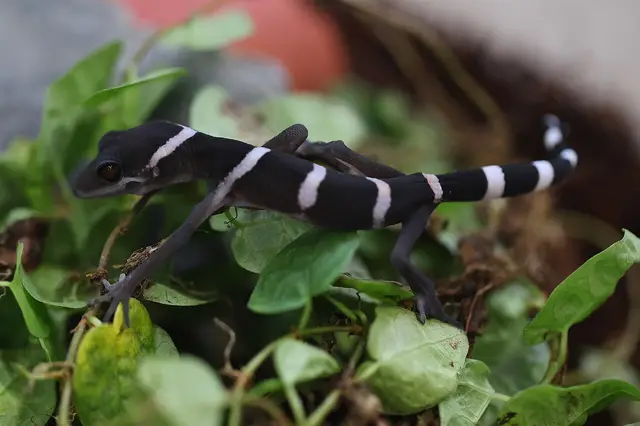
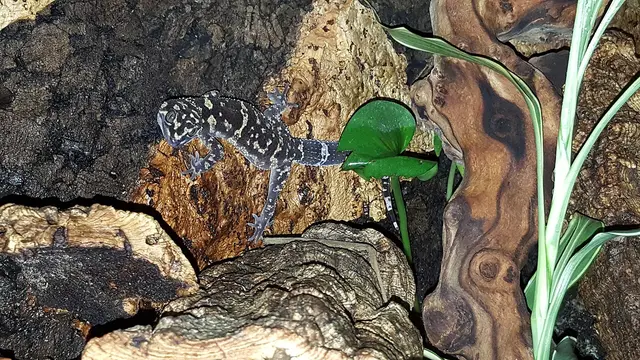
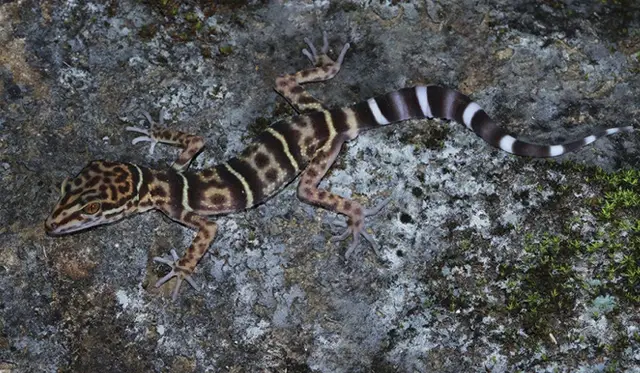
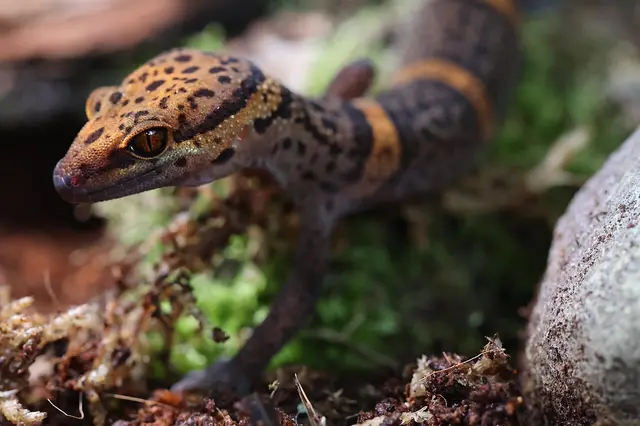
It's a medium-sized, slender gecko. Adults measure 86 to 93 mm from snout to vent, and the tail is short, about 0.85 times the body length. The back is brownish-black, crossed by a thin cream loop behind the head and four narrow cream bands edged in black. The belly is white, tinged brownish, with dark brown spots on the sides.
The iris is grey-white with a hint of orange. Males carry 9 to 12 pores in front of the vent, while females have none. Those traits, plus scale counts, help separate it from its close relatives in the Goniurosaurus yingdeensis group, including the Nanling leopard gecko (G. varius).
Where it lives
Wang, Jin, Li and Grismer described the species in 2014 in the journal Herpetologica. The type specimens came from Shimentai Nature Reserve near Yingde, Guangdong, at about 184 m. The name honours the taxonomist Pu Zhe-long, whose given name means dormant dragon in Chinese.
No other locality has turned up. A 2020 ZooKeys study of the group, drawing on field surveys from 2015 to 2019, still knew it only from Shimentai. The IUCN counts a single location, between 150 and 300 m, with an extent of occurrence of about 640 square kilometres. Its habitats are lowland subtropical forest and rocky areas.
The same study found that G. zhelongi lives west of the Ruyuan Canyon, while G. yingdeensis lives to the east. Both were found on granite as well as limestone, so these geckos may not be strictly tied to karst.
Pins are Wikidata “endemic to” fields. Orange dots, when present, are GBIF occurrence tiles — survey bias included.
Why it is in trouble
The 2019 assessment (criterion B1ab(v)) rests on that tiny range and a continuing decline in the number of mature animals. The IUCN lists the population trend as decreasing.
The main threat the IUCN names is collection for use. The IUCN scores intentional use, where the species itself is the target, as a high-impact ongoing threat across the whole population, and flags international trade. It doesn't say what the animals are used for. Recreational activities are also listed, with an unknown level of impact.
What is being done
A proposal to list the whole genus on CITES Appendix II went to the 2019 conference of the parties (CoP18), and the German herpetological society DGHT supported it in its comments. The IUCN lists harvest management and action at sub-national, national and international level among the measures needed, along with research on population size and trends.
The assessment records that the species was not known from a protected area, though the later ZooKeys survey reports all its specimens from Shimentai National Nature Reserve.
Sources
Written for this catalog in our own words from the sources below, checked against them on 12 November 2026. Population figures are estimates and carry the year they were made. Status and assessment year: IUCN. 2026. The IUCN Red List of Threatened Species. Version 2026-1. iucnredlist.org.