Critically Endangered
Yingde Leopard Gecko
Goniurosaurus yingdeensis
The Yingde leopard gecko is a banded eyelid gecko known only from the limestone hills around Yingde, in northern Guangdong, China. It was described in 2010 and has been rated Critically Endangered by the IUCN since the 2019 assessment, with intentional collection and small dams listed as threats.
How to recognise it
This is a medium-sized gecko in the family Eublepharidae, the eyelid geckos. Adults measure about 76 to 96 mm from snout to vent.
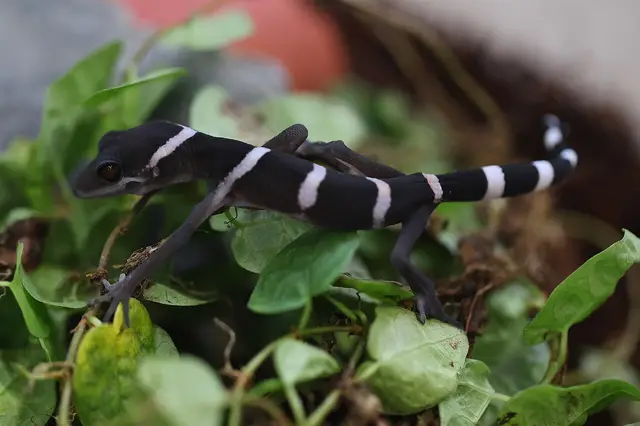
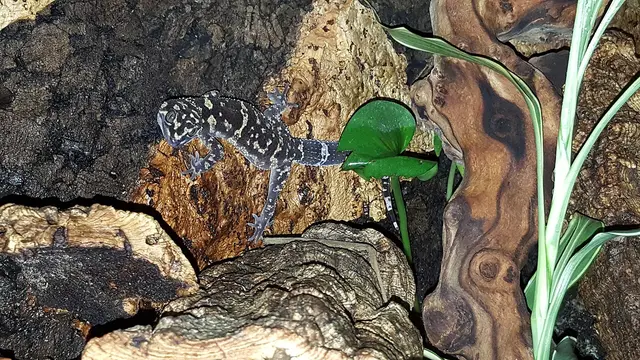
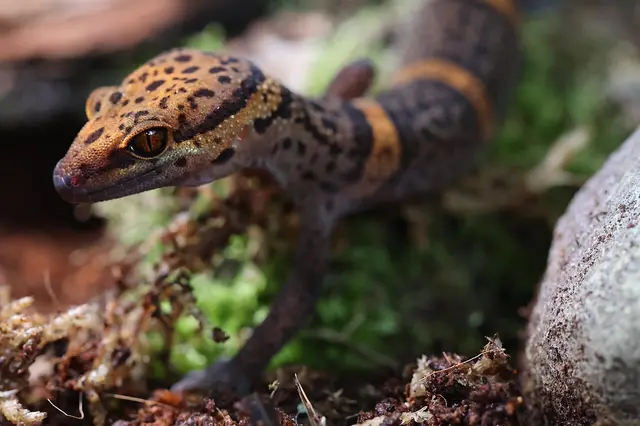
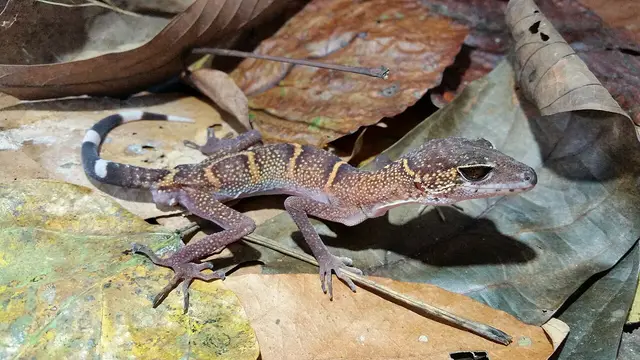
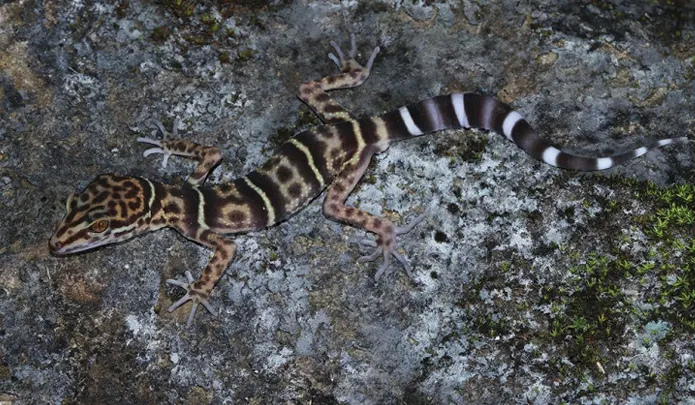
The pattern is the easiest clue. A thin cream nuchal loop (a band across the neck) is rounded at the back, and five slim, spotless cream bands cross the body behind it. The iris is grey, turning orange near the pupil. The chin, throat and underside are white with dark brown spots. Males have a strongly swollen area behind the vent and 10 to 13 precloacal pores, and females have a slightly swollen area.
Where it lives
Wang, Yang and Cui described the species in 2010, using specimens from Yingde. The type locality is a stream valley about 200 m from Guoshanyao Village at roughly 137 m elevation. The holotype, an adult male, was collected on 16 May 2009.
The IUCN gives its elevation range as 137 to 400 m and counts it as a single location, with an extent of occurrence of about 46 square kilometres. Its habitats are caves and rocky areas. A 2020 ZooKeys paper places it in a group of three narrowly distributed geckos from the karst of northern Guangdong, alongside G. zhelongi and G. varius.
Despite the name cave gecko, members of the genus generally favour forest floor, limestone cliffs, roadside drains of rock or cement, and areas near cave entrances, according to the same paper. It describes a newly named relative as a true cave dweller.
Pins are Wikidata “endemic to” fields. Orange dots, when present, are GBIF occurrence tiles — survey bias included.
How it lives
Little has been published on its daily life. The Reptile Database lists it as egg-laying, though that entry is marked as not imputed from direct evidence, and says the species is known mainly from its original description. No population count is available.
Why it is in trouble
The IUCN lists the intentional collection of the gecko as an ongoing threat affecting the whole population and causing very rapid declines, together with small dams. It records the population trend as decreasing and a continuing decline in area.
A 2026 genetic study in Herpetozoa by Li Zongying and colleagues looked at 86 geckos from 10 localities. It found low genetic diversity, strong differences between populations and little gene flow between them, with rivers the biggest barrier. Isolated groups like these can lose variation faster, which adds to the risk for a species with a small range.
What is being done
The species occurs in at least one protected area, and the IUCN lists site protection and management along with action at national and international level. The 2020 ZooKeys paper acknowledges support from a G. yingdeensis population conservation research project at Guangdong Shimentai National Nature Reserve.
In that paper, researchers describing a neighbouring cave species withheld its exact locality to protect it from the pet trade.
Sources
Written for this catalog in our own words from the sources below, checked against them on 12 November 2026. Population figures are estimates and carry the year they were made. Status and assessment year: IUCN. 2026. The IUCN Red List of Threatened Species. Version 2026-1. iucnredlist.org.